


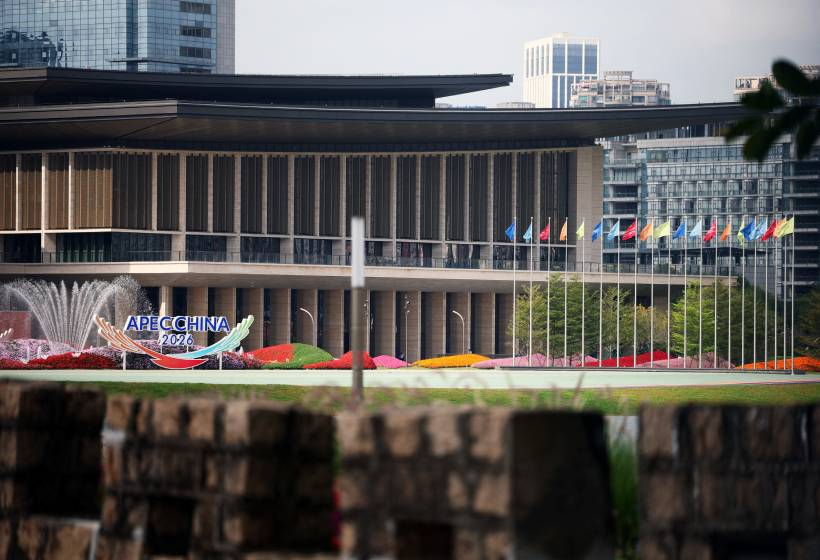
The Asia-Pacific Economic Cooperation (APEC) summit in China’s southern technology hub of Shenzhen is attracting international attention as leaders from 21 member economies prepare to discuss trade, investment and regional economic cooperation. This year’s gathering carries additional geopolitical significance, with US President Donald Trump, Chinese President Xi Jinping and Russian President Vladimir Putin expected to attend.
Beyond its economic agenda, the summit offers an important setting for discussions on major-power relations, energy security, artificial intelligence and regional tensions. The planned meeting between the three leaders on Thursday is particularly significant, although Beijing has not disclosed its agenda.
With geopolitical competition affecting trade routes, supply chains and investment decisions, the Shenzhen summit will test whether the Asia-Pacific’s major economies can maintain economic cooperation despite growing strategic disagreements.
1. What Is APEC and Why Does It Matter?
Founded in 1989 as an informal dialogue involving 12 economies in Canberra, Australia, APEC has developed into one of the region’s most important platforms for economic cooperation.
Stay ahead of the geopolitical week.
MD Briefing delivers expert analysis across five global fronts — the Indo-Pacific, energy, geoeconomics, European security, and the Middle East — every Monday morning. Free.
Its 21 members collectively account for approximately 62% of global gross domestic product and around half of international trade. The forum promotes economic growth, trade liberalisation and investment through cooperation among economies with different political systems and levels of development.
One distinctive feature is that APEC refers to its participants as “member economies” rather than countries. This arrangement allows both Hong Kong, which is governed by China, and Taiwan to participate without requiring members to resolve their competing sovereignty claims.
India, despite being the world’s most populous country, is not an APEC member.
The organisation also operates differently from many international institutions. Its decisions are reached through consensus, but commitments are voluntary and non-binding. This allows economies to cooperate without accepting legally enforceable obligations or surrendering national policy-making authority.
The APEC Economic Leaders’ Meeting is scheduled for November 18 and 19, preceded by the annual APEC CEO Summit on November 17 and 18.
2. Why Has China Chosen Shenzhen?
China is hosting the APEC summit for the third time, following earlier gatherings in Shanghai in 2001 and Beijing in 2014. The choice of Shenzhen carries both economic and geopolitical significance.
Located near Hong Kong, Shenzhen is a central part of China’s Greater Bay Area development strategy, which seeks to integrate the economic strengths of Guangdong, Hong Kong and Macau into a major international centre for technology, finance and innovation.
The city is also home to some of China’s most influential technology and manufacturing companies, including BYD, Huawei and Tencent. Its development reflects Beijing’s ambitions to strengthen domestic innovation, expand advanced manufacturing and increase China’s role in global technology markets.
According to Chim Lee, a senior analyst at the Economist Intelligence Unit, the location allows China to showcase its development model and trade ambitions while highlighting Shenzhen’s resilience amid geopolitical uncertainty.
Hosting the summit in this technology hub also gives Beijing an opportunity to present its economic achievements to international leaders and business representatives at a time when competition over technology and industrial supply chains is intensifying.
3. Which Leaders Are Expected to Attend?
The summit is bringing together political leaders from across the Asia-Pacific, alongside representatives of the region’s major economies.
Canadian Prime Minister Mark Carney, Mexican President Claudia Sheinbaum and Papua New Guinea’s Prime Minister James Marape were among the leaders already in Shenzhen ahead of the main meetings.
Trump, Putin, Philippine President Ferdinand Marcos Jr. and Japanese Prime Minister Sanae Takaichi are also expected to attend.
Taiwan has appointed Acer founder Stan Shih as its representative, reflecting the distinctive arrangements through which Taiwan participates in APEC despite Beijing’s sovereignty claims.
The presence of leaders from the United States, China and Russia gives this year’s gathering an additional diplomatic dimension. Their discussions could influence how major powers manage disagreements over security, trade and strategic competition across the wider international system.
4. What Are the Main Issues to Watch?
Middle East instability and economic security
The economic consequences of conflict in the Middle East are expected to feature in discussions. Disruptions to energy supplies and trade routes can increase transportation costs, threaten supply chains and contribute to inflation.
For Asia-Pacific economies, many of which depend heavily on international trade and imported energy, instability in the Middle East presents a significant economic risk.
The Trump-Xi-Putin meeting
The planned trilateral meeting on Thursday is likely to attract the greatest international attention. China has described the encounter as having “groundbreaking significance” for promoting world peace and strategic stability.
However, the three governments have different priorities. Washington and Moscow may seek discussions on the war in Ukraine, while China has shown reluctance to participate in nuclear disarmament negotiations, partly because its nuclear arsenal is smaller than those of the United States and Russia.
The absence of a publicly disclosed agenda makes it difficult to predict whether the meeting will produce concrete agreements. Nevertheless, direct engagement among the three leaders could provide an opportunity to address major-power tensions.
US-China trade and technology competition
The stability of US-China relations will be another central issue. Both sides are facing difficulties in meeting commitments associated with an extended trade truce, while disagreements over tariffs, rare earth supplies and artificial intelligence continue to shape their economic relationship.
The United States’ arms sales to Taiwan will also remain under scrutiny from Beijing. These issues demonstrate how economic cooperation and strategic rivalry increasingly overlap in relations between the world’s two largest economies.
China’s relations with Japan and the Philippines
Regional security tensions will also feature prominently.
Relations between China and Japan have remained strained since November 2025, when Japanese Prime Minister Sanae Takaichi suggested that Japan could deploy its military if Chinese action against Taiwan also threatened Japanese territory.
Beijing strongly opposes foreign involvement in what it considers an internal matter. The disagreement reflects broader concerns about Taiwan’s security and the possibility of a wider regional confrontation.
China’s relations with the Philippines will also be closely watched because of continuing disputes in the South China Sea. Tensions over maritime claims and activities in the contested waterway remain a challenge to regional stability and freedom of navigation.
5. Who Are APEC’s 21 Members?
APEC comprises 21 member economies spanning the Pacific region:
Australia, Brunei, Canada, Chile, China, Hong Kong, Indonesia, Japan, South Korea, Malaysia, Mexico, New Zealand, Papua New Guinea, Peru, the Philippines, Russia, Singapore, Taiwan, Thailand, the United States and Vietnam.
Their participation reflects the economic diversity of the Asia-Pacific, bringing together advanced industrial economies, emerging markets and developing countries.
Although APEC does not have the authority to impose binding economic policies, its annual meetings provide an important platform for dialogue among governments and business leaders.
What Happens Next?
The Shenzhen summit comes at a time when economic interdependence and geopolitical competition are increasingly difficult to separate. Governments across the Asia-Pacific must manage trade relationships while responding to security tensions, technological rivalry and uncertainty in global energy markets.
For China, hosting the gathering provides an opportunity to demonstrate its economic influence and promote Shenzhen as a centre of global innovation. For Washington, the summit offers a chance to engage directly with Beijing and other regional partners. For Russia, participation provides another platform for high-level diplomatic engagement.
The most closely watched development will be whether Trump, Xi and Putin can use their meeting to establish a more predictable relationship among their countries. Yet the wider success of APEC will depend on whether its members can preserve practical economic cooperation despite their political differences.
The summit’s importance therefore extends beyond the leaders attending it. Its outcomes could offer an indication of how the Asia-Pacific will navigate an increasingly fragmented global economy and a more competitive international order.
With information from Reuters.
