Likelihood of a summit between the leaders of the United States, China, and Russia at the Asia-Pacific Economic Cooperation (APEC) summit to be held in Shenzhen next month was first indicated by Kremlin aide Yuri Ushakov in Bishkek nearly two months ago. Ushakov had not ruled out a possible meeting of three leaders in Shenzhen in an interview with the Russian state television during the Shanghai Cooperation Organization (SCO) summit in Kyrgyzstan in early September, where both Xi Jinping and Vladimir Putin were present.
Interestingly, Ushakov further maintained last Thursday (Oct. 22) that the trilateral dialogue will be held two days after President Trump affirmed joining his Russian and Chinese counterparts, and Xi Jinping will include such a “get together” in the agenda in Shenzhen. According to reports from Bloomberg and other foreign media outlets, following the meeting between Russian President Vladimir Putin and US Presidential Envoy Steve Witkoff, Ushakov stated, “China has begun preparations for a trilateral meeting between the leaders of Russia, the United States, and China.” Further, Ushakov said that if circumstances permit, a [trilateral] meeting will be included in the agenda of the APEC summit in Shenzhen.
What will Xi, Trump, and Putin discuss?
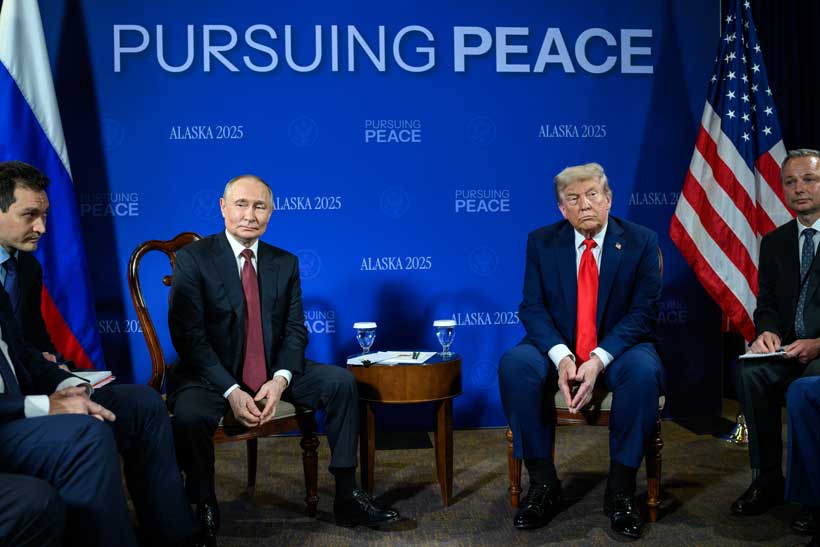
When Russian leader Putin first proposed the trilateral meeting on October 19, he was unambiguous and categorically stated such a meeting involving the three leaders will focus on ending the ongoing four-year-old Ukraine conflict. A day later, Trump said he was open to a three-way meeting with Chinese President Xi Jinping and Russian President Vladimir Putin next month in Shenzhen. But Trump clearly stated the talk would have to be about nuclear weapons and denuclearization. Now, quite curiously, Xi is known to have repeatedly rejected President Trump’s push for trilateral nuclear arms control talks involving the US, Russia, and China. It is common knowledge China’s precondition for a three-way nuclear arms reduction dialogue is that the US and Russia drastically reduce their own arsenals first.
Stay ahead of the geopolitical week.
MD Briefing delivers expert analysis across five global fronts — the Indo-Pacific, energy, geoeconomics, European security, and the Middle East — every Monday morning. Free.
In addition, typical of President Trump, the US leader is already claiming the credit for such a grand initiative—being called the “century summit.” Writing for the South China Morning Post, Teresa Elena Frontado said, “Trump says the proposed meeting is his suggestion and linked it to his November visit to China. If President Xi wants to have it, I’d have it.” “We would have it [three-way meeting] to talk about nuclear weapons and denuclearization,” Trump told reporters outside the White House before travelling to Kansas.
As it is crystal-clear from the above-stated positions, the lack of consensus between the three leaders to arrive at a commonly agreeable agenda for a trilateral meeting in Shenzhen is nothing but elusive. Experts within China and overseas are of the opinion that without a clearly defined agenda, the trilateral meeting in Shenzhen looks far from certain as of now. This author was quoted a week ago by SCMP in an article, saying “without a clearly agreed-upon agenda, the possibility of the trilateral [talks] happening in Shenzhen is rather remote.” In the same article, Wang Wen, Dean and Professor at Beijing’s People’s University, said, “The agenda is the critical lever for whether a meeting can actually take place.”
China Is Making Preparations for 3-Way Talks, But Typically Won’t Say It
Typically, China continues to be tight-lipped on the possibility of a meeting in a China-US-Russia format in Shenzhen. As of late, on October 20, China’s Foreign Ministry declined to comment on a possible three-way meeting at the APEC summit next month. Chinese Foreign Ministry spokeswoman Mao Ning, asked at a briefing to comment on the possibility of a three-way meeting, said that for now she has “no information to provide.” However, she reiterated Beijing’s general commitment to playing “an active role” in promoting peace negotiations for the Ukraine crisis.
Again, typically, it is not at all surprising for Beijing to keep mum until the last minute before a major diplomatic event. Remember, Beijing’s decision on whether President Xi would travel to India to take part in the 18th BRICS summit in New Delhi last month remained wrapped under a veil of secrecy until three days before the event. Diplomatic observers suggest reasons for Beijing’s such behavior include internal political dynamics and weighing until the last minute gains and benefits for the CPC and its top leadership. In the case of the Xi-Trump-Putin meet in Shenzhen, experts feel Beijing is being extra careful.
On the other hand, it is very intriguing that in spite of claims of a strong “friendly, brotherly” bond between Xi and Putin and “no-limit friendship” between Moscow and Beijing, instead of responding to Putin’s call for a trilateral meeting, China chose to accord preference to President Trump’s decision on the matter. Media reports suggest China on October 21 pledged to play an active role in promoting peace talks to resolve the Ukraine conflict, only after US President Donald Trump’s remarks expressing openness to a trilateral meeting with Chinese President Xi Jinping and Russian President Vladimir Putin.
What Will China Gain from the Trilateral Meeting in Shenzhen?
The biggest gain for China, if the three-way meeting is included in the APEC agenda, will be huge diplomatic mileage and an enhanced power status [for China] internationally. These gains might augur well for the image of Xi Jinping at home before the next years’ 21st Party Congress. On the other hand, even if the three leaders fail to evolve a consensus on the conflict in Ukraine, Beijing’s loss will be insignificant despite the failed trilateral meet being called “damp squib” internationally. But Berlin-based Temur Umarov, a specialist of Russia-China relations, does not think China has too much stake in the outcome of the talks. “Beijing has no intention of taking responsibility for Ukraine’s future. [Therefore] Beijing would participate not as an active mediator but only as a symbolic partner,” he said.
Echoing Umarov’s views, analysts in the greater China region believe, though
Officials in China have privately welcomed the idea, but Beijing is not aggressively pushing the three-way talks in Shenzhen. Professor Wang Wen, cited above, too, feels Beijing would be keen to discuss issues [in three-way talks] mutually beneficial but would resist any pressure to be seen aligning with a particular bloc. As experts in several European capitals have observed, Xi Jinping is aware that China must maintain a cautious balance between supporting Putin and preserving relations with Europe. Such a trilateral meeting could also draw China more directly into the Ukraine war and trigger a backlash from European countries.
Moreover, there is a flip side too, which might prove to be costly for China in the future. Several media in Europe, citing the Wall Street Journal, have cautioned China of setting a precedent if the trilateral meeting is hosted by China without inviting Ukraine and the EU. “If the leaders of the United States, China, and Russia jointly discuss the Ukraine issue without inviting Ukraine to the talks, it might exacerbate the concern that Taiwan, especially given China’s continued commitment to unification by force, could one day be used as a bargaining chip in similar negotiations,” the WSJ has observed.
To sum up, to be successful, summit diplomacy—a bilateral or a three-way summit—hinges largely on substantive gains going to a major side. China’s policymakers are deeply engaged in 推敲 (Tui qiao)—a traditional Chinese metaphor, roughly meaning careful weighing—regarding the pros and cons of holding the three-way talks dialogue during the APEC summit in Shenzhen. They are aware the gains from the talks for Russia and Putin far outweigh what benefits Beijing. More importantly, it is also very clearly understood that hosting the talks during the APEC summit will most certainly steal the spotlight, diluting Beijing’s plans to leverage the summit to showcase its influence in the Asia-Pacific region.