Two Patrons, One Sunday
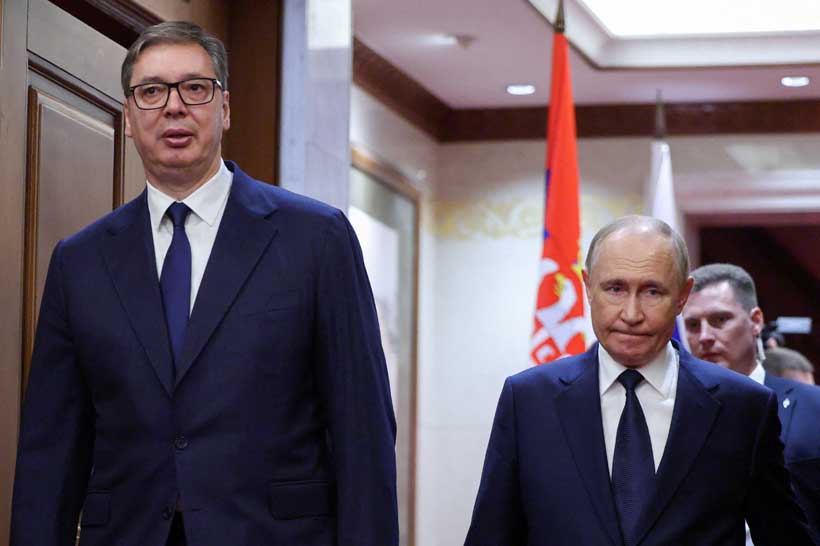
On 25 October, two candidates who had campaigned with the open approval of a great power lost on the same evening. In Belgrade, Aleksandar Vučić, whom Vladimir Putin had told the Valdai Club he hoped to see as Serbia’s prime minister, conceded within hours that the Student List had won. In Brazil, Flávio Bolsonaro had met Donald Trump at the White House in June and campaigned while Washington suspended its consular services in the country, citing security threats that Brazil’s federal police said they could not find. He became the first first-round leader since 1985 to lose a presidential runoff.
Put these results next to Canada and Australia in 2025 and Hungary in April, and a tidy thesis writes itself: foreign patrons are now poison. That thesis is only half right. What costs votes is not the endorsement. It is the squeeze.
Eighteen Months of Foreign Blessings
Stay ahead of the geopolitical week.
MD Briefing delivers expert analysis across five global fronts — the Indo-Pacific, energy, geoeconomics, European security, and the Middle East — every Monday morning. Free.
The run of results is striking. In Canada, Pierre Poilievre’s Conservatives looked a shoo-in until Trump launched a trade war and talked of making Canada the “51st state”. On election day Trump posted that the arrangement “makes no sense unless Canada is a State!” Mark Carney won, and Poilievre lost the seat he had held for 20 years. Five days later, Peter Dutton, mocked as a “Temu Trump” after Washington’s tariffs hit Australian goods, lost the Australian election and his own seat of Dickson. In Hungary, Trump gave Viktor Orbán a “complete and total endorsement” and JD Vance campaigned in Budapest the week before the vote, yet Péter Magyar’s Tisza won a commanding majority.
The “poison” thesis ignores the counter-examples. Karol Nawrocki visited the White House, and the US homeland security secretary, Kristi Noem, urged Poles to back him; he won with 50.89%. Trump told Argentines “we would not be generous with Argentina if he loses”, and Javier Milei’s party took over 40% and a near ten-point lead.
It’s the Squeeze, Not the Blessing
Sort the cases by what the patron was doing to the voters’ own country rather than by whom it endorsed, and the pattern becomes clear. Where the patron was coercing the country going to the polls (tariffs, annexation talk, pressure on its courts, a closed consulate), the favoured candidate lost: Canada, Australia, Brazil. Where the patron arrived with protection or cash, the favoured candidate won. Poland hosts around 10,000 US troops and faces Russia across its border, and Argentina was offered a $20bn currency swap line for a peso in trouble. In every case the endorsement looked the same. Voters were asking different questions. In one group it was “will my country be punished?”; in the other, “will my country be rescued?”
Brazil is the clearest test, because the pressure was explicit. Trump’s 50% tariff threat in July 2025 was openly tied to Jair Bolsonaro’s coup trial, and Lula replied that he would not take orders from a “gringo”. This July, Washington imposed 25% tariffs on most Brazilian imports. Lula made sovereignty the spine of his runoff campaign, and Reuters reported that State Department officials pushed for sanctions to weaken him. In his victory speech he thanked voters for overcoming “interference coming from the outside”.
The timing rules out the lazy version of the argument. The consular suspension came on 2 October, and two days later Flávio still won the first round by 2.2 million votes. Coercion did not flip committed voters. What it did was give Lula a mobilising message for the 33.4 million Brazilians who stayed home in the first round, 21% of the electorate and the highest abstention since 1998. AtlasIntel’s Andrei Roman credited lower abstention for the result. The patron penalty works at the margin, through turnout and the soft centre, which is exactly where close elections are decided. Even Trump seemed to sense it. Asked whom he wanted to win the runoff, he said: “I don’t want to get into that, but we are watching.”
Serbia tests the thesis rather than confirming it. Putin has blessed Vučić before nearly every Serbian election since 2012, and it never cost him. Russia’s standing in Serbia is warm: in a 2020 Belgrade Centre for Security Policy survey, 40% named Russia as Serbia’s best friend and 72% called its influence positive. Crucially, the winners did not run against Moscow. On 30 September the Student List said Serbia would “maintain its principled stance against imposing restrictive measures on the Russian Federation”. Vučić did not lose because Putin backed him. He lost because of corruption, the Novi Sad canopy collapse and fourteen years of state capture, issues that dominated the campaign. Hungary follows the same pattern: Trump’s backing did not save a worn-out incumbent, but nobody seriously argues it sank him. Trump himself said he “wasn’t that involved”.
The strongest objection is that every case of a “patron penalty” has a domestic explanation. Canada’s Liberals changed leader, Dutton ran a weak campaign on cost of living and climate, and Lula promised free weekend public transport. That is fair, and it is why the claim here is narrow. Foreign coercion did not create these results from nothing. It changed what the election was about. In Canada and Brazil, the incumbent party got to fight on national sovereignty instead of its own record. That is an enormous gift to any government that has been in office long enough to be blamed for prices. Where no such gift existed, as in Serbia and Hungary, the domestic record decided and the endorsement made little difference.
So which electorates punish patronage? The penalty appears when three conditions hold at once. First, the patron is visibly coercing the voters’ own economy or institutions. Second, the endorsed candidate cannot credibly claim to be the one who can handle the patron. Third, a rival can credibly wrap himself in the flag. Remove the coercion and add a nearer threat (Poland) or a bailout (Argentina), and the same endorsement becomes an asset.
How the Patrons Adapt
Base case: deniable patronage (roughly 55%). Washington and Moscow keep backing allies but stop endorsing them out loud in democracies exposed to their pressure. Support shifts to networks (CPAC gatherings, friendly platforms and media) and to economic incentives timed around votes. Trump’s “we are watching” in Brazil and his quick praise of Magyar (“the new man’s going to do a good job”) are early signs. The key assumption is that the White House treats Brazil and Hungary as lessons rather than as fraud. For analysts, the signal moves from statements to financial instruments, which are harder to track.
Downside case: post-election coercion (roughly 30%). Washington treats Lula’s win as tainted and echoes Flávio’s bid to annul the result, which targets Justice Cristiano Zanin’s two-hour extension of voting. The mechanism already exists: the officials who reportedly pushed for sanctions before the vote. New tariffs or sanctions would turn an electoral penalty into a bilateral crisis, speed up Brazil’s trade pivot to Asia, and raise risk for soy, beef and coffee exporters and for US investors in Brazilian critical minerals.
Upside case: transactional reset (roughly 15%). Washington moves quickly to deal with Lula and with a Student List government in Belgrade, much as it settled into working with Carney, and foreign endorsement fades as an issue in the 2027 election cycle. This depends on the White House deciding that the cost of losing proxies exceeds the cost of losing face.
Probabilities reflect the author’s analytical judgment based on currently available information and are not statistical forecasts.
Coercion Is the Tell
Foreign blessings are not toxic. Foreign pressure is. Over eighteen months, voters in allied democracies punished candidates whose patron was squeezing their own country. They shrugged at endorsements that came with protection, cash or long-standing affection, and judged worn-out incumbents on their records. Serbia’s students kept Russia’s friendship and still beat Russia’s candidate.
Watch for: Washington’s first formal response to Flávio Bolsonaro’s annulment challenge before Lula’s inauguration on 5 January. If the State Department echoes it, or announces sanctions in that window, the downside case is live. Great powers can still pick winners abroad. What they can no longer do is punish a country and expect its voters to thank the candidate they chose.