Two-Thirds Gone, Winter Ahead
On 30 September the US Department of Energy put the last 40 million barrels of its share of March’s emergency release up for loan. That quietly closed a chapter. The record 400-million-barrel collective action agreed by the International Energy Agency’s 32 members on 11 March is now largely spent: IEA chief Fatih Birol said on 3 October that only about a third has yet to reach the market. A day earlier the G7 agreed to draw a further 100 million barrels — the second withdrawal from the same account in seven months.
Birol’s message was reassurance: 80% of the agency’s stocks are “still in our pocket”. The figure is accurate, and misleading. The system was designed to bridge a disruption of weeks. If the Strait of Hormuz stays shut into 2027, the bridge becomes a countdown, and the clock is running faster than the headline numbers suggest.
A Bridge Built for Weeks
Stay ahead of the geopolitical week.
MD Briefing delivers expert analysis across five global fronts — the Indo-Pacific, energy, geoeconomics, European security, and the Middle East — every Monday morning. Free.
The IEA was created in 1974, after the Arab oil embargo, around one promise: members hold oil stocks equal to at least 90 days of net imports and release them together in an emergency. The mechanism has been used six times — in 1991, 2005, 2011, twice in 2022 and in March this year. Every previous use covered a disruption measured in weeks or a few months.
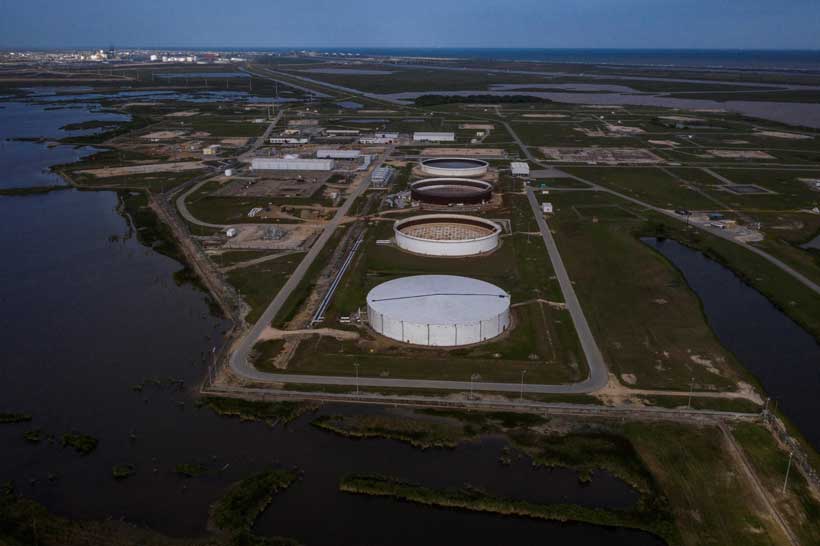
This one is different in scale and in length. Before the war began on 28 February, about 20 million barrels a day of crude and products — roughly a quarter of seaborne oil trade — moved through Hormuz. By September, pipelines and escorted convoys had narrowed crude losses to about 45% of pre-war levels, but Gulf exports of refined products and LPG were still around 60% below February, according to the IEA’s September Oil Market Report. Global observed inventories have fallen by 507 million barrels since February. The US Strategic Petroleum Reserve (SPR) holds 283.8 million barrels, its lowest level since 1982 and under 40% of its capacity.
Why the Big Number Misleads
Start with the arithmetic most coverage skips. March’s release, the largest in history, equalled roughly 20 days of pre-war Hormuz flows. The G7’s new package adds about five more. Emergency stocks are counted in barrels; a closure is counted in time. A finite buffer cannot cover an open-ended disruption. It can only buy time for something else — a deal, new routes, or lower demand — to close the gap.
Second, not all of the oil “in our pocket” can be spent. Of the 1.8 billion barrels of IEA emergency stocks, about 600 million are obligated industry stocks — oil that companies must hold as part of their working inventory. Draw those down hard and refineries and distributors lose the operating stock they need to run. The genuinely spare oil is the 1.2 billion barrels in public hands, and a large share of that sits in an American reserve already at a 44-year low.
Third, the stocks are the wrong kind. The March release was 72% crude. Today’s shortage is in diesel and jet fuel: Gulf refineries are exporting far less, and Europe has spent years closing its own. Crude is of little use without spare refining capacity to turn it into diesel, and that capacity now sits in the US, India, South Korea and China — the reason the G7 package front-loads diesel, and why Washington’s threat to ban diesel exports carried so much weight. As MD has argued, refining capacity now matters more than oil reserves. The 1974 system stores the raw material of the last crisis, not the product of this one.
Fourth, the system’s membership no longer matches the market. The 90-day rule applies to net importers. The United States, a net exporter, has no obligation to hold stocks at all: its reserve is held by political choice, and with midterm elections on 3 November it is being spent by political choice too. Meanwhile the world’s largest stockpile, an estimated 1.4 billion barrels in China, sits outside the IEA. Beijing drew on it and cut imports from about 12 million barrels a day to under 8 million in May and June. That helped the market, but on China’s terms, without coordination, and it can stop at any time. The IEA’s September data show OECD stocks edging up while non-OECD stocks, China’s above all, fell.
The strongest objection is Birol’s own: stocks remain large, the IEA expects world oil demand to fall by 2.5 million barrels a day this year, and the US Energy Information Administration (EIA) forecasts a 4.9 million barrel-a-day surplus in 2027 that would refill the tanks. All true — but that surplus rests on one assumption: Middle East output back to pre-war levels by the second quarter of 2027. Remove it, and the 2027 glut becomes a second winter of shortage. Nor is falling demand a sign of resilience. It is what the IEA calls demand destruction, and it lands hardest on Asian importers with thin buffers: Pakistan holds roughly 28–30 days of reserves, Vietnam fewer than 20.
There is a sting at the end, too. Whenever Hormuz reopens, governments will have to buy back hundreds of millions of barrels. That refill demand will hold prices up just as consumers expect relief. The emergency system lends cheap oil in the crisis and charges interest afterwards.
Three Ways Through Winter
Base case — a scraped-through winter (about 50%). A US–Iran deal after the 3 November midterms produces a phased reopening of Hormuz in the first quarter of 2027. Stocks cover the gap, at a price: Brent stays near $90–100, diesel stays expensive, and IEA members finish the winter with emergency stocks at multi-decade lows. Refilling starts in mid-2027 and blunts the price fall the EIA expects. The key assumption is that the dispute over sequencing in the talks is settled within weeks of the election. For European buyers, that means hedging diesel exposure, not just crude.
Downside — every country for itself (about 30%). Talks fail and the closure runs past March. A third collective action would push governments into obligated industry stocks and below the 90-day floor. Export bans spread, starting with the US diesel threat, and the IEA’s collective model gives way to national hoarding. The first casualties are import-dependent economies with thin buffers — Pakistan, the Philippines, Vietnam — and Europe’s hauliers and farmers, where the 2022 gas playbook does not fit a diesel crisis. For business, this means planning for physical shortages, not just high prices. The early warning would be talk of a third IEA collective action before the end of January.
Upside — the 1974 moment (about 20%). A rapid reopening in November or December brings the EIA’s glut forward. Governments refill at around $70 a barrel, and the crisis becomes the moment the IEA negotiates stock coordination with China and India and adds dedicated diesel and jet-fuel reserves — the first redesign of the system since it was built.
From Bridge to Countdown
The emergency oil system is not failing. It is doing what it was designed to do, for far longer than it was designed to do it. Three things make the clock run faster than the headline stocks suggest: much of the oil is the wrong kind, a third of it is not really spare, and the biggest holders sit outside the system’s rules.
Watch the IEA’s Oil Market Report on 14 October. If global inventories fell again in September and OECD stocks joined the decline, the buffer is being spent faster than the talks are moving. The question this winter is not whether the reserves exist. It is whether diplomacy arrives before they run out.