


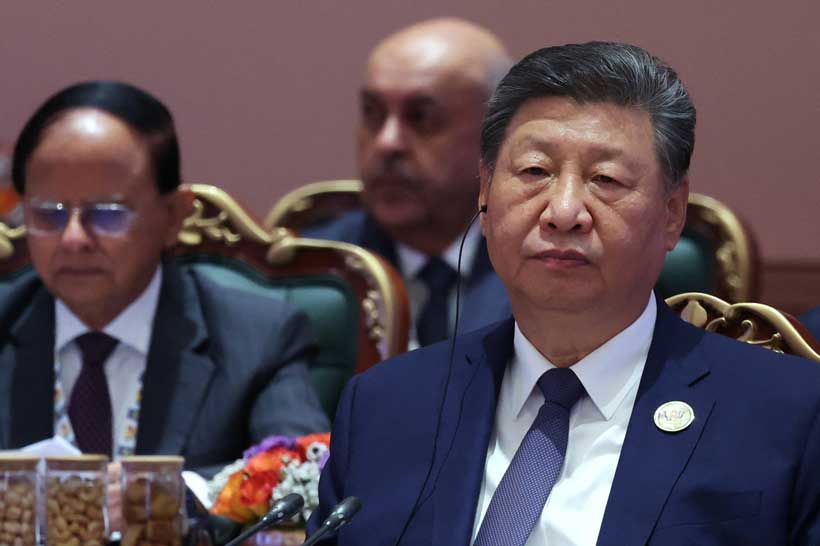
Xi Jinping’s September 2026 visit to New Delhi, on the sidelines of the 18th BRICS Summit, brought India-China relations into a phase of cautious engagement. Yet the significance of the meeting lies less in a definitive reset than in the possibility of managing a relationship in which diplomatic openings coexist with unresolved structural tensions. The experience of the past several years suggests that summit-level engagement can create diplomatic movement without necessarily resolving the structural tensions underlying the relationship.
This makes the question for India less about whether relations are “reset” and more about how they are managed. The border remains central: India continues to emphasize that peace and tranquillity in the border areas are essential to the development of bilateral relations. At the same time, discussions on trade imbalances, supply chains, market access, and business linkages indicate that the relationship cannot be reduced to the LAC alone.
This raises a broader strategic question for India: does responding to Chinese pressure require continuous escalation at the same point of contestation? If strategic autonomy requires preserving freedom of choice, India may need to consider what can be called asymmetric withdrawal—maintaining existing positions, military preparedness, and deterrence while selectively withdrawing from the logic of continuous escalation. The objective would not be to retreat from the border but to prevent the border from becoming the organizing principle of the entire relationship.
The Question of Strategic Cognition
Stay ahead of the geopolitical week.
MD Briefing delivers expert analysis across five global fronts — the Indo-Pacific, energy, geoeconomics, European security, and the Middle East — every Monday morning. Free.
Xi’s reference to “strategic cognition” and “strategic judgement” during his meeting with Prime Minister Narendra Modi deserves attention. According to the Chinese account, Xi argued for an “objective and rational strategic perception” and described China and India as partners rather than rivals.
Such language is not separate from the wider strategic relationship. As Srikanth Kondapalli argues, it can be understood as part of an asymmetrical Chinese power play, in which Beijing’s approach can be understood as seeking to shape not only the material environment around India but also the way New Delhi assesses its strategic choices.
This matters because strategic competition is also a competition over perception, priorities, and the choice of arena. If every Chinese signal along the border produces a corresponding Indian demonstration of resolve, the LAC can begin to determine the tempo of the wider relationship. The result is a strategic dynamic in which India remains reactive even when the broader relationship offers other avenues for advancing its interests.
India therefore needs a strategic cognition of its own: not simply the ability to recognize Chinese pressure, but the ability to decide which pressures require a response, which require negotiation, and which do not require escalation. Strategic autonomy is meaningful only when India retains that freedom of choice.
This does not mean accepting Chinese preferences. It means ensuring that Beijing does not determine the arena, intensity, or terms of every strategic interaction.
From Border Escalation to Asymmetric Withdrawal
The question, then, is what this distinction means for the border. The experience since 2020 demonstrated the importance of military preparedness and credible deterrence, but it also showed that military firmness and diplomatic engagement can operate alongside each other. India’s subsequent negotiations with China produced concrete arrangements, including the 21 October 2024 agreement on patrolling in Depsang and Demchok, followed by disengagement at these two friction points.
The significance of these developments lies in the distinction between maintaining deterrence and sustaining escalation. India does not need to reduce its capacity to defend the existing position in order to reduce the risks associated with continued confrontation. This is the basis of what can be called asymmetric withdrawal: withdrawal from escalation is not withdrawal from the border.
For India, therefore, border stability need not mean an automatic return to the military posture that existed before 2020. The objective is to preserve the ability to defend the existing position while avoiding a permanent cycle in which every disagreement produces another round of military escalation.
This is particularly important because the border has increasingly become the organizing principle through which the wider India-China relationship is interpreted. When trade, economic dependence, diplomatic engagement, or multilateral cooperation are assessed primarily through the condition of the LAC, the boundary acquires a significance beyond its immediate security function. It can begin to shape the terms of engagement in domains that are not directly connected to territorial security.
This is where asymmetric withdrawal becomes relevant. India can maintain surveillance, infrastructure, military preparedness, and the capacity to respond to violations while reducing its dependence on confrontation as the principal mechanism for managing the relationship. The objective is not to weaken deterrence. It is to separate deterrence from escalation. Asymmetric withdrawal therefore involves a redistribution of strategic attention: maintaining credible deterrence where India’s territorial interests are directly engaged, while creating greater space for diplomacy, economic diversification, and engagement in other areas.
This distinction matters because India and China do not possess identical sources of leverage. Their geographic proximity, economic relationship, military capabilities, and diplomatic influence create different forms of vulnerability and opportunity. India therefore need not seek equivalent responses across every arena in which Chinese influence is exercised. The objective is to preserve room for maneuver rather than reproduce the same competitive logic across domains.
Expanding Strategic Space Beyond the LAC
The larger value of asymmetric withdrawal lies in the strategic space it creates beyond the border. That space allows India to pursue its interests across other domains without making each dimension of the relationship contingent on developments along the LAC.
This does not mean separating the border from the wider relationship. Rather, it means preventing developments in one domain from automatically determining India’s choices in another. Trade, technology, energy, supply chains, and multilateral institutions can become distinct arenas of engagement, with cooperation pursued where interests overlap and vulnerabilities reduced where dependence creates strategic risk.
The September 2026 Modi-Xi meeting illustrated this possibility. While India continued to underline the importance of border peace and adherence to existing agreements, the two sides simultaneously discussed trade, market access, supply chains, business linkages, and people-to-people ties. The parallel treatment of these issues points to the possibility of managing the border while keeping other areas of the relationship open to negotiation and cooperation.
The economic relationship presents the clearest example. India remains deeply connected to Chinese manufacturing and supply chains, while the trade imbalance and dependence on critical inputs have acquired strategic significance. Complete economic disengagement would be costly and, in many sectors, difficult. Yet excessive dependence can itself become a source of strategic vulnerability. The challenge is therefore not to choose between dependence and decoupling but to reduce vulnerability while preserving useful interdependence.
India can strengthen domestic productive capacity, develop alternative sources of critical inputs, deepen supply-chain partnerships, and expand access to other markets while continuing to engage China where such engagement serves Indian interests. Strategic autonomy does not require the absence of interdependence; it requires ensuring that interdependence does not eliminate strategic choice.
The same logic applies to multilateral institutions. BRICS, despite China’s influence within it, does not require India to adopt Chinese strategic preferences. The New Delhi Declaration emphasized cooperation across political and security, economic and financial, and cultural and people-to-people pillars, while also calling for resilient and diversified supply chains.
India’s participation in such frameworks can therefore be understood through the principle of non-entanglement. Non-entanglement does not mean disengagement. It means avoiding commitments or dependencies that unnecessarily constrain strategic choices while cooperating where interests overlap.
This approach allows India to engage China without allowing the relationship to become defined by a single arena. Engagement in BRICS does not require accommodation on the border. Economic cooperation does not require strategic trust. Dialogue does not require the suspension of deterrence.
The purpose is not to exclude China from Indian foreign policy but to ensure that China does not become its organizing principle. The strategic value of asymmetric withdrawal therefore lies in creating multiple channels through which India can pursue its interests without allowing border tensions to dictate the terms of the wider relationship.
Conclusion
India-China relations after Xi Jinping’s visit are entering neither a full reset nor a return to uninterrupted confrontation. The more consequential question is whether the two sides can stabilize the border while allowing the wider relationship to develop along separate, carefully managed tracks.
For India, asymmetric withdrawal offers one way of approaching that challenge. It does not imply territorial retreat or reduced preparedness. It means preserving credible deterrence at the border while withdrawing selectively from the logic of continuous escalation, thereby creating greater space for diplomacy, diversification, and selective engagement.
The objective is not disengagement from China, but greater freedom in deciding how and where to engage with it. India can hold its position along the border without allowing the border to determine the terms of the entire relationship.
