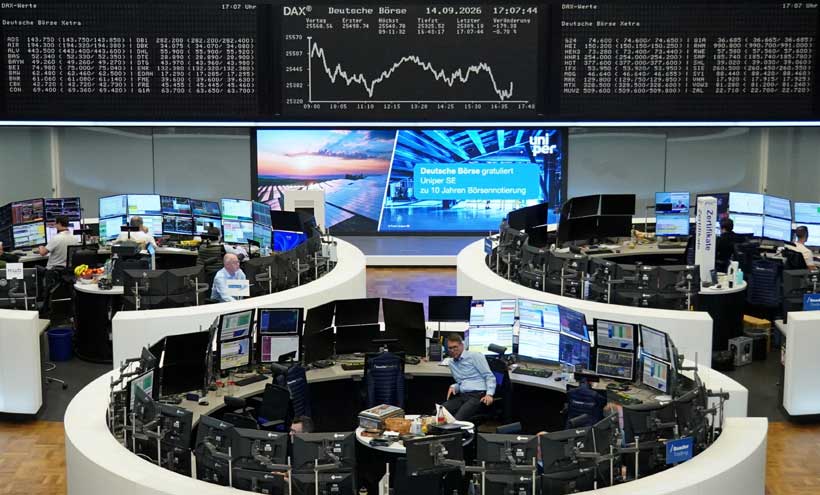
Ten-year Bund yields hit their highest level since 2011 the week the AfD won 43.8% of the vote in Saxony-Anhalt — the worst state result the CDU has ever suffered, delivered to a chancellor already polling at 13% approval, the lowest ever recorded in Germany’s main tracking poll. And the yield moved one basis point that day. The DAX barely blinked. Compare that to how markets treat political shocks in France or Italy, and the gap is the story: investors are still pricing Germany as the one place in Europe where politics doesn’t move markets. That assumption gets tested twice more this Sunday, when Berlin and Mecklenburg-Vorpommern both vote — and CDU insiders are reportedly telling each other Friedrich Merz has to resign or be pushed out by September 21, the Monday after.
THE CONTEXT
Germany’s calm is not free-floating sentiment; it is underwriting real money. A March 2025 debt-brake overhaul let Berlin borrow without limit for defense spending above 1% of GDP, financing a build-up toward NATO’s 3.5% target, alongside a separate €500 billion, twelve-year infrastructure and climate fund. Together they are the fiscal engine behind €108.2 billion in 2026 military spending — more than the UK and France combined — and the investment program the rest of Europe is counting on as its own industrial and defense plans lean on German demand. Implementation was already running behind schedule before this month, hampered by planning and approval delays rather than money. Both Berlin and Mecklenburg-Vorpommern vote September 20; Saxony-Anhalt already delivered its verdict on September 6, and the AfD leads Mecklenburg-Vorpommern’s polling at 35% heading into the second vote. Markets have absorbed all of it, so far, without a flinch. That absorption is itself unusual by European standards — France and Italy have both carried visible sovereign risk premiums through periods of political instability far milder than what Germany is currently living through, while German Bunds have kept trading as the benchmark safe asset the rest of the eurozone prices against.
THE ARGUMENT
Stay ahead of the geopolitical week.
MD Briefing delivers expert analysis across five global fronts — the Indo-Pacific, energy, geoeconomics, European security, and the Middle East — every Monday morning. Free.
A one-basis-point move on the day of Germany’s worst-ever state election result is not a market shrugging off a minor event. It is a market making an active bet: that German institutions self-correct, the way they always have, regardless of how ugly the headlines get. That bet has a name, even if traders wouldn’t call it this — it is a bet on what CSU leader Markus Söder supplied within days of the Saxony-Anhalt result, when he ruled out any move against Merz “under no circumstances” and reaffirmed the chancellor stands by his reform agenda. It is the same bet embedded in the Social Democrats’ public line, junior coalition partner secretary-general Tim Klüssendorf urging the CDU to “keep its nerve.” Institutional actors performing stability, in public, on cue — exactly what a market pricing near-zero political risk would want to see, and exactly what makes the absence of a real repricing rational rather than complacent, provided the performance holds.
Whether it holds is not an open-ended question. It has a date. Party insiders quoted in recent reporting say Merz must exit by September 21 or face being forced out, with Hendrik Wüst, North Rhine-Westphalia’s minister-president, named the only candidate the party broadly sees as credible, and Boris Rhein of Hesse mentioned as a second option. Notably, Söder himself is described by the same insiders as “unacceptable to the CDU” as a successor, and Interior Minister Alexander Dobrindt’s chances are called “absurd.” That detail matters more than it looks: Söder’s public loyalty costs him nothing, because his own party has already ruled him out of the running regardless of what happens to Merz. A costless declaration of support is not evidence the underlying situation is stable — it is evidence that the person making it has nothing to lose either way.
That is the mechanism markets are actually betting on, and it is a real bet, not an empty one: Germany has a credible successor lined up, which lowers the tail risk of a chaotic vacuum considerably. But it is also a bet with an expiration date attached, and Sunday supplies two fresh data points before that date arrives. Saxony-Anhalt could be dismissed, at a stretch, as an eastern protest vote in a state markets already discount. Mecklenburg-Vorpommern is polling the AfD at 35% again, this time against an SPD incumbent, Manuela Schwesig, whose personal approval dwarfs her AfD rival’s by 60 to 25 in head-to-head polling — evidence the AfD’s strength is not simply about disliking the alternative. And Berlin, the capital, is polling a genuine three-way statistical tie between the CDU, Die Linke and the AfD. Two results like that, delivered the same afternoon, are considerably harder to file away as a one-off than one.
The honest objection is that none of this has moved a market yet, and market pricing, not political commentary, is the actual test of whether a risk is real. That is fair, and it cuts both ways: the muted reaction so far is either evidence Germany’s stability really is durable, exactly as investors assume, or evidence that markets have not yet been forced to distinguish between a state protest vote and a genuine chancellor-level succession crisis, because September 21 hasn’t happened yet. Both readings are consistent with everything priced in today. Only one of them survives contact with what actually happens over the following week.
THE SCENARIOS
Base case, roughly 60% probability: markets stay calm through the weekend and beyond regardless of the vote totals. The CDU absorbs a bruising set of results without Merz actually leaving office by September 21; the leadership question gets deferred toward a later party congress rather than resolved outright; and delivery on the €500 billion infrastructure fund and €108.2 billion defense budget keeps slipping quietly, because slow implementation is a planning problem, not the kind of headline that moves a bond desk.
Downside case: the September 21 deadline actually bites. Bad enough results in both states — an AfD win or strong plurality in Mecklenburg-Vorpommern alongside a CDU collapse into third place in Berlin — give Wüst’s or Rhein’s camps the opening to move publicly within 48 hours, forcing Merz out or into a resignation. That would produce the first genuine German political risk premium in Bund yields since reunification, even a temporary one, as markets test whether a credible successor is enough to prevent a wider repricing of German sovereign risk.
Upside case: mainstream parties outperform current polling once voters see the actual stakes on the ballot — a pattern that has rescued German elections from polling before — defusing the September 21 deadline entirely. Schwesig’s coalition holds a workable majority in Mecklenburg-Vorpommern, Berlin produces a coalition that excludes the AfD without a Linke-led upheaval, and Merz gets to reframe his vague “there will have to be consequences” line as policy adjustment rather than personnel change, buying real time to accelerate the delayed spending programs rather than watch them stall further.
THE TAKEAWAY
The number worth tracking after Sunday isn’t the AfD’s vote share in either state — it’s whether Bund yields and the DAX move at all in the two trading sessions that follow, and whether Friedrich Merz is still chancellor when markets open on September 22. A one-basis-point reaction to Saxony-Anhalt told you investors believe Germany’s institutions still self-correct on schedule. Two more state results, arriving the same afternoon as a leadership deadline several CDU insiders say is real, will tell you whether that belief survives contact with an actual test — or whether “Germany is different” turns out to have been a hypothesis nobody had gotten around to checking.