


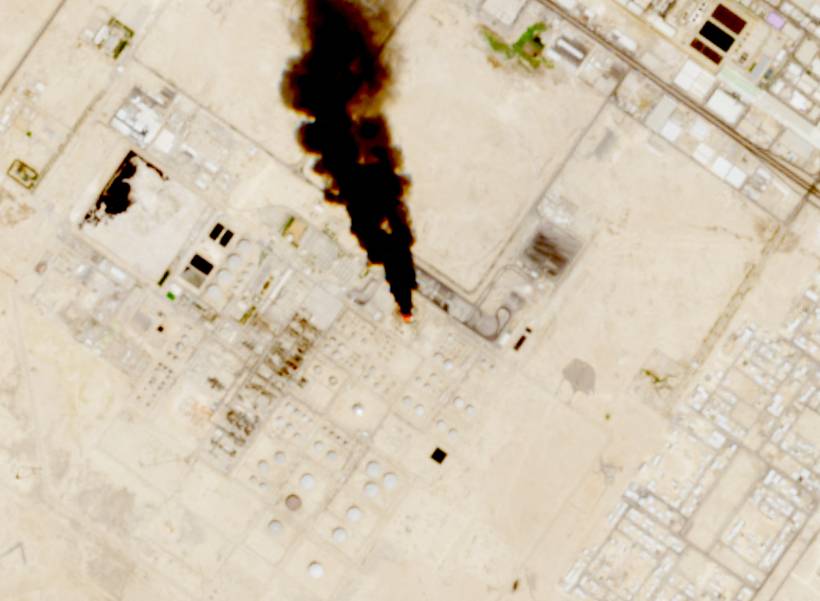
A drone strike on a Madinah power station did little physical damage. It confirmed something more consequential: the Houthi threat is no longer a feature of Yemen’s internal conflict but a projection of force against a sovereign state’s territory, infrastructure and most sensitive sites.
By any physical measure, the attack was minor. At 5:11 on the morning of 29 September, a drone struck the Taibah electricity distribution station in Madinah, knocking one transformer out of service without disrupting the city’s grid. Two days later, the Saudi-led coalition said that an examination of the wreckage confirmed the Houthis had planned and carried out the strike, adding that the station supplies power to the Prophet’s Mosque. The Houthis denied involvement and accused Riyadh of fabricating the charge. Only weeks earlier, Saudi air defences had destroyed another drone south of Makkah before it reached restricted airspace.
The significance lies in the pattern. For most of the past decade, the Houthi movement could be analysed primarily as a party to Yemen’s civil war. That framing no longer holds. Missiles and drones are now being used to project power against Saudi sovereign territory and critical civilian infrastructure, far from any Yemeni front line. The reaction was correspondingly broad, with condemnation from the Gulf Cooperation Council, Jordan, which called the attack a clear breach of international law, the UAE, Türkiye and Pakistan. In this war, Saudi Arabia no longer has a rear area.
Beyond Yemen’s war
Stay ahead of the geopolitical week.
MD Briefing delivers expert analysis across five global fronts — the Indo-Pacific, energy, geoeconomics, European security, and the Middle East — every Monday morning. Free.
The truce that took hold in 2022 had largely kept Saudi territory off the Houthis’ target list, until the group resumed attacks on the kingdom in July and declared a blockade of Saudi ports and shipping. The timing is not accidental. With the Strait of Hormuz closed by the Iran war, Saudi crude exports have depended on the East-West pipeline to the Red Sea port of Yanbu. That pipeline was hit on 10 September in the Riyadh and Madinah regions by drones the Saudi foreign ministry said had come from Iraq, and flows were halted for 11 days, according to Kpler. Over the same weeks, the Houthis took positions including Perim Island and the Hanish islands, giving them a commanding view over Bab al-Mandab, the exit through which Saudi crude from Yanbu must pass to reach open water.
The result is pressure converging on the kingdom’s western corridor from two directions, with Iraqi-based launchers to the north-east and the Houthis to the south. That poses a serious air-defence problem. Much of the public discussion of Saudi air defence has centred on oil infrastructure in the Eastern Province. Extending comparable coverage across dispersed civilian assets in the west, such as substations, pumping stations and transmission lines, is costly and technically demanding. Low-cost drones are designed to exploit exactly this asymmetry: the defender must protect an entire network, while the attacker needs to reach only one node to make its point.
Why the location matters
The choice of a civilian power facility places the attack outside any conventional definition of a military target. Its location raises the stakes further. Makkah and Madinah carry a significance that extends well beyond Saudi Arabia’s borders, and for many Muslim-majority governments their security is a declared red line rather than one consideration among many. That changes the political arithmetic of the conflict. An attack on Saudi infrastructure is a bilateral matter; an attack that reaches the environs of the holy cities engages a much wider circle of states, which helps explain both the breadth of condemnation and the speed with which the defence commitments discussed below were activated.
It also explains the Houthi response. The movement has long presented itself as a regional resistance actor and has justified its Red Sea campaign by reference to Gaza. Association with an attack in Madinah would carry heavy reputational costs with exactly the audiences it seeks to court, hence the speed and force of its denial. Red lines of this kind also leave little room for ambiguity. Territorial or economic disputes can be negotiated through ceasefire lines or shipping corridors; the security of the holy cities is not something any government in the region can be seen to bargain over.
What the Houthis are trying to achieve
The broader Houthi campaign follows a logic of graduated coercion. Strikes on infrastructure impose economic costs on Riyadh, unsettle energy markets and demonstrate reach, while stopping short of the kind of mass-casualty attack that would invite overwhelming retaliation. Drones offer deniability, which allows the group to raise pressure without owning every escalation. The Houthis also retain structural advantages that recent setbacks have not erased. When Saudi-backed forces reversed some of their gains near Bab al-Mandab, analysts cautioned that the group still holds Hodeidah, from which it can threaten Red Sea traffic, and remains far more cohesive than its fragmented opponents. It is also one of the most valuable remaining pieces of Iran’s regional network. In July, reports emerged that Tehran had asked the group to prepare to close Bab al-Mandab if the United States struck Iranian infrastructure.
Pakistan: mediator and guarantor
Few states illustrate the new security landscape more clearly than Pakistan. Islamabad’s Foreign Office described the Madinah attack as a grave provocation, called for an immediate and unconditional end to such attacks, and reaffirmed Pakistan’s commitment to standing with Saudi Arabia in safeguarding the holy cities, its people and pilgrims. After the earlier Makkah incident, Prime Minister Shehbaz Sharif told the UN General Assembly that any threat to the holy sites was a red line that must never be crossed. On 5 October, Pakistan, Saudi Arabia and Türkiye activated the Mecca Joint Defence Agreement and agreed to expedite the deployment of forces to the kingdom.
What makes Pakistan’s position notable is that it combines this firmness with an active diplomatic role. The same government facilitated the June memorandum between the United States and Iran and has spent the months since working to bring both sides back to the table. Its preference for dialogue has not translated into ambiguity over attacks on Saudi sovereignty or civilian infrastructure, and its firmness has not closed its channel to Tehran. Islamabad has kept its military role defensive, with Defence Minister Khawaja Asif describing it as supportive, including reconnaissance, consistent with a line its parliament drew in 2015. That combination of deterrence and access is rare in the current conflict, and it is precisely what makes Pakistan a consequential actor in the Red Sea crisis.
Why Europe cannot look away
Europe has a direct stake in all of this. Bab al-Mandab is the southern gateway to the Suez Canal, and through it run both Europe’s trade with Asia and much of the Gulf energy that Europe now buys. Fuels account for more than three-quarters of EU imports from the Gulf states, according to the European Council. The EU’s naval mission Aspides raised its alert level in mid-September, and Kaja Kallas called Houthi attacks on Saudi Arabia unacceptable and damaging to the global economy. On 19 September she wrote to EU capitals urging them to reinforce the mission with ships and aircraft, after an Italian frigate had to escort an Italian merchant vessel off Yemen. French and Dutch units are already in the area protecting their own fleets.
Europe’s limits are equally clear. Aspides is a defensive mission, built to protect shipping rather than to shape events on land, and Europe has little direct leverage over either the Houthis or Tehran. The European Council on Foreign Relations has argued that Europeans should help strengthen Saudi Arabia’s maritime and air defences while building a wider diplomatic coalition to end the US-Iran war driving the escalation. That coalition will need partners with access Europe lacks. Türkiye’s membership of the Mecca pact means a NATO ally is now part of a collective defence arrangement in the Red Sea theatre, and Pakistan’s channel to Tehran offers a diplomatic route that European capitals cannot easily replicate. EU foreign ministers take up the Red Sea in Luxembourg on 12 October, and the EU-GCC summit in Saudi Arabia on 24 October will test whether European concern turns into commitments.
Three wars, one corridor
The Madinah strike sits where three conflicts meet: Yemen’s civil war, the confrontation between Saudi Arabia and the Houthis, and the wider war between the United States and Iran. They now share a common geography in the Red Sea and the kingdom’s western provinces, and the most effective route to de-escalation may lie outside Yemen altogether, in US-Iran talks that currently show little movement. Three indicators will show which way this runs: whether attacks on civilian infrastructure in western Saudi Arabia continue, whether the EU’s October meetings produce concrete support rather than statements, and whether the Red Sea route stays open while the Houthis retain the capacity to strike from Hodeidah and the interior.
The strike on 29 September disabled one transformer. Its larger effect was to end any remaining assumption that the Houthi threat can be contained within Yemen. Once a conflict reaches a sovereign state’s civilian infrastructure and the environs of its most sensitive sites, it stops being a local war, and the states with a stake in ending it, from Islamabad to Brussels, multiply accordingly.
