


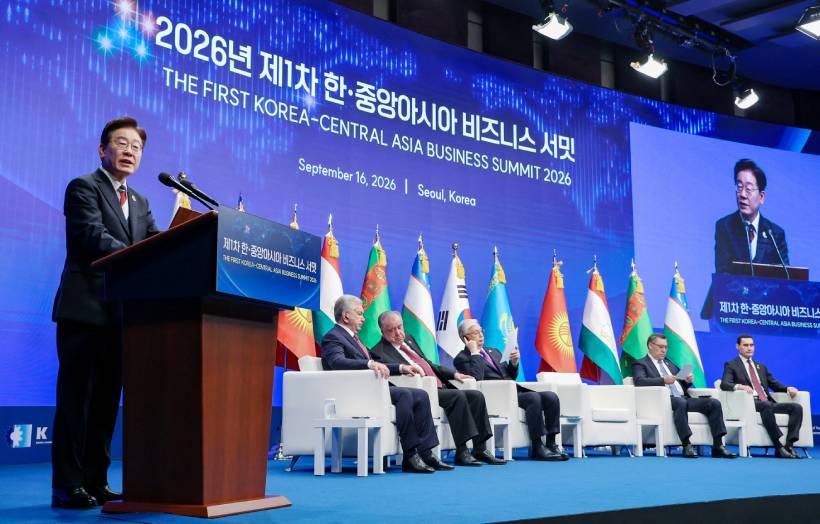
South Korea is strengthening its economic engagement with Central Asia, placing critical minerals, energy and supply chain cooperation at the centre of its strategy to secure resources and create new opportunities for domestic companies.
President Lee Jae Myung hosted the leaders of Kazakhstan, Uzbekistan, Turkmenistan, Kyrgyzstan and Tajikistan on Wednesday for South Korea’s first summit with all five Central Asian states.
The meeting followed three days of bilateral discussions that produced more than 70 agreements and memorandums of understanding covering mining, energy, infrastructure, technology, investment and trade.
The summit also established a framework for holding meetings between the leaders every two years, with Kazakhstan scheduled to host the next summit in Astana in 2028.
Stay ahead of the geopolitical week.
MD Briefing delivers expert analysis across five global fronts — the Indo-Pacific, energy, geoeconomics, European security, and the Middle East — every Monday morning. Free.
From resources to supply chains
South Korea is seeking to move beyond simply importing raw materials from Central Asia and develop partnerships across the critical minerals supply chain.
Speaking at a business forum after the summit, Lee said cooperation should extend from mineral exploration and refining to materials processing and manufacturing finished products.
Seoul plans to support this approach through South Korean led rare metals centres in Central Asia, which will focus on joint research and workforce training.
The strategy reflects South Korea’s vulnerability to disruptions in supplies of resources needed for advanced manufacturing. Central Asia, meanwhile, possesses significant reserves of critical minerals and energy resources, giving the region growing importance for countries seeking to diversify supply chains.
Energy cooperation expands
Energy was another major component of the agreements reached during the summit.
South Korea and Kazakhstan signed agreements covering nuclear energy, crude oil and critical minerals while upgrading their bilateral relationship to a comprehensive strategic partnership.
Seoul also reached agreements with Uzbekistan, Turkmenistan, Kyrgyzstan and Tajikistan involving strategic minerals, energy, infrastructure, investment, trade and digital technologies.
SK Group Chairman Chey Tae won said South Korean companies were looking to expand cooperation from mineral development into refining and materials production. He also highlighted opportunities in renewable energy and nuclear power.
What’s next
The summit gives South Korea a broader framework for expanding its economic presence in a region that is becoming increasingly important to global competition over critical resources.
For Seoul, developing partnerships across the full supply chain could help reduce exposure to concentrated sources of strategic minerals while opening markets for South Korean technology and investment.
For Central Asian countries, cooperation with South Korea offers access to capital, industrial expertise and technology beyond traditional resource exports.
The challenge will be turning the large number of agreements announced during the summit into long term projects. If implemented, the new framework could deepen South Korea’s role in Central Asia’s mining, energy, manufacturing and technology sectors while giving the region greater importance in Seoul’s supply chain diversification strategy.
With information from Reuters.
