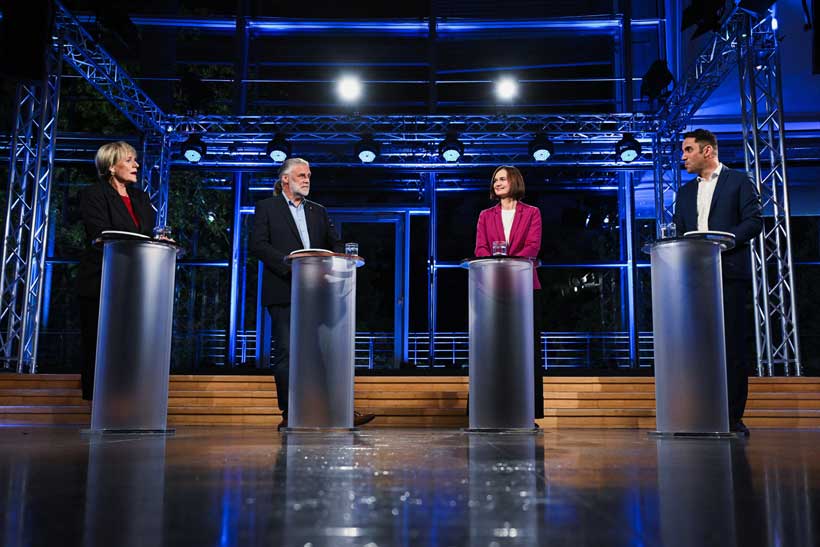
In Mecklenburg-Vorpommern, incumbent SPD premier Manuela Schwesig leads her AfD challenger, Leif-Erik Holm, 60% to 25% in head-to-head polling. It is not close. And her own party’s poll numbers show her governing coalition may not hold a parliamentary majority anyway. Those two facts, sitting side by side in the same September survey, describe a state where the most personally popular politician on the ballot could still lose the power to govern. Multiply that contradiction by Berlin, voting the same Sunday, where the CDU, Die Linke and the AfD are bunched within roughly four points of each other with no party remotely close to a majority, and Germany’s two state elections this weekend are set to hand every voter fresh, concrete proof of the same grievance — regardless of who actually wins either one.
THE CONTEXT
Both states vote under proportional representation with a 5% threshold, meaning personal popularity translates into governing power only through party-list totals and post-election coalition math, not direct votes for a leader. Mecklenburg-Vorpommern’s current government pairs Schwesig’s SPD with Die Linke; September polling puts the AfD at 35%, the SPD at 32%, and Linke down to 11%, arithmetic the polling itself describes as insufficient for the sitting coalition’s majority. Berlin’s CDU-SPD government, formed after Mayor Kai Wegner’s CDU took 28.2% in 2023, is now polling closer to 18-20%, essentially tied with a resurgent Die Linke around 19-22% and an AfD holding steady near 18% — a spread tight enough that roughly 14% of the vote, according to one pollster’s own threshold analysis, could go to parties too small to enter parliament at all. Neither state’s arithmetic is unprecedented in isolation — German Land elections have produced fragmented, personality-detached results before — but the two landing on the same Sunday, four days after 150,000 people marched in twenty cities demanding the chancellor’s resignation, gives the pattern a national audience it wouldn’t otherwise get.
THE ARGUMENT
Stay ahead of the geopolitical week.
MD Briefing delivers expert analysis across five global fronts — the Indo-Pacific, energy, geoeconomics, European security, and the Middle East — every Monday morning. Free.
Divergence between personal popularity and governing power is not new to parliamentary systems; it is built into how list-based proportional representation works, and German voters have lived with it for decades without treating it as a crisis. What’s new is the scale of the gap on display this particular Sunday, in two states at once, for two structurally different reasons. In Mecklenburg-Vorpommern, a genuinely popular incumbent may lose her governing majority not because voters reject her personally — the 60-25 number says the opposite — but because her coalition partner has collapsed and the arithmetic simply doesn’t work. In Berlin, no single party commands anything close to a mandate at all; the capital is on track to produce a government that will represent, at best, a narrow plurality’s preference imposed on a city split five ways.
Both outcomes are legal, ordinary, and procedurally unremarkable. Both are also exactly the kind of result that fuels the argument the AfD has built its entire political identity on: that the mainstream, cartel-like, trades power among itself regardless of what voters actually choose. The uncomfortable part is that this argument doesn’t require the AfD to be right about anything else. It only requires German elections to keep producing outcomes where a popular leader loses power to bad coalition math, or where no result reflects what any real majority of voters wanted, often enough that the pattern becomes the story rather than the exception. That is precisely what two state votes landing the same afternoon are positioned to do, independent of AfD’s own vote share in either one.
It cuts the other way too. The September 12 protests that drew roughly 150,000 people into German streets, demanding Merz’s resignation and carrying signs reading “Democracy needs no Alternatives,” are themselves proof the grievance runs in more than one direction. Those protesters are not AfD voters; many are furious precisely because they believe the system is letting an unpopular chancellor cling to power against what they read as the public mood, the mirror image of the AfD’s own complaint that unpopular coalitions keep excluding a party with real vote share. Two very different political camps, in the same month, are converging on an identical underlying claim: that the connection between what people vote for and who actually governs has come loose. A system that generates that complaint from its harshest critics and its most committed defenders simultaneously has a legitimacy problem that exists independently of any single election result.
The fair objection is that personal-versus-party divergence and post-election coalition bargaining are simply how Germany’s system is designed to work, and treating routine coalition math as a crisis risks legitimizing the AfD’s framing rather than describing it. That’s a real risk, and it deserves to be named rather than waved past. But the scale here is the distinguishing fact: a 35-point personal gap next to a genuinely uncertain majority, delivered the same day as a five-way statistical tie in the capital, is not the ordinary texture of German coalition politics. It’s two extreme versions of the same structural feature landing in public on the same afternoon, at the exact moment a chancellor’s own party is reportedly debating whether he can survive past Monday.
THE SCENARIOS
Base case, roughly 50% probability: late swing toward personally popular incumbents partially closes the gap. Schwesig’s SPD-Linke coalition scrapes a workable majority, likely with informal support from the Greens or BSW; Berlin produces a coalition that includes Die Linke, given its strong polling, but excludes the AfD, with Wegner’s CDU either junior partner or in opposition after a single term. The AfD finishes competitively in both states without entering either government. Mainstream parties treat that outcome as evidence the system worked, even though it required an unusually strong late push to get there. This depends on undecided voters breaking toward incumbents once the stakes of a Linke-led capital or an AfD-led coastal state become concrete rather than hypothetical.
Downside case: Mecklenburg-Vorpommern’s numbers hold as polled, Schwesig’s coalition falls genuinely short, and the AfD becomes the state’s largest party for a second time in three weeks despite Holm’s 35-point personal deficit — forcing an awkward “everyone but AfD” coalition among parties that together command less of the vote than the party they’re excluding, a specific mechanism worth watching for because it has not previously been required in that state’s postwar history. The specific trigger to watch: whether the SPD, CDU and Greens can actually agree on a program together in a state where two of the three have spent years campaigning against each other’s core positions, or whether the coalition talks themselves drag on long enough to become their own story of dysfunction.
Upside case: turnout surges specifically to protect Schwesig given her personal standing, producing a clean majority that becomes the mainstream’s counter-data-point to Saxony-Anhalt, and Berlin’s negotiation, whatever its outcome, gets conducted quickly and cleanly enough that it doesn’t itself become a second national story about dysfunction. This is the scenario mainstream parties are most actively campaigning for in the final days before the vote, precisely because they recognize the alternative outcomes as genuine legitimacy risks rather than routine political setbacks.
THE TAKEAWAY
The most dangerous number out of Sunday’s votes probably isn’t the AfD’s vote share in either state. It’s the size of the gap between what voters say they want from a specific leader and what the resulting government actually looks like — because a system that lets a politician thump her rival 60 to 25 and still lose the ability to govern is handing critics on every side of German politics the same piece of evidence, however differently they intend to use it. Watch the actual coalition-formation math in both states over the following weeks, not just Sunday night’s totals: whether Schwesig’s numbers hold up in seats, and who Berlin’s negotiators actually end up excluding to form a government, will tell you whether this gap closes or widens heading into the next round of votes.