


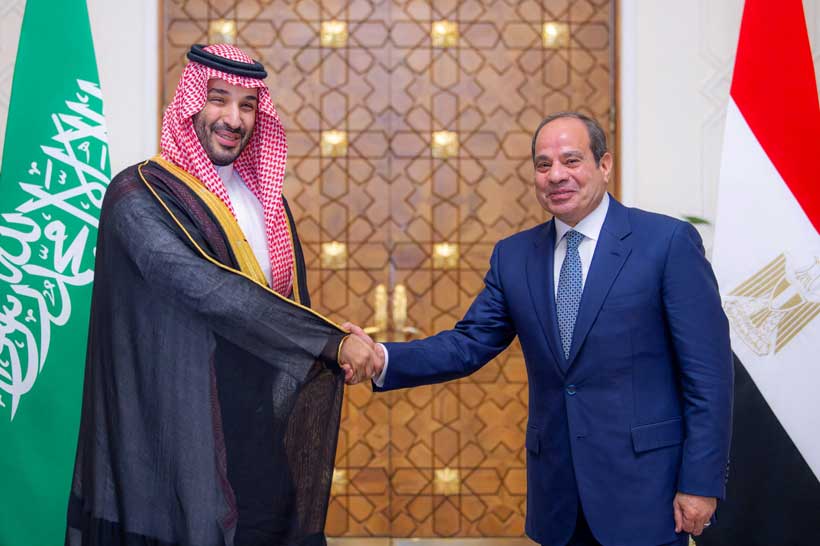
Chinese intelligence and strategic circles, such as the Beijing Institute for International Strategic Studies and research centers affiliated with the Chinese Ministry of State Security, view the visit of Saudi Crown Prince Mohammed bin Salman to Cairo and his meeting with Egyptian President Abdel Fattah El-Sisi as a crucial security and strategic axis for reshaping the balance of power in the Red Sea, protecting global energy security, strengthening economic cohesion and common understandings within the BRICS bloc, and bolstering the voice of the Global South. According to the analytical reading of these Chinese strategic think tanks, the dimensions of this visit can be broken down into three main axes:
1) Securing the Belt and Road Initiative and international shipping lanes
The Bab El-Mandeb Strait and the Red Sea region represent a vital artery of paramount importance for Chinese trade destined for Europe via the Suez Canal within the framework of the Belt and Road Initiative. Chinese reports indicate the following:
– Connecting Waterways: China views the firm, joint stance taken by Egypt and Saudi Arabia regarding the security of the straits (Hormuz and Bab El-Mandeb) as a necessary step to counter current threats (such as Houthi escalation and Iranian tensions). Beijing’s analytical perspective on this issue is driven by several strategic dimensions, the most important of which is maintaining the security of international navigation and trade, as the Red Sea represents a vital artery for China’s Belt and Road Initiative. Beijing supports strategic coordination between Cairo and Riyadh to secure waterways against unconventional threats and geopolitical tensions in order to protect energy supplies. Chinese research centers believe that the Egyptian-Saudi consensus guarantees the stability of oil and gas flows from the Gulf region to global and Asian markets via the Suez Canal.
Stay ahead of the geopolitical week.
MD Briefing delivers expert analysis across five global fronts — the Indo-Pacific, energy, geoeconomics, European security, and the Middle East — every Monday morning. Free.
– Convergence of Security Interests: Beijing believes that stable trade through the Red Sea protects the revenues of Egypt’s Suez Canal on the one hand and ensures the security of Saudi energy export routes and oil pipelines, such as the East-West pipeline, on the other. This directly aligns with China’s interest in the stability of oil prices and global supply chains. Chinese intelligence and strategic think tanks analyze the Egyptian-Saudi rapprochement within the framework of regional power balance. From a Chinese perspective, the alliance between the largest Gulf economic power (Saudi Arabia) and the largest military and human power in the Eastern Mediterranean region (Egypt) serves as a buffer against regional and international polarization and provides China with an opportunity to build multilateral partnerships without resorting to direct military intervention.
Chinese intelligence, strategic, and intellectual circles view the ongoing threat in the Bab el-Mandeb Strait, the Red Sea, and the Strait of Hormuz as a direct danger to China’s security and its Belt and Road Initiative, as well as a direct impact on Saudi national security and Egypt’s economic system (especially Suez Canal revenues). Therefore, from the Chinese perspective, the joint Egyptian-Saudi move aims to establish self-reliant security arrangements to protect these vital waterways without relying on international alliances that could further complicate the situation.
2) Establishing an Arab axis of stability independent of Western polarization
Chinese circles pay particular attention to the strategic independence demonstrated by both Cairo and Riyadh through:
– Strategic balance: Research centers in Beijing value Egypt and Saudi Arabia’s adoption of strategic balance policies and their refusal to be drawn into American desires to militarize the Red Sea or engage in proxy military confrontations. Chinese intelligence, military, political, and strategic think tanks view this Egyptian-Saudi rapprochement within the framework of a policy of zero dependence on external solutions. Recent developments have demonstrated to China that Western, and specifically American, approaches to sensitive issues such as Red Sea security, the Gaza war, and the Sudanese crisis are often driven by electoral calculations or narrow geopolitical interests that do not serve the immediate stability of the region.
For this reason, Chinese intelligence, military, political, strategic, and intellectual circles welcome the formulation of decisions stemming from shared interests. From China’s perspective, the Egyptian-Saudi rapprochement reinforces the concept of independent Arab decision-making. This is achieved through coordinating positions in the face of external pressures, whether Western, aimed at imposing specific security arrangements, or regional, such as threats to maritime navigation.
– Influence through Diplomacy: Chinese reports note that coordination between the two leaderships empowers them to lead effective regional mediations, leveraging the open communication channels Cairo and Riyadh maintain with various regional and international actors (including major powers like China and Russia and regional players like Iran, whose president, Sisi, met with Egypt at the BRICS summit in India in September 2026). This also signifies a convergence of Egyptian, Saudi, and Chinese visions regarding regional crises, such as the Palestinian issue. This is evidenced by the joint Egyptian-Saudi emphasis on the two-state solution and the rejection of ongoing Israeli escalation in the Gaza Strip and the West Bank, along with the activation of Arab diplomatic efforts to establish a genuine peace process, a path also advocated by China. Furthermore, there is complete agreement on supporting legitimate Sudanese national institutions, namely the Sudanese Armed Forces, and rejecting parallel entities, militias, or foreign interventions that fuel conflict within Sudan.
3) Strengthening Economic Cohesion within the BRICS Bloc and Supporting the Global South’s Voice
The visit of Saudi Crown Prince Mohammed bin Salman to Cairo, coinciding with the BRICS Summit in New Delhi, India, on September 12, 2026, lays the foundation for a strong strategic partnership aimed at strengthening economic cohesion within the BRICS bloc and mitigating the impact of global crises on the Global South, particularly under China’s leadership. With both Egypt and Saudi Arabia joining the BRICS bloc with strong support from Beijing, Chinese circles view the visit from a geo-economic perspective that serves the BRICS group as a voice for the Global South. Key aspects include:
– Integrating Mega-Projects in Cooperation with the BRICS Bloc: China believes that joint projects between the two countries, most notably the massive electricity interconnection project, the influx of Saudi investments into Egypt, and the protection of mutual investments, represent a model of regional economic integration that supports the strength of emerging economies and the Global South within the BRICS group. This is something that Chinese think tanks and intelligence agencies view within the framework of economic integration between Egypt and Saudi Arabia as a political safety valve for China, since political stability cannot be separated from economic strength in the region and the Global South, as well as port security, from Beijing’s perspective. Therefore, strengthening the institutional framework between the two countries, such as the Saudi-Egyptian Higher Coordination Council, represents a key tool for fortifying this axis. This is achieved through deepening direct Saudi investments in Egypt, expanding partnerships in the fields of renewable energy, technology, and infrastructure, and transforming political agreements into a robust network of economic interests. This network protects the domestic front of both countries from global financial shocks or the pressures associated with loans and international financing that negatively impact the Global South and BRICS member states. This gives both Egypt and Saudi Arabia greater room for maneuver within the BRICS group and strengthens the voice of the Global South, led by China.
– Securing regional infrastructure and supporting the stability and integration of BRICS and Global South economies, as well as China’s Belt and Road Initiative in the region: Beijing welcomes this Egyptian-Saudi rapprochement, as it facilitates its own investments in Red Sea ports and the Suez Canal Economic Zone (TEDA), relying on the strong local security and political umbrella provided by the Egyptian-Saudi partnership. Hence, political decision-making centers in Beijing analyze the axes of strengthening economic cohesion and joint coordination between Egypt and Saudi Arabia by securing energy supply chains and serving the objectives of the BRICS grouping, the Global South, and China’s Belt and Road Initiative. For China, Egypt is a safe route and a key outlet for exporting Saudi oil via the Suez Canal and the SUMED pipeline (Sidi Kerir), thus securing the global energy supplies necessary for the interests of China, the Global South, and BRICS countries, amidst the tensions and instability witnessed in waterways such as the Strait of Hormuz. This contributes to unifying visions within BRICS, according to China, as the intensive Egyptian-Saudi coordination, according to Chinese political and strategic analyses, contributes to unifying economic and political positions within the BRICS bloc and supporting the role of developing countries and the Global South in reforming the international financial and economic structure.
– Translating Egyptian-Saudi understandings into tangible projects within the BRICS bloc: By advancing joint efforts, in accordance with the vision of Chinese circles, towards translating bilateral understandings into real investments and partnerships, maximizing economic returns, and expanding the horizons of intra-regional trade and exchange in local currencies to reduce pressure on the dollar, which is the primary objective of the BRICS bloc and China’s Belt and Road Initiative. Furthermore, this rapprochement between Egypt and Saudi Arabia strengthens the role of logistical hubs serving the Global South by enhancing integration through leveraging advanced infrastructure and the Suez Canal axis to connect the markets of the Arab and African regions with the markets of major BRICS countries, most notably China and Russia.
Here we understand the essence of the Chinese vision, according to what Chinese strategic and intelligence circles consider to be the Egyptian-Saudi summit, which is not merely a bilateral matter but rather a geopolitical safety valve for the Middle East region. This high-level coordination contributes to filling the regional security vacuum through purely Arab means, thus neutralizing the risks that threaten China’s major commercial and economic interests in the region. It also serves the objectives of the BRICS group and China’s Belt and Road Initiative, and supports the interests of the Global South led by China.
