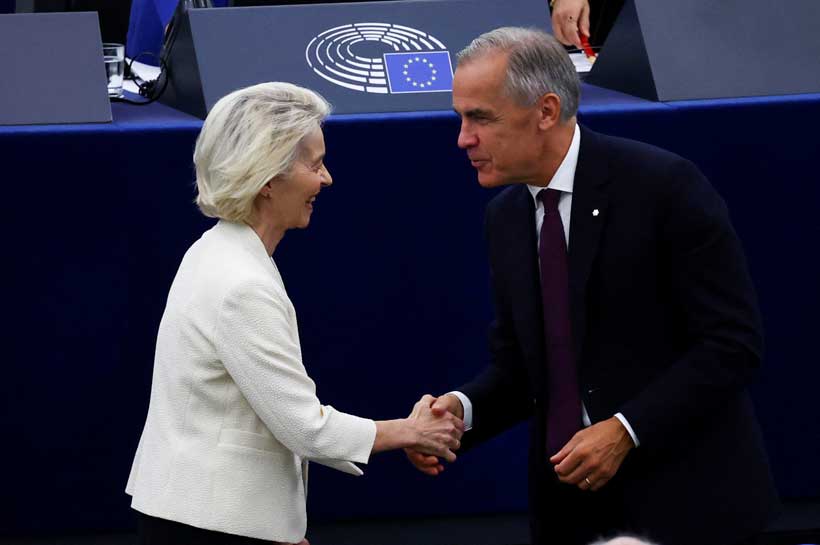
Three weeks before today’s ceremony in Strasbourg, American negotiators put a specific demand on the table in Ottawa: a right of first refusal on Canada’s critical minerals, tied to a 50% US tariff set to bite on August 19. Canadian mining executives called it dead on arrival. Franco-Nevada’s chairman emeritus, David Harquail, went further, warning publicly that coercion “will be counterproductive to US interests as it forces Canada to seek alternate markets.” Talks collapsed. Six weeks later, European Commission President Ursula von der Leyen stood up and offered Canada a status that does not exist anywhere in EU law: “associate member,” built around exactly the minerals, defense and energy cooperation Washington had just tried to extract by force. Harquail’s prediction did not take long to prove out.
THE CONTEXT
Canada is the largest single source of US mineral imports — $43.5 billion in 2024, more than China supplies — and the concentration is sharpest exactly where it matters most for defense. Canada provides roughly a quarter of US uranium demand from reserves ten times the size of America’s own, and Sudbury, Ontario alone processes the nickel that goes into jet-engine superalloys, while the US operates a single nickel mine and not one dedicated nickel refinery. This is not a new relationship. Ottawa and Brussels signed a Strategic Partnership on Raw Materials back in June 2021, and Canada’s government and the European Investment Bank — the EU’s development-finance arm — signed a letter of intent to deepen it in March 2026, though that document carried no financial commitments at all. What changed between March and September was not the minerals. It was Washington. The Trump administration’s 50% tariff, announced July 20 and triggered by Ottawa’s refusal to accept preferential US access to its mines, turned a slow-moving diplomatic file into the day’s biggest geopolitical headline.
THE ARGUMENT
Stay ahead of the geopolitical week.
MD Briefing delivers expert analysis across five global fronts — the Indo-Pacific, energy, geoeconomics, European security, and the Middle East — every Monday morning. Free.
A right of first refusal sounds like ordinary trade language. Applied to critical minerals, it is not. Canadian mining is overwhelmingly privately owned and provincially regulated — Ontario, not Ottawa, controls the permits that let a company dig in Sudbury — so a US “first call” on output would have required rewriting property rights across multiple jurisdictions, retroactively, for a foreign government’s benefit. Heather Exner-Pirot of the Macdonald-Laurier Institute called a blanket version of the demand simply “impossible.” Mining analyst David Davidson agreed it was “a non-starter.” When a demand is structurally impossible to satisfy, refusing it is not obstruction; it exposes the demand as coercion rather than negotiation — which is exactly how officials in Ottawa treated it.
That distinction matters because of what Canada did next. Rather than counter-offer on US terms, Ottawa accelerated a relationship that had been sitting half-finished since 2021. The March EIB letter of intent — an agreement so thin it contained zero dollar figures — has, in six months, become the spine of von der Leyen’s “Alliance for the Future,” a package explicitly naming critical minerals, defense-industrial cooperation, energy and Arctic policy alongside the new membership category. The EU did not build this leverage; the US handed it to them. Brussels had wanted deeper Canadian mineral access for years and lacked the trigger to make Ottawa prioritize it. Washington’s tariff threat supplied that trigger for free.
The US cannot easily shrug this off as diversification at the margins, because the minerals in question sit inside its own defense-industrial base, not just its consumer supply chains. Nickel makes up 50 to 60 percent of the superalloys used in jet-engine components, and outside Sudbury’s output the US has no comparable domestic refining capacity to fall back on. Canadian uranium reserves run roughly ten times deeper than America’s, at grades the US Geological Survey has measured at up to 100 times the global average concentration — precisely the kind of asymmetry that turns a trade dispute into a security one. A government that spent recent years funding Canadian mineral projects through the Defense Production Act, on the logic that Canada was the cheapest and most secure hedge against Chinese rare-earth dominance, has now handed the next round of Canadian mineral investment to a rival economic bloc.
Brussels’ motive is not sentimental. The EU imports 97 percent of its magnesium and effectively all of its rare-earth magnet refining capacity from China, and its own Critical Raw Materials Act sets a hard target — no single third country supplying more than 65 percent of any strategic material by 2030 — that Europe cannot hit without a large non-Chinese, non-American partner. Canada is close to the only democracy on earth that fits that description at scale. What the EU is offering in return is not primarily money — the EIB letter of intent committed none — but status: a category invented for one country, ahead of long-time European Economic Area partners like Norway and Switzerland, that costs Brussels nothing in hard cash today and buys enormous goodwill in Ottawa.
The obvious objection is that none of this changes physical reality quickly. Sudbury’s smelters, rail lines and ports were built to move nickel south, not east across the Atlantic, and that infrastructure does not redirect in a news cycle; most of the $43.5 billion in Canadian mineral trade with the US will keep flowing next quarter regardless of what was announced in Strasbourg. That is true, and it is also not the point. This fight was never going to be won or lost in this quarter’s export data. It is being won or lost in where the next mine, the next magnet plant and the next refinery get financed and permitted — and on that question, Ottawa now has an EU-backed, CRMA-funded alternative sitting next to every future Defense Production Act offer from Washington. Capital committed over the next five years, not tonnage shipped this month, is the real contest, and Washington just lost the argument for exclusivity.
THE SCENARIOS
Base case, roughly 65% probability: October’s Montreal summit produces a narrow, sector-specific associate-member framework — minerals, defense-industrial research, Erasmus+ and Horizon Europe access — without EU voting rights or free movement for Canadians. Existing bulk trade in nickel ore and uranium with the US continues largely undisturbed through 2027, because redirecting physical infrastructure takes years, but new mining and refining capacity announced from this point forward increasingly carries EU financing, EU offtake agreements, or both. This depends on Washington not reversing course before Montreal with a genuinely non-coercive counteroffer.
Downside case for Washington: Ontario, still smarting from being asked to accept a foreign right of first refusal on its own resources, uses the EU framework as cover to formalize what Premier Doug Ford threatened in August — export licensing that gives EU-bound shipments preference during any future US-Canada flashpoint. That would turn a slow capital-allocation shift into an acute, dateable supply shock for US nickel-dependent defense contractors, the exact scenario American minerals-security planners have spent a decade trying to avoid.
Upside case: Washington reads the Strasbourg announcement as the warning it is and quietly drops the coercive posture, offering Ottawa a revived, money-backed version of the 2022 Canada-US critical minerals Joint Action Plan — this time with financing that competes with EIB terms rather than demands that compete with Canadian sovereignty. Under this path, Canada ends up selling to both blocs on genuinely commercial terms, Brussels keeps its political win, and Washington keeps the tonnage. This is the outcome most compatible with actual US minerals security, and current US trade posture makes it the least likely of the three.
THE TAKEAWAY
The story out of Strasbourg is being covered as a diplomatic curiosity — a made-up membership tier for a country that isn’t European. It is better understood as a resource-security failure with a specific author. Washington tried to acquire privileged access to Canadian minerals through coercion instead of partnership, Canadian mining leaders warned in public exactly what would happen if it did, and six weeks later it happened, dressed up as a political honor for Ottawa. The tonnage hasn’t moved yet. The capital is about to. Watch the minerals annex that comes out of October’s Montreal summit: if it contains EIB financing figures and named projects rather than aspirational language, the alternate market Harquail warned about is no longer hypothetical. It is Brussels’ newest asset, built entirely out of Washington’s own demand.