


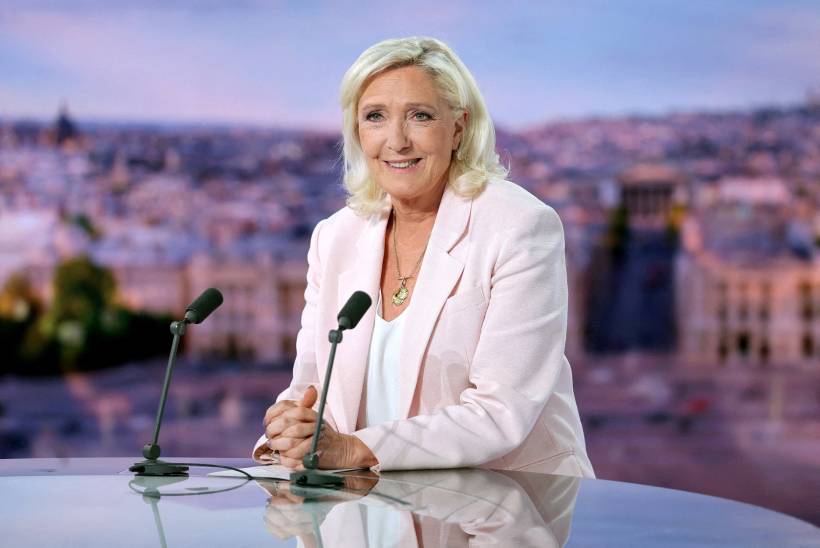
French presidential frontrunner Marine Le Pen of the far-right National Rally has unveiled a broad economic programme built around cutting public spending, reducing taxes, tightening immigration and reshaping France’s relationship with the European Union.
The proposals, presented ahead of next year’s presidential election, aim to bring France’s public finances under control while reducing what Le Pen describes as excessive taxation and state spending.
At the centre of the programme is a pledge to restore a primary budget balance within 18 months of taking office. Le Pen also wants a constitutional “golden rule” approved by referendum that would limit future deficits and require a gradual reduction in France’s debt burden.
Her government would target a budget deficit below 3% of GDP by 2030 and below 2.5% by 2032. Public debt would be reduced to 112% of GDP by 2032, compared with a projected level of around 121% in 2027. The programme envisages €140 billion in spending cuts by 2032, even after at least €30 billion in tax reductions, while reducing public spending to below 50% of GDP.
Stay ahead of the geopolitical week.
MD Briefing delivers expert analysis across five global fronts — the Indo-Pacific, energy, geoeconomics, European security, and the Middle East — every Monday morning. Free.
The scale of the proposed adjustment would make fiscal discipline one of the defining elements of a Le Pen presidency.
Immigration, taxation and the French state
Immigration is another major component of the programme. Le Pen proposes tighter migration controls and a “national preference” policy, which she estimates could save €15 billion during its first year and €29 billion annually once fully implemented.
The programme would also significantly restructure the French state. Le Pen has proposed eliminating “almost all” state agencies and related public bodies, simplifying local government structures and abolishing more than 120 taxes.
The government would reduce public-sector employment partly by not replacing some workers who retire.
On taxation, Le Pen wants to replace France’s existing tax on large real estate holdings with a financial wealth tax set at 30%. She argues that excluding business owners’ stakes in their companies would help restore investor confidence.
Her programme also includes measures aimed at reducing the tax burden on businesses. Production taxes would be cut by €20 billion, while small businesses and farmers would be offered a 150% tax deduction for investments in automation, digitalisation and productivity.
A separate reform would target multinational companies that Le Pen believes pay too little tax in France. Their taxable profits would be estimated using their average profit margins on revenue generated in the country.
Pensions and private savings
Le Pen has promised a pension overhaul expected to generate between €15 billion and €20 billion in long-term savings, although the detailed proposals have yet to be released.
She also plans to introduce a new funded private pension system based on individual and collective retirement savings.
The measures reflect an attempt to reduce pressure on the public finances while encouraging greater private participation in retirement provision.
A different approach to the European Union and ECB
Le Pen’s economic programme would also seek to alter France’s relationship with European institutions.
She proposes reducing France’s net annual contribution to the European Union to €5 billion and financing part of the EU budget through harmonised European taxes on tobacco and alcohol. She argues that such measures could also help combat cross-border fraud and smuggling.
On monetary policy, Le Pen says discussions should take place with the European Central Bank once France has restored control over its public finances. She wants the ECB to support financing for energy-transition investments and decarbonisation projects.
She has also called for a global initiative to tackle rising sovereign and private debt, alongside stronger international cooperation against tax avoidance and fraud.
Energy and industrial policy
Energy policy is another central pillar of the programme. Le Pen wants to cut energy taxes, including through major reductions in value-added tax on energy and other essential goods.
She also proposes ending what she describes as loss-making subsidies for wind and solar power and restoring greater national control over electricity production.
The programme includes a possible extension of zero-interest loans for cleaner vehicles.
In industry and research, Le Pen wants public research spending to rise by the equivalent of 0.3 percentage points of GDP by 2032, with the broader objective of pushing France’s total research and development spending above 3% of GDP.
Fighting fraud and reshaping competition
The programme also places considerable emphasis on recovering lost tax revenue.
Le Pen proposes introducing VAT collection at source, which she says could help address an estimated €26 billion in VAT fraud. Customs and consumer-protection services would receive additional resources, while public procurement rules would be revised to combat cartels and excessive pricing.
Minimum fines for economic offences would also be set above the financial damage caused.
Climate ambitions alongside a more nationalist energy policy
Despite her opposition to some renewable-energy subsidies, Le Pen says France should achieve carbon neutrality before 2050 and publish a new national low-carbon strategy.
At the European level, she proposes a new carbon-based contribution formula under which EU economies with higher carbon emissions would contribute more to the bloc’s budget.
The combination illustrates a broader feature of her economic programme: maintaining climate commitments while placing greater emphasis on national control over energy policy and reducing the cost of the transition for French households and businesses.
What comes next
Le Pen’s proposals amount to an attempt to combine aggressive fiscal consolidation with tax reductions, higher investment and stronger national control over economic policy.
The central challenge will be whether the proposed savings can realistically offset the cost of tax cuts and new spending commitments while reducing France’s debt burden.
The programme also raises questions about its compatibility with European fiscal rules, the practical implementation of its immigration and state reforms, and the extent to which the European Central Bank and EU institutions would support its proposals.
With the presidential election approaching, the details of the measures still to be released, particularly on pensions, small-business taxation and private retirement savings, will determine how credible the programme appears to voters and financial markets.
With information from Reuters.
