


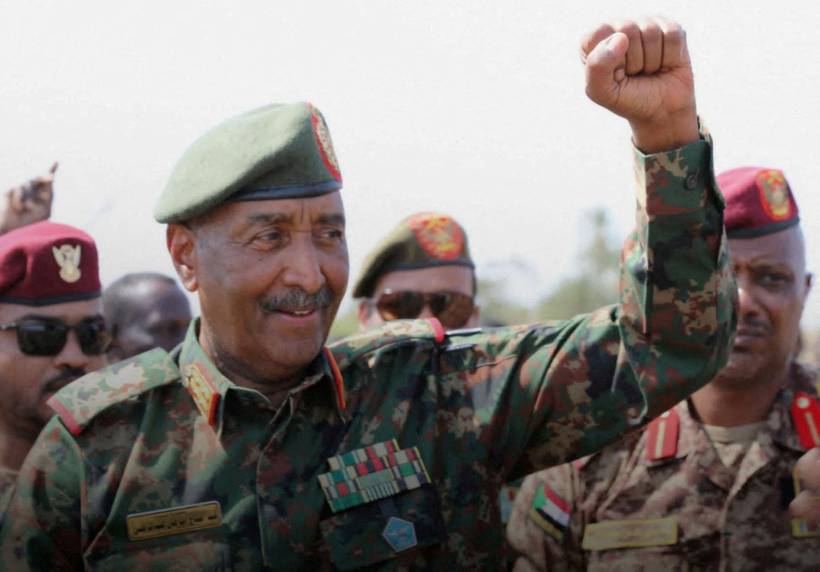
A US envoy attended an event with Sudanese army chief Abdel Fattah al-Burhan in Egypt over the weekend, highlighting Washington’s difficult balancing act as it tries to push Sudan’s warring sides toward a political settlement.
Massad Boulos, US Senior Advisor for Arab and African Affairs, said he attended a lunch hosted by Egyptian President Abdel Fattah al-Sisi alongside Burhan. He said the meeting reaffirmed Washington’s efforts, together with Egypt and other regional and international partners, to advance a political solution to Sudan’s war.
The encounter came less than two weeks after Washington withheld a visa for Burhan ahead of a planned appearance at the United Nations, reportedly in connection with a US-backed ceasefire proposal that Sudan’s army has resisted.
The contrasting moves underline the challenge facing the Trump administration: maintaining pressure on Sudan’s military leadership while keeping channels open with one of the two principal actors in the conflict.
Stay ahead of the geopolitical week.
MD Briefing delivers expert analysis across five global fronts — the Indo-Pacific, energy, geoeconomics, European security, and the Middle East — every Monday morning. Free.
Why Is Washington Talking to Burhan?
The Sudanese Armed Forces and the paramilitary Rapid Support Forces have been fighting since April 2023, when a dispute over the integration of the two forces helped derail Sudan’s planned transition to civilian rule.
Neither side has been able to secure a decisive end to the conflict, while the fighting has created a humanitarian crisis on a massive scale.
More than 14 million people have been displaced, according to humanitarian estimates, while reports of ethnically driven killings and other abuses have intensified international concern.
For Washington, that makes diplomacy difficult but necessary. Any sustainable political settlement will require engagement with the actors capable of influencing the battlefield, even as the United States maintains that neither the army nor the RSF represents legitimate constitutional governance for Sudan.
Boulos said on Monday that the United States was prepared to support efforts toward a comprehensive dialogue among Sudanese political forces and a preliminary roadmap for the country’s future.
Pressure and Engagement at the Same Time
The meeting with Burhan stands out because it followed a clear US pressure tactic.
Washington withheld Burhan’s visa ahead of his planned UN appearance. Sudanese and other sources said the decision was connected to a US-backed ceasefire proposal that the Sudanese army has resisted.
At the same time, the Trump administration has continued to pursue diplomacy involving regional governments, including Egypt.
That combination suggests that Washington is not treating diplomatic engagement with Burhan as recognition of his government as Sudan’s legitimate authority. Instead, it appears aimed at keeping communication open with a central actor in the conflict while attempting to influence his calculations over a ceasefire and eventual political process.
The distinction is important because the United States has explicitly said that neither of Sudan’s two main armed factions represents legitimate constitutional governance.
Egypt’s Role Is Increasingly Important
The meeting also highlights Egypt’s position in efforts to resolve the war.
Cairo has maintained close relations with Sudan’s army and has significant strategic interests in the conflict. Sudan’s instability affects Egypt’s security, border region and broader regional interests.
For Washington, working with Egypt provides a channel to engage Sudan’s military leadership while also involving a regional government with considerable influence over Burhan.
The United States is therefore not attempting to manage the Sudan conflict alone. Its diplomacy increasingly involves regional actors alongside international partners.
The RSF Remains Central to Any Settlement
Any political agreement will also have to address the Rapid Support Forces.
Washington has accused the RSF of committing genocide, while also accusing Sudan’s army of war crimes. Both sides have denied responsibility for abuses.
That creates a particularly difficult diplomatic environment. The United States is trying to promote negotiations between two forces that it has simultaneously accused of serious violations.
A ceasefire could reduce the immediate humanitarian suffering, but a longer-term settlement would have to answer much harder questions about who controls Sudan’s security institutions, how the armed groups are reorganized and what role civilian political forces will play.
Those issues were at the heart of Sudan’s political crisis even before the current war began.
What Happens Next?
The immediate question is whether Washington can turn diplomatic engagement into progress toward a ceasefire.
Boulos’s comments suggest that the United States is seeking a broader political process rather than simply a temporary halt in fighting. But achieving that will depend on whether the Sudanese army and RSF are willing to compromise after more than three years of war.
The Trump administration’s approach now appears to combine pressure, regional diplomacy and direct engagement. The meeting in Egypt shows that Washington is willing to talk to Burhan despite its recent pressure on him.
Whether that produces a meaningful political opening will depend less on the symbolism of the meeting than on whether the United States and its regional partners can persuade Sudan’s warring parties to accept a process that ultimately moves beyond military rule and toward a civilian political settlement.
With information from Reuters.
