


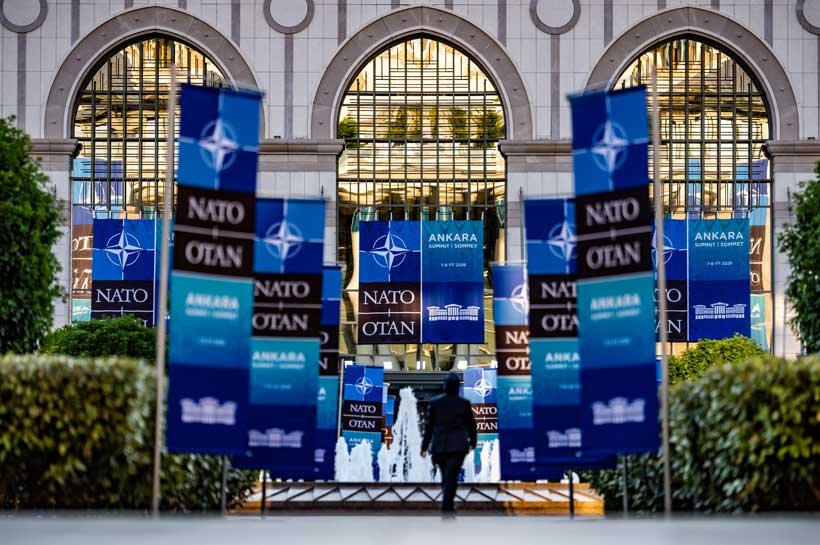
On 12 August, NATO’s ambassadors met in Brussels to respond to a fortnight of Russian drones and missile debris crossing into Polish and Romanian airspace. The Alliance’s statement was unambiguous about responsibility—Russia, it said, “bears full responsibility for the airspace violations, which are dangerous and unacceptable”—and unusually candid about what the incidents signalled: not an accident of war spilling over a border, but “Russia’s increasing tolerance for risk.” (NATO, 12 August 2026)
Five days earlier, the Wall Street Journal had reported that US intelligence now assesses Vladimir Putin may attempt to test NATO’s resolve directly, with a limited attack on an allied state, at some point in the next few years rather than confine himself to grinding attrition in Ukraine. Lithuania’s defense minister was blunter about where: “The Baltic region and Poland are the closest targets.” (Kyiv Independent, 7 August 2026)
Read together, the drones over Tulcea County and the missile fragment that landed sixty kilometers from Lublin are not isolated data points to be filed under “escalation.” They are reconnaissance, and what is being mapped is not radar coverage. It is political will—specifically, the gap between what NATO says it will defend and what its member societies can actually be relied upon to defend.
A calibrated probe, not reckless escalation
Stay ahead of the geopolitical week.
MD Briefing delivers expert analysis across five global fronts — the Indo-Pacific, energy, geoeconomics, European security, and the Middle East — every Monday morning. Free.
The pattern rewards a specific reading. In late July, Romanian forces shot down three Russian drones over national territory in three days, one within 80 kilometers of Bucharest; a Russian ballistic missile fragment fell some 60 kilometers from the Polish city of Lublin. In mid-August, further drones entered Romanian airspace, prompting Romanian F-16 scrambles and a formal Polish protest note to Moscow’s ambassador. None of this triggered consultations under Article 4 of the North Atlantic Treaty, still less an Article 5 response, only a joint statement and a pledge to reinforce integrated air and missile defenses “from the Baltic to the Black Sea.” (NATO statement; Romania Insider)
That restraint is precisely the point. Each incursion is small enough to be deniable, cheap enough to repeat, and reversible enough that no single incident forces the Alliance’s hand, while collectively they generate a running experiment in how NATO actually responds, as opposed to how its treaty and doctrine say it will. Moscow has domestic reasons to be running that experiment now. Ukrainian strikes on Russian energy infrastructure have produced friction at home without translating into meaningful battlefield gains for Kyiv, and Western resupply is visibly strained: allied deliveries of air-defence missiles to Ukraine reportedly fell by two-thirds in early 2026, and US stocks of Patriot and THAAD interceptors are thin. (Kyiv Independent) A Kremlin under pressure to show its population something other than stalemate has an incentive to look for a cheaper win elsewhere.
Systemic incentive, filtered through domestic constraint
This is a structurally rational move on Moscow’s part, and it is also, almost by definition, a neoclassical realist one. Structural realism explains why an adversary probes at all: in an anarchic system, a revisionist power tests wherever the ratio of resolve to capability looks softest, because uncertainty about an opponent’s true resolve is the one variable that can be cheaply discovered before it is expensively tested in war. But structural incentive alone cannot tell you where or when the probe will land, because states do not translate systemic pressure into policy directly. It is filtered—refracted, weakened, or amplified—through unit-level variables: elite cohesion, public appetite for cost, and the domestic politics of the states whose commitment is actually in question. That refraction is what neoclassical realism was built to explain, and it is a more useful explanation than either the systemic story alone (Russia is simply aggressive) or the purely domestic one (Europe is simply divided). Neither survives contact with the evidence on its own; together they describe exactly what is happening over Poland and Romania.
Three domestic fractures are visible from Moscow, and none of them requires a collapse of NATO to matter, only enough visible strain to make the cost of finding out attractive.
The first is European public fatigue, which is real but not uniform, and that ambiguity is itself useful to an adversary. Support for Ukraine has proven more durable than “war fatigue” headlines suggest, but polling across member states shows softening on the specific question that matters most for deterrence: whether taxpayers will keep funding higher defense budgets and open-ended troop commitments. A probe does not need European publics to abandon Ukraine; it only needs enough public and parliamentary hesitation in enough capitals to slow a collective response when speed is what deterrence requires.
The second is the uncertain weight of the American commitment. In May, the Pentagon ordered roughly 5,000 troops withdrawn from Germany as part of a broader force-posture review, with President Trump signalling further reductions and floating cuts to the US presence in Spain and Italy, a decision he tied publicly to frustration with allies who, in his words, had proven “useless” during the Iran crisis. (Time, 3 May 2026) Republican members of Congress warned the move risked “sending the wrong signal to Vladimir Putin” on Ukraine and Eastern European security; the warning is notable precisely because it came from within the administration’s own party. An alliance whose leading member is simultaneously drawing down forces in Europe and reorienting toward the Indo-Pacific is not renouncing Article 5, but it is generating exactly the kind of ambiguity a probe is designed to measure.
The third is geography itself. Poland, Romania, and the Baltic states do not merely sit on NATO’s frontier; they carry a structurally disproportionate share of the Alliance’s exposure, with limited strategic depth and, in the Suwałki Gap, a corridor whose defense depends on reinforcement decisions made in capitals many hundreds of kilometers to the west. The rapid-deployment corps structure NATO has begun building for Estonia and Latvia is a direct acknowledgement of that vulnerability (Modern Diplomacy, 26 May 2026) and an admission that, as matters currently stand, the frontline states cannot be defended fast enough on their own resources alone.
Why the gap is dangerous
None of this means Moscow has concluded NATO would not respond to a genuine incursion. It means Moscow does not yet know, with confidence, how the Alliance would respond and is running a low-cost, incremental experiment to find out before deciding whether a “limited” test is worth attempting. That is the rational core of gray-zone probing: it converts an expensive, high-uncertainty question, such as, would NATO actually fight for the Baltic states? — into a series of cheap, low-uncertainty ones, each of which sharpens the Kremlin’s estimate of the answer.
The danger is not that the gap between declared posture and domestic cohesion exists; alliances have always had one. The danger is that it can be misjudged. A Kremlin that reads European hesitation, American distraction, and Baltic exposure as sufficient grounds for a limited incursion, calibrated to stay below the threshold that would trigger united retaliation, could be wrong about where that threshold actually sits, and the miscalculation would be discovered only after troops had crossed a border, not before.
Closing it
Closing the gap requires more than the reinforcement package NATO announced on 12 August, valuable as integrated air and missile defense upgrades are. Hardware answers a systemic question; the vulnerability being probed is a unit-level one. What would actually raise the cost of testing NATO’s resolve is visible proof that the burden of frontline defense is shared rather than merely promised, collective, alliance-funded reinforcement commitments to Poland, Romania, and the Baltic states that do not depend on the attention span of any single administration, and defense budgets whose durability survives a change of government in Washington, Berlin, or Warsaw alike.
Until that proof exists, the incentive structure favors Moscow continuing exactly what it has been doing since July: not a war, but a survey—conducted one drone, one missile fragment, and one ambiguous NATO statement at a time.
