Vučić’s threat to divert the Ibar River is not a Kosovo policy — it is manufactured leverage aimed at three audiences at once: Brussels, where Serbia’s own accession has stalled while Ukraine and Moldova pull ahead on the EU’s own readiness index; Belgrade’s protest movement, which a nationalist flare-up helps him manage; and the EU’s internal “coupling” dynamic, under which sympathetic member states now tie unlocking Serbia’s frozen Cluster 3 to Ukraine’s accelerating track. It is timed for the exact moment Brussels has the least capacity to respond to a new Balkans crisis — which is what makes it calculated rather than erratic.
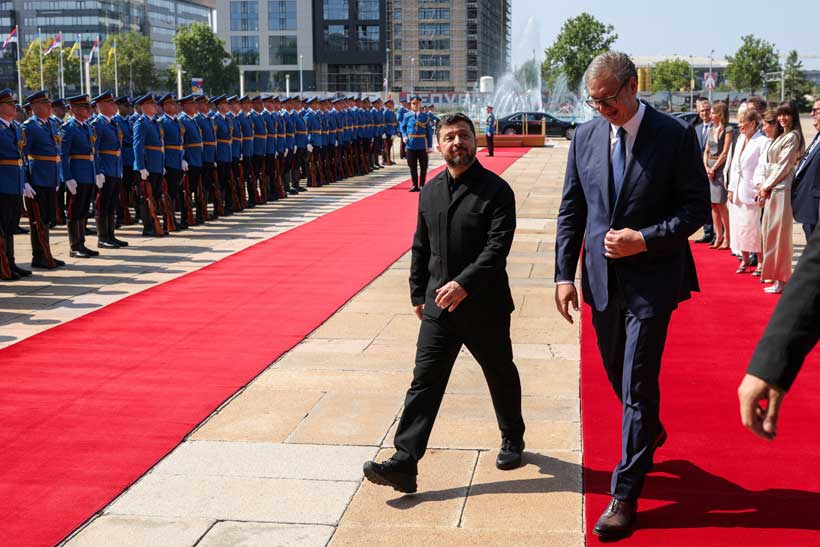
On August 8, Aleksandar Vučić hosted Volodymyr Zelenskyy in Belgrade with the kind of red-carpet pomp usually reserved for a state ally, not a president who has spent three years refusing to sanction Russia. The next day, he announced something stranger: Serbia was consulting engineers about diverting the Ibar River away from Kosovo. “We have various reasons for changing the course of the Ibar,” he said, “and then we will see what the Albanians will do.” No route, no cost, no timeline — just a threat against a shared river, aimed at Pristina, dropped a day after courting the head of state whose country just jumped Serbia in the queue for EU membership. That sequencing is the story, not the river.
THE CONTEXT
The Ibar is a transboundary river governed by international water law, feeding the Gazivode/Ujman reservoir that supplies water, hydropower and irrigation to hundreds of thousands of people across the Serb-majority north of Kosovo and beyond. Diverting it is, by Kosovo Serb opposition figures’ own estimate, close to an engineering impossibility — raising the riverbed roughly 500 meters or boring a 30-kilometer tunnel. Vučić’s threat lands as Serbia’s own EU accession has stalled: on the Commission’s own readiness index, Ukraine (5.85) and Moldova (5.87) now score above Serbia (5.5), despite gaining candidate status only in 2022 against Serbia’s 2012. Eight member states have blocked Belgrade’s long-stuck bid to open Cluster 3, citing rule-of-law backsliding and Serbia’s refusal to align with EU sanctions on Russia — talks that have not meaningfully advanced since December 2021. At home, Vučić is managing the largest protest movement of his rule, sparked by a 2024 railway-canopy collapse and still drawing hundreds of thousands into the streets over corruption and judicial independence.
Stay ahead of the geopolitical week.
MD Briefing delivers expert analysis across five global fronts — the Indo-Pacific, energy, geoeconomics, European security, and the Middle East — every Monday morning. Free.
THE ARGUMENT
Treat the Ibar threat as a single-issue Kosovo story and it looks unhinged: a barely feasible engineering project, announced with no plan, against a river Serbia does not fully control. Treat it as leverage aimed at three separate audiences simultaneously, and it looks calculated.
The first audience is Brussels. Serbia cannot vote on Ukraine’s accession — it is not a member state — but it does not need a vote to benefit from the political mechanics around Ukraine’s progress. EU diplomats have described a live risk that sympathetic capitals, including France, Spain, Italy, Greece and Austria, “couple” Ukraine and Moldova’s accelerating clusters with pressure to finally reopen Serbia’s Cluster 3, on grounds of “geographical balance and equality of treatment.” A Balkans flare-up serious enough to require EU attention is exactly the kind of event that forces that coupling logic into the room. Vučić does not need to out-argue eight blocking member states on rule of law; he needs Serbia to become a problem Brussels cannot table indefinitely while it fast-tracks Kyiv.
The second audience is Belgrade. A Kosovo confrontation is the most reliable tool in Vučić’s domestic kit: it reframes the news cycle around national grievance rather than corruption, and it does so at a moment analysts increasingly expect him to call snap elections before the year is out to outrun the protest movement rather than face it down. Manufacturing an external threat has been a survival tactic for Balkan strongmen long before Vučić; the timing here, arriving as demolitions were already under way at Gazivode itself through June and July, suggests the river threat was layered on top of a dispute already simmering, not invented from nothing.
The third audience is Kosovo and its patrons, and here the objection to this whole reading deserves a direct answer: if the diversion is close to impossible, doesn’t that make the threat empty noise rather than serious leverage? No — because the leverage was never in the engineering, it was in the uncertainty. Kosovo’s institutions had to respond as though the threat were real: acting president Albulena Haxhiu called it a matter for “international community” involvement, and Environment Minister Fitore Pacolli invoked the Helsinki Convention to declare that “water resources cannot be used as an instrument of threat, pressure or destabilisation.” Getting a foreign government to publicly treat your engineering fantasy as a security threat is itself the win. It costs Vučić nothing to say it and forces Pristina, Brussels and NATO’s KFOR mission to spend real attention proving it should be taken seriously enough to condemn.
What makes this particular moment right for the threat is Brussels’ bandwidth, not Belgrade’s water table. The Commission and the member states are simultaneously managing Ukraine’s fast-tracked accession clusters, a bruising fight over using frozen Russian assets to fund Kyiv, and enlargement fatigue across multiple files at once. A Balkans crisis serious enough to need real attention, arriving now, competes for a sliver of institutional capacity that is already spoken for — which is precisely why raising the temperature costs Vučić little and buys him outsized notice.
THE SCENARIOS
Base case (~55%): the threat stays rhetorical through the rest of 2026. No construction begins beyond the demolitions already recorded at Gazivode this summer, but the diplomatic noise nudges the Cluster 3 coupling argument further into the open at this autumn’s EU enlargement discussions, giving Belgrade talking points and a domestic news cycle without giving Kosovo an actual engineering crisis to manage. Vučić periodically revives the threat whenever the protest movement regains momentum or Ukraine’s accession clusters advance again, treating it as a reusable lever rather than a one-off gesture.
Downside case: the demolitions already under way at Gazivode escalate into visible construction activity tied to the diversion claim — survey crews, heavy equipment, or work near the reservoir itself — forcing a genuine security response from Kosovo’s government and KFOR at the precise moment Brussels has the least spare capacity to mediate it. That produces the opposite of Vučić’s intended effect: a crisis serious enough to further freeze Serbia’s own accession prospects, hand Russia a ready-made narrative about Western neglect and instability in the Balkans, and pull sustained EU attention toward Serbia’s own conduct rather than toward unlocking Cluster 3 on Belgrade’s terms.
Upside or alternative case: the coupling dynamic EU diplomats already fear becomes explicit policy — Brussels formally pairs progress on Ukraine’s clusters with reopening Serbia’s Cluster 3, treating regional balance as a genuine commitment rather than a talking point raised by sympathetic capitals. That would lower the temperature on Vučić’s need for confrontation as leverage and give Montenegro and Albania, both further along and quieter about it, a concrete argument that patience is about to be rewarded after all — though critics inside the Commission would rightly note that formalizing the coupling also rewards exactly the kind of brinkmanship the Ibar threat represents.
THE TAKEAWAY
The Ibar River will almost certainly keep flowing where it already flows. What will not stay the same is the pattern this episode confirms: a queue-jumped Balkans candidate has learned that a credible-sounding threat against its neighbor is cheaper and faster than a decade of technocratic reform at extracting Brussels’ attention.
Watch two things in the coming weeks — whether physical work actually begins at Gazivode beyond the demolitions already under way, and whether the European Commission’s next enlargement report, due this autumn, so much as gestures at linking Serbia’s stalled Cluster 3 to Ukraine’s accelerating track. If it does, Vučić’s bet on being a nuisance rather than a reformer will have paid off, and every other candidate still waiting patiently in line will have noticed.