


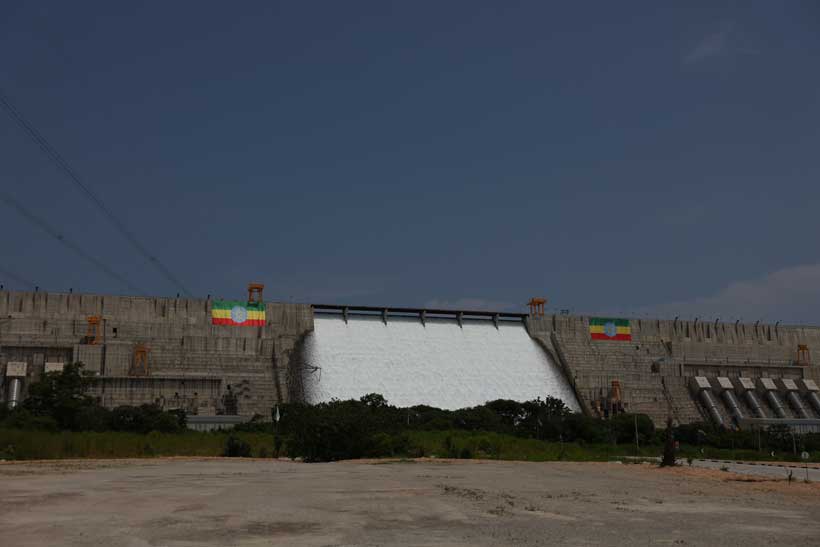
China’s endorsement of Egypt’s right to protect its water and food security marks a significant diplomatic development in the Grand Ethiopian Renaissance Dam (GERD) dispute. It does not amount to a formal rejection of Ethiopia’s dam, but it gives Cairo’s legal and political position greater international visibility. For Addis Ababa, the message is clear: Beijing’s partnership is valuable, but it will not be treated as unconditional support for Ethiopia’s interpretation of sovereignty and development rights.
A joint statement issued during Chinese President Xi Jinping’s visit to Cairo recognized the Nile’s vital importance to Egypt and referred to Cairo’s legitimate right to safeguard its water and food security and development interests. China and Egypt also called on all Nile Basin states to comply with international law, including the obligation not to cause harm. The language did not name Ethiopia or the GERD. Yet its connection to the dispute is unmistakable, particularly because the principle of avoiding significant harm has long been central to Egypt’s argument over the dam’s filling and operation.
A carefully balanced position
China’s position should be understood as calibrated diplomacy rather than a strategic reversal. Beijing has maintained close relations with Egypt, Ethiopia, and Sudan. It has also played an important role in Ethiopia’s infrastructure development and in the wider expansion of the country’s electricity network. Chinese companies have been involved in aspects of the dam’s construction, while Chinese financing has supported transmission infrastructure connected to Ethiopia’s power ambitions. Analysts have therefore described China as an important enabler of the project, even though Beijing has not formally taken Ethiopia’s side in the dispute. In contract, Ethiopia maintains a firm position that the GERD is a nationally owned project built by Ethiopians, with foreign involvement limited to specific technical components.
Stay ahead of the geopolitical week.
MD Briefing delivers expert analysis across five global fronts — the Indo-Pacific, energy, geoeconomics, European security, and the Middle East — every Monday morning. Free.
However, China has repeatedly avoided endorsing unilateral action by any party. During a United Nations Security Council discussion in 2021, China called for Egypt, Ethiopia, and Sudan to resume dialogue and consultation. Its representative, Zhang Jun, argued that the dam could become a tripartite development project that enhances mutual trust and produces mutually beneficial results. This approach reflects Beijing’s broader preference for sovereignty, negotiation, and non-interference, while leaving room to protect its economic and diplomatic interests.
The recent statement with Egypt narrows Ethiopia’s diplomatic space without closing it. China did not endorse Cairo’s demand for a specific binding operating agreement. Nor did it declare that Ethiopia had violated international law. Instead, Beijing accepted principles that can be used by Egypt in future diplomatic and legal discussions. This distinction matters. Diplomatic statements often influence negotiations not by settling disputes, but by changing the political costs of particular positions.
Why the wording matters
For Egypt, the statement represents a symbolic and diplomatic achievement. Cairo has sought to frame the Nile not only as a development resource but also as a matter of national survival. By recognizing the river as Egypt’s principal lifeline, China has acknowledged the importance of Egypt’s vulnerability in a language that carries considerable political weight. The statement also links water security to food security and development. That broader framing strengthens Egypt’s effort to present the dispute as an international concern rather than a disagreement confined to three riparian states.
The reference to the obligation not to cause harm is especially important. International water law requires equitable and reasonable utilization of shared watercourses, while also requiring states to take appropriate measures to prevent significant transboundary harm. These principles must be applied together. Egypt cannot reasonably demand that upstream development cease indefinitely. Ethiopia cannot reasonably assume that its status as an upstream state removes its responsibility to account for downstream effects. The central question is therefore how the principles should be operationalized through data exchange, drought rules, dispute settlement, and coordinated dam management.
China’s endorsement may also encourage Egypt to seek similar language from other external partners. If Cairo can translate a bilateral statement with Beijing into wider diplomatic support, Ethiopia may face greater pressure in multilateral forums. The risk is not that China will impose a settlement. The greater risk is that the dispute will become increasingly internationalised without producing the technical arrangements needed to manage the river.
The message for Addis Ababa
Ethiopia should resist interpreting the Chinese statement as a hostile alignment with Egypt. Such a reading could encourage a counterproductive diplomatic response. Addis Ababa still has strong grounds to insist on its right to pursue hydropower and economic development. Ethiopia’s argument is reinforced by the fact that the Blue Nile originates within its territory, while much of the country’s population has historically lacked reliable access to electricity. The GERD is presented domestically as a national development project and a symbol of political sovereignty.
However, Ethiopia should also recognise that development rights are most defensible when accompanied by credible safeguards. The dam’s completion does not end the dispute. Longterm stability will depend on the rules governing operation during prolonged drought, the exchange of hydrological information, the coordination of releases with Sudanese infrastructure and mechanisms for addressing unexpected impacts. Without such arrangements, each side can portray ordinary operational uncertainty as evidence of bad faith.
The appropriate Ethiopian response would therefore combine diplomatic firmness with institutional flexibility. Addis Ababa could reaffirm that it rejects the use of the dam as a tool of political coercion, while proposing a strengthened technical mechanism involving the three countries. Such a mechanism should have transparent procedures, regular information sharing, and a clear process for emergency consultation. It should protect Ethiopia’s ability to generate electricity while providing downstream states with predictable information about releases and exceptional conditions.
Ethiopia should also distinguish between sovereignty and unilateralism. Sovereignty gives a state authority over its territory and resources. It does not eliminate the duties that arise when a project affects a shared international watercourse. Accepting this distinction would not surrender Ethiopia’s legal position. It would demonstrate that Addis Ababa understands power in contemporary diplomacy as the ability to make national interests compatible with regional legitimacy.
China’s wider strategic calculation
China’s policy is shaped by more than the technical details of the dam. Egypt controls the Suez Canal, a major artery for global commerce and a strategic link between Asia, Europe and Africa. Ethiopia is one of China’s most important partners in the Horn of Africa and has been a major destination for Chinese infrastructure engagement. Sudan, despite its devastating conflict, remains relevant to Red Sea security and the regional balance. Beijing therefore has strong reasons to prevent the Nile dispute from damaging its relations with any of the three states.
The Chinese position also reflects a broader concern about the politics of infrastructure. China has financed and built dams in many regions, making water projects part of its international economic presence. It cannot appear indifferent to downstream risks, especially when its partners use Chinese technology and finance for projects with regional consequences. At the same time, Beijing is unlikely to support principles that would create a broad international precedent for external intervention in sovereign infrastructure decisions.
This explains the careful wording of the statement. China recognizes Egypt’s concerns, invokes international law, and avoids assigning blame. It supports dialogue but does not offer itself as the principal mediator. It preserves relations with Ethiopia while responding to Egypt’s concerns. In strategic terms, Beijing is managing exposure rather than choosing a side.
From endorsement to negotiation
The most important question is whether the statement will produce diplomatic movement. It will do so only if the parties treat it as an incentive for negotiation rather than as a certificate of victory. Egypt should avoid presenting China’s language as proof that Ethiopia has already been condemned. Ethiopia should avoid treating the statement as evidence that China has abandoned its partnership. Both interpretations would reduce the space for compromise.
A workable arrangement should focus on predictable conduct rather than historical rhetoric. It should establish procedures for drought periods, require timely data exchange, and create a standing channel for technical consultation. Sudan’s interests must be fully included. Although the most visible disagreement is between Egypt and Ethiopia, Sudan is both a downstream state and a country with its own dams, agricultural needs, and security concerns.
The African Union remains the most legitimate institutional setting for such work. External powers can provide technical expertise and diplomatic support, but an agreement imposed or shaped primarily by outside actors could deepen the perception that African water governance is being decided elsewhere. China’s support for an African led process in the earlier phase of the dispute offers a useful foundation for this approach.
China’s water security endorsement is therefore best understood as a warning and an opportunity. It warns Ethiopia that its development agenda will be judged through the lens of downstream security and international law. It offers Addis Ababa an opportunity to show that hydropower sovereignty can coexist with responsible transboundary governance.
Between the two Niles, diplomacy cannot be sustained by symbolic declarations alone. Egypt needs reassurance, Ethiopia needs development, and Sudan needs security. China’s latest statement has altered the diplomatic atmosphere, but it has not resolved the underlying problem. The next stage must convert carefully chosen principles into practical rules. Only then can the GERD become what China once described it as: not a source of permanent rivalry, but a foundation for shared development.
