


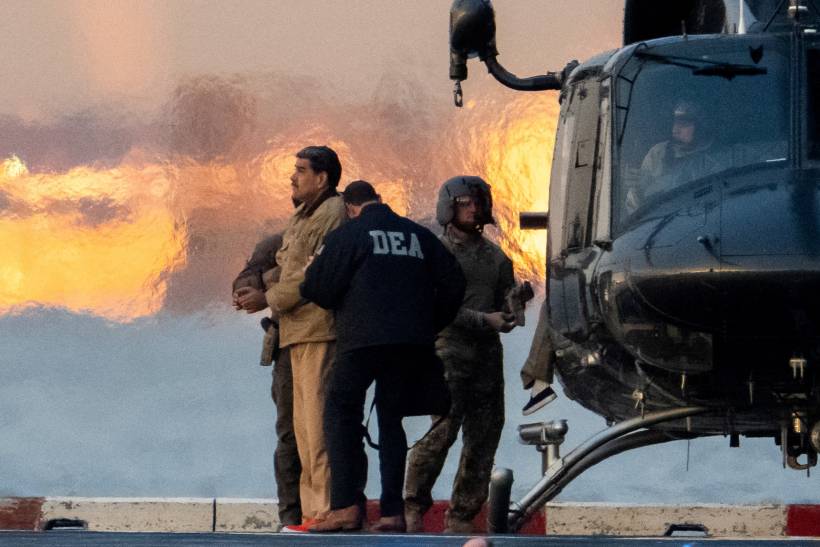
The prosecution of ousted Venezuelan President Nicolás Maduro is set to test how US courts apply international law in criminal cases involving foreign leaders and defendants captured abroad. Maduro, who has pleaded not guilty to drug trafficking charges, is expected to argue that his prosecution violates principles of sovereign immunity and the US Venezuela extradition treaty.
Maduro Challenges US Prosecution
Maduro’s lawyer is expected to ask a Manhattan federal court to dismiss the case, arguing that Maduro is protected by head of state immunity and questioning the legality of his capture during a US military raid in Venezuela.
The case presents an unusual legal situation because US courts rarely deal with criminal prosecutions involving foreign heads of state who have been forcibly brought into the country.
Sovereign Immunity at the Centre
International law generally provides sitting heads of state with protection from prosecution in foreign courts. Maduro is therefore expected to argue that his position as Venezuela’s legitimate president should shield him from the US case.
Stay ahead of the geopolitical week.
MD Briefing delivers expert analysis across five global fronts — the Indo-Pacific, energy, geoeconomics, European security, and the Middle East — every Monday morning. Free.
However, the US has not recognised Maduro as Venezuela’s president since 2019. Washington rejected his 2018 election as fraudulent and also disputed his claim to victory in the 2024 election.
US courts have traditionally given significant weight to the executive branch when determining whether a foreign leader is recognised as a head of state.
The Noriega Precedent
One of the most important precedents is the case of former Panamanian leader Manuel Noriega, who was captured by US forces and brought to the United States to face drug trafficking charges.
Noriega unsuccessfully claimed head of state immunity. A federal judge rejected the argument partly because he had never officially held the title of president.
Maduro’s situation differs because he was internationally recognised as Venezuela’s president for years, making the question of his legal status more complicated.
Does Venezuela Support Maduro’s Immunity?
Another important issue could be the position of Venezuela’s current government under Delcy Rodriguez.
Rodriguez’s government previously described Maduro as Venezuela’s rightful president and demanded his return. However, its more recent cooperation with the Trump administration could complicate any attempt by Maduro to rely on Venezuela’s support for his immunity claim.
The Extradition Treaty Argument
Maduro is also expected to challenge the legality of his capture under the US Venezuela extradition treaty.
The treaty establishes procedures through which the two countries can formally request the surrender of fugitives. Maduro could argue that the United States bypassed those procedures by using military force to bring him to the country.
However, longstanding US legal precedent makes this argument difficult.
The Male Captus Doctrine
US courts have repeatedly held that the circumstances under which a defendant is brought into the country do not necessarily prevent prosecution.
The principle dates back to an 1886 Supreme Court case involving a bank clerk who fled to Peru after stealing money and was captured by a private detective.
The doctrine was reinforced in 1992, when the Supreme Court allowed the prosecution of a Mexican doctor who had been kidnapped and brought to the United States to face drug related charges.
The principle is commonly described by the Latin phrase “male captus, bene detentus”, meaning that even if someone was improperly captured, they can still be properly detained and prosecuted.
Why the Case Matters Beyond Maduro
The case raises a broader question about the relationship between international law and US criminal jurisdiction.
US courts have historically been reluctant to dismiss criminal cases simply because international law, extradition arrangements or the circumstances of a defendant’s capture have been violated.
That approach gives US prosecutors considerable room to pursue defendants who are brought into American jurisdiction through controversial means.
International Law vs US Jurisdiction
The central legal tension is therefore between two principles: international law’s protection of sovereign officials and the US judiciary’s longstanding refusal to treat unlawful capture as an automatic bar to criminal prosecution.
Maduro’s lawyers will attempt to connect both principles to argue that the prosecution itself is illegitimate.
Prosecutors, meanwhile, are likely to argue that Maduro’s lack of US recognition as Venezuela’s president removes the immunity issue and that the legality of his capture does not determine whether he can be tried.
Analysis
Maduro’s legal challenge is unlikely to succeed easily because US precedent generally gives prosecutors a strong advantage when defendants argue that the circumstances of their capture violated international law.
The more significant issue is sovereign immunity. Maduro’s lawyers need to establish that he qualifies as a foreign head of state for purposes of US law, despite Washington’s longstanding refusal to recognise him as Venezuela’s legitimate president. That makes the political position of the US executive branch particularly important.
The case also exposes a tension between international legal norms and domestic judicial practice. International law places considerable importance on sovereign equality and the protection of foreign leaders, while US courts have repeatedly prioritised their own jurisdiction once a defendant is physically before them.
Even if Maduro loses, however, the case could have consequences beyond the courtroom. As one former Justice Department lawyer noted, bypassing extradition procedures may weaken the practical value of treaties designed to regulate the transfer of suspects between states.
Ultimately, the Maduro case could reinforce a longstanding US position: violations of international law may create diplomatic and political consequences without necessarily preventing a criminal prosecution in US courts.
With information from Reuters.
