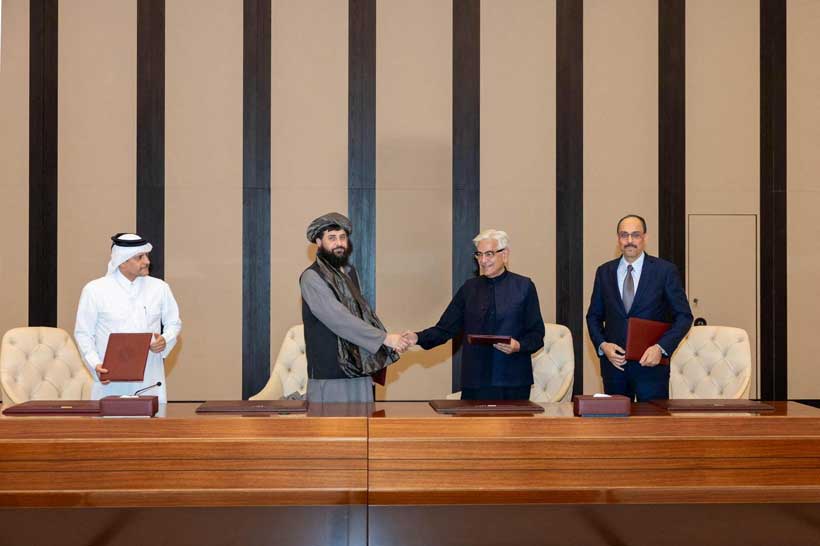
The ceasefire between Pakistan and Afghanistan resembles a ghost. It exists on paper but peace remains missing on the ground. Along the Durand Line, a 19th century colonial cartograph that Afghanistan has historically disputed, mistrust continues to deepen. Pakistan sees militant sanctuaries across the frontier as a direct threat to its national security. On the other hand, Kabul sees Pakistani strikes inside Afghanistan as violations of its sovereignty. Between these competing positions sits an unusually crowded diplomatic table. Riyadh, Doha, Ankara and Beijing have all tried to prevent another major confrontation. Their interventions have reduced tensions at critical moments but they have failed to remove the causes of the conflict. Therefore,the problem is the absence of one clear and enforceable security bargain.
The present diplomatic process took shape after serious border skirmishes in October 2025. Türkiye and Qatar helped broker a ceasefire in Doha, while later negotiations in Istanbul tried to strengthen it. The Istanbul process even proposed a monitoring and verification mechanism. Yet, the basic disagreement remained unresolved. Pakistan and Afghanistan do not fully agree on what constitutes a ceasefire violation. For Kabul, a ceasefire mainly means that Afghan and Pakistani forces should stop attacking each other. Islamabad takes a broader view. Pakistan argues that attacks carried out by the Tehreek-e-Taliban Pakistan (TTP) from Afghan territory are also violations of the security understanding. Two armies can be ordered to stop firing. A militant network operating across a difficult frontier cannot be controlled so easily.
This makes the TTP the heart of the deadlock. Islamabad wants visible and verifiable Afghan action against militants, which operate from Afghan soil. Kabul rejects the allegation that it shelters the TTP and argues that Pakistan should address its own internal security problems. This disagreement creates a dangerous cycle. Every major militant attack increases pressure on Islamabad to respond. Pakistani military action then strengthens Kabul’s argument that its sovereignty is under attack. One side sees Afghan inaction as a threat to national security, while the other sees Pakistani action as a threat to territorial sovereignty.
The Taliban government also faces a difficult internal calculation. The Afghan Taliban and the TTP are separate organisations but they share historical and ideological links. A sweeping crackdown on the TTP could create political and security problems for Kabul. Pakistan faces the opposite pressure. Continued terrorist attacks make strategic patience increasingly difficult to defend at home. Therefore, neither government finds the concession demanded by the other politically easy.
Stay ahead of the geopolitical week.
MD Briefing delivers expert analysis across five global fronts — the Indo-Pacific, energy, geoeconomics, European security, and the Middle East — every Monday morning. Free.
The growing relationship between Afghanistan and India has added another layer of mistrust. India has expanded its engagement with the Taliban government since 2025. Afghan Foreign Minister Amir Khan Muttaqi visited New Delhi in October that year, while India announced the reopening of its embassy in Kabul. The two sides have also sought stronger trade ties and greater use of Iran’s Chabahar Port. For Kabul, such engagement provides investment, diplomatic space and alternative trade routes. However, for Islamabad India Afghanistan nexus is viewed through the wider lens of its rivalry with New Delhi.
Pakistan has also publicly accused India of supporting militant groups operating from Afghan territory. These claims remain Pakistani allegations rather than independently established facts but their political importance cannot be ignored. The perception of an Afghanistan India nexus deepens Pakistan’s fear of strategic encirclement. It also makes mediation harder because the conflict is no longer viewed only as a dispute over the TTP. It begins to morph into part of the wider regional competition between Pakistan and India. At the same time, Kabul is unlikely to accept any Pakistani attempt to determine its relations with New Delhi. Hence, a mediator must address Pakistan’s security concerns without turning Afghan foreign policy into another subject of negotiation.
The presence of four mediators should, in theory, improve the chances of compromise. In practice, it can dilute diplomatic pressure. Qatar has valuable access to the Taliban leadership and a long history of facilitating negotiations. Türkiye has relations with both sides and experience in regional diplomacy. Saudi Arabia possesses financial influence and religious soft power. China has the strongest combination of economic and strategic leverage. Yet, these strengths have not been fully orchestrated through one framework.
Instead, different diplomatic channels have often addressed different parts of the crisis. One may concentrate on ending immediate hostilities, another on political dialogue, another on economic incentives and another on counterterrorism. This creates a diluted pressure problem. When pressure grows in one channel, either side can wait for another diplomatic initiative. Difficult concessions can be delayed while responsibility for the settlement is spread among several actors. The result is a crowded table where everyone has influence but no one fully owns the peace process.
Still, describing the four mediators as complete failures would be unfair. Türkiye and Qatar helped establish the 2025 ceasefire. Saudi Arabia and other regional actors supported later efforts to calm hostilities. China subsequently brought Pakistani and Afghan representatives back to negotiations in Urumqi in 2026. These interventions have prevented periods of confrontation from turning into uninterrupted interstate war. Their failure is more precise. They have succeeded at conflict management but not at conflict resolution.
Breaking the deadlock will require concessions from Islamabad and Kabul. Pakistan cannot realistically expect Afghanistan to eliminate the TTP overnight. Instead, it should demand measurable steps. These could include restrictions on militant movement, action against identified facilities, disruption of financing, intelligence sharing and measures to prevent cross border infiltration. If Kabul accepts a credible verification mechanism, Islamabad should correspondingly reduce unilateral military action. Airstrikes may eliminate individual targets but they also generate anger inside Afghanistan and allow the Taliban to shift the debate from militancy to sovereignty. Therefore, Pakistan must exchange some coercion for conditional restraint.
Kabul must make an equally difficult adjustment. It does not have to accept every Pakistani allegation but categorical denial cannot become a permanent security policy. Independent verification offers a way out. If Afghan territory is not being used against Pakistan, verification should strengthen Kabul’s case. If militant networks are found, Afghanistan should act against them. Such a mechanism could be jointly designed by Pakistan, Afghanistan and an agreed mediator. Kabul would not surrender sovereignty. Instead, it would demonstrate that sovereignty also carries responsibility for preventing national territory from being used against another state.
Among the four mediators, China appears best placed to lead such a framework. Beijing has deep economic and strategic ties with Pakistan while steadily expanding its engagement with Afghanistan. It also has direct interests in regional stability, connectivity and the security of Chinese personnel and investments. The Urumqi negotiations demonstrated that China can bring both sides back to the table. But Beijing should not simply become another voice in an already crowded room. China could act as the lead coordinator, while Qatar provides diplomatic access, Türkiye supports technical negotiations and Saudi Arabia supplies economic incentives. In this way, four competing channels could become a division of diplomatic labour.
Pakistan and Afghanistan ultimately do not need another temporary promise to stop firing. They need rules for what happens after the guns fall silent. A durable agreement must define a violation, establish a credible verification mechanism, demand measurable Afghan action against militant networks and require corresponding Pakistani restraint. Economic and trade incentives should make compliance more rewarding than confrontation. The India factor must also be managed carefully. Pakistan cannot reasonably expect Kabul to abandon relations with New Delhi, while Kabul cannot ignore how regional rivalries intensify Pakistan’s security fears. Riyadh, Doha, Ankara and Beijing have kept diplomacy alive but diplomacy has become better at interrupting crises than preventing their return. The crowded table does not need another chair. It needs one framework, one verification mechanism and one lead mediator. Until that happens, the ceasefire will remain less a road to peace than an interval between crises.