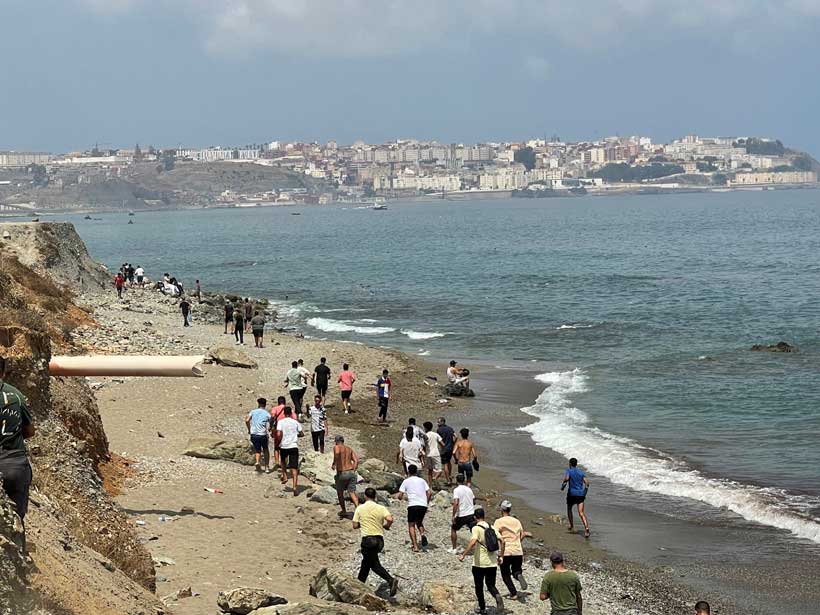
The recent mass irregular migration incident in Ceuta should be seen as more than a border security issue. It is a significant test of the current relationship between Morocco and Spain—two neighboring states whose interests are increasingly entangled across migration, trade, security, energy, investment, and regional geopolitics.
Ceuta occupies a unique and complex position in regional relations. As a Spanish territory, it also serves as an external border of the European Union, while being geographically located within Moroccan territory. This layered situation transforms it from a simple migration crossing into a critical geopolitical hub—where European border policies, Moroccan sovereignty, African migration patterns, and bilateral diplomacy all converge.
The current incident highlights an important impasse, but what really matters is what it reveals about the political relationship between Morocco and Spain. It shows that migration still remains one of the few quick ways to turn a cooperative relationship between two states into a security crisis. At the same time, it explains why neither Madrid nor Rabat wants this kind of crisis to become a lasting split in their ties.
The core point of this impasse is that Ceuta reveals a paradox of strategic interdependence: as Morocco and Spain grow closer economically and diplomatically, the potential costs of instability increase for both nations. However, this very interdependence also creates the possibility that migration could be used as a bargaining chip.
Stay ahead of the geopolitical week.
MD Briefing delivers expert analysis across five global fronts — the Indo-Pacific, energy, geoeconomics, European security, and the Middle East — every Monday morning. Free.
Beyond the common perspective of a ‘migration crisis,’ the key mistake is to see the Ceuta incident only as an immigration problem. While irregular migration is an important factor, it’s essential to understand this event in the broader context of border security and infrastructure. Morocco has gradually become a significant hub for transit, destination, and asylum in the Western Mediterranean and Atlantic migration routes. According to UNHCR, by March 2026, Morocco had registered over 23,000 refugees and asylum seekers, highlighting its shift from mainly a transit country to an essential migration management center.
At the same time, Spain has increased cooperation with Morocco to manage migration before migrants reach Spanish territory. In 2025, Spain saw 36,775 arrivals by sea and land, a 43% decrease from the previous year. However, UNHCR warns that fewer arrivals don’t mean fewer protection needs; instead, migratory routes may be becoming more risky. This shows the complex, evolving nature of migration in the region and the importance of understanding these shifts beyond simplified crisis narratives.
This point is critical from a human perspective. While border control can limit visible arrivals, it doesn’t address the deeper forces driving migration. Economic inequality, youth unemployment, regional instability, conflicts in the Sahel, and perceptions of better opportunities in Europe continue to create significant pressure on people to move.
The case at Ceuta, a critical safety gateway in the regional system, highlights how quickly pressure can surge at a single frontier between Europe and Africa. Rather than viewing this incident as merely a spontaneous act by individuals, it’s more insightful to see it as the product of three interconnected factors: people’s strong desire to migrate, the influence of information networks, and a temporary or perhaps lasting weakening of border controls.
However, this does not imply that the Moroccan government intentionally facilitated the crossing. To make such a claim, we would need more than evidence of a large-scale movement. A thorough analysis must distinguish among official policies, administrative actions, local conditions, organized smuggling, and migrants’ perceptions. Recognizing these divergences is essential to truly understanding the dynamics at play in Morocco.
Given Morocco’s strategic location, it’s impressive how its relationship with Spain has transformed over the past decade. What once seemed like frequent disagreements now appears to be evolving into a more meaningful and strategic partnership. In April 2025, Spain openly described their ties as “excellent” and highlighted progress under their bilateral roadmap, which includes efforts on migration, circular migration, and joint efforts to combat irregular migration networks. The relationship was also strengthened during the December 2025 high-level meeting, where 14 cooperation agreements were signed, covering sectors such as digitalization, cybersecurity, climate change, and the energy transition. This shift suggests a growing mutual trust and a shared interest in cooperation that goes beyond traditional diplomacy.
This development presents a notable strategic dilemma. Spain depends on Morocco because Rabat acts as a key gateway between Africa and Europe. At the same time, Morocco is not only reliant on Spain. Over time, Rabat has diversified its international relationships, working with the European Union, the United States, China, Gulf nations, and various African countries. This gives Morocco a stronger bargaining position, unlike a state that depends predominantly on a single European ally.
Understanding migration cooperation as part of a larger web of strategic interdependence helps clarify the situation. It’s not just about Spain paying Morocco to restrain migration. During crises, this distinction is crucial. If Madrid perceives every migrant surge as Moroccan coercion, it risks turning a manageable bilateral issue into a geopolitical clash. On the other hand, if Rabat politicizes border management too much, it could jeopardize one of its most significant European partnerships.
The European crisis exposes a major flaw in its migration strategy. The EU relies increasingly on countries outside its borders to manage migration before individuals arrive on European soil. Morocco has shifted from merely being Spain’s neighbor to becoming a vital partner in Europe’s external migration control. This strategy effectively pushes Europe’s border enforcement beyond its physical boundaries, making parts of European security dependent on external jurisdictions. While this curbs illegal crossings before migrants reach Europe, it also means that Europe’s safety depends heavily on the political stability and cooperation of neighboring states.
As I noted, Ceuta clearly highlights the pitfalls of this model. The takeaway for the EU isn’t just about building higher fences; it’s about recognizing that physical barriers alone won’t fix a political relationship rooted in mutual dependence. A smarter, more sustainable approach would combine border security with legal channels for mobility, development aid, labor migration, and coordinated asylum processes. One promising idea is to expand circular migration programs. For example, the WAFIRA II program, supported by the EU and launched by Morocco, Spain, and France in 2025, aims to promote safer, more organized seasonal migration, involving around 3,000 Moroccan workers. These programs are important because they help a country distinguish between controlling movement and fighting illegal migration.
To that end, this incident in Ceuta highlights the complex and delicate relationship between Morocco and Spain, emphasizing how migration, territory, and diplomacy are deeply intertwined. Ceuta is more than just a border; it’s a strategic hotspot that reflects broader regional tensions. The challenge lies in managing migration in a way that avoids escalating conflicts by establishing legal pathways, cracking down on smuggling, and keeping migration issues separate from political disputes. Morocco seeks to be seen as a dependable partner to Europe without sacrificing its independence, while Spain recognizes that relying solely on neighboring states for border security carries political costs. Moving forward, how both countries interpret incidents like this will shape their future cooperation. Seeing Ceuta as a security threat could fuel conflict, but viewing it as a sign of mutual dependence could open opportunities to strengthen border management and strategic ties. Ultimately, the key takeaway is that Morocco and Spain are becoming increasingly connected, and turning this interdependence into formal cooperation is crucial for stability and progress.