


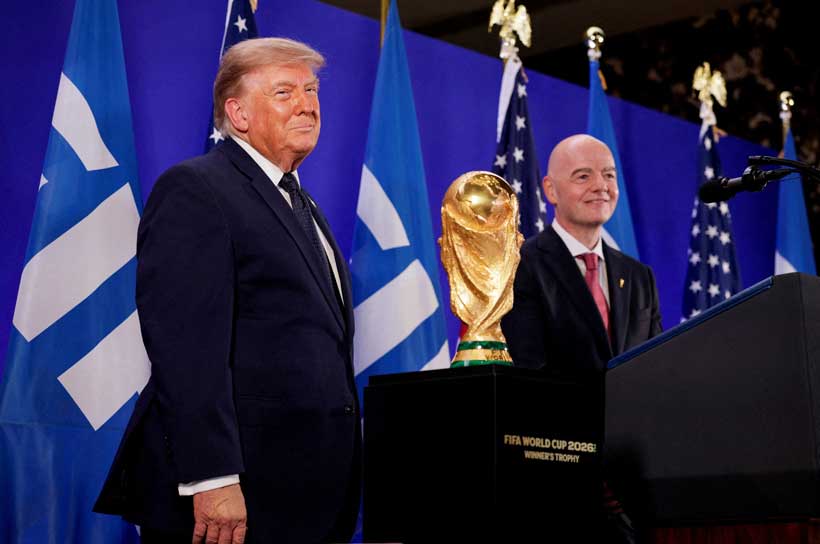
FIFA has now abandoned its controversial plan to sell a stake in World Cup commercial rights, after opposition from Europe and other football confederations turned what appeared to be an investment dispute into a wider challenge to Gianni Infantino’s leadership. There was a time when FIFA threatened governments with suspension under the banner of “keeping politics out of football.” Political interference in the game was treated as a red line. Today, however, FIFA itself is at the centre of an increasingly political controversy. Personal ties between Infantino and Donald Trump, business links with individuals close to the Trump family, and the revolt over the investment plan have raised an uncomfortable question: Is the world’s most powerful sports organisation still an independent governing body, or has it become too closely entangled with political influence and financial power in the United States? The answer could also make the outcome of the U.S. midterm elections consequential for FIFA’s president.
Following the sweeping corruption scandals of the previous decade, FIFA sought to rebuild its image as a transparent, independent institution standing above politics. Gianni Infantino’s election was presented as part of that effort—a leader tasked with restoring the organisation’s damaged credibility. Yet the trajectory of the past decade tells a different story. Infantino has increasingly relied on personal relationships with political leaders as a governing strategy, appearing alongside heads of state, attending high-level political gatherings, and participating in government initiatives. Among all of these relationships, none has attracted more scrutiny than his relationship with Trump. Infantino has repeatedly appeared alongside the president, attended official White House events, and remained highly visible beside him during the 2026 World Cup.
At the centre of the controversy was the plan to sell a stake in the commercial rights and future revenues of the FIFA World Cup to an investment group led by Joshua Kushner, the brother of Jared Kushner—the husband of Ivanka Trump. At first glance, the transaction might have appeared to be nothing more than a commercial investment. In practice, however, its implications extended far beyond ordinary financial management. The FIFA World Cup is the organisation’s most valuable commercial asset, generating billions of dollars through broadcasting rights, sponsorships, advertising, licensing, and global marketing. Transferring a portion of those interests to investors linked to the president’s extended family created the perception that one of global football’s most important assets was being drawn into a political and financial network close to Washington. For many football associations, this was not merely an economic decision but a political one.
Europe’s response was swift and unusually forceful. European football associations openly opposed the proposal and raised the prospect of boycotting FIFA competitions. Opposition was not confined to Europe: CONCACAF and the Asian Football Confederation also rejected the plan. Faced with the widening resistance, Infantino ultimately withdrew the proposal. That decision ended the immediate dispute over the investment, but it did not erase the broader questions the episode had raised about FIFA’s leadership and its growing dependence on personal political relationships.
Stay ahead of the geopolitical week.
MD Briefing delivers expert analysis across five global fronts — the Indo-Pacific, energy, geoeconomics, European security, and the Middle East — every Monday morning. Free.
The U.S. political dimension has also changed since the controversy began. House Judiciary Committee Democrats have already opened an investigation into Infantino’s relationship with the Trump administration. That makes the midterm elections relevant in a different way from when the dispute first emerged. If Democrats gain control of Congress, existing scrutiny of Trump’s political and business network could acquire greater institutional weight. Under such circumstances, Infantino’s close relationship with Trump could become a significant liability, particularly because the controversy now combines political ties with commercial dealings involving investors close to the president’s family. For a FIFA president preparing for another leadership contest, that scrutiny could carry considerable political costs.
Ultimately, what is unfolding is not simply a debate over a commercial agreement but a broader protest against a system in which the governance of world football has become increasingly dependent on personal political relationships. FIFA’s statutes require member associations to manage their affairs independently and without undue influence from third parties. That principle has repeatedly served as the basis for suspending national federations when governments or outside actors interfere in their administration. The rule does not prohibit the FIFA president from maintaining relationships with political leaders, but the contrast remains difficult to ignore. Critics therefore ask a simple question: if FIFA insists on institutional independence from outside power among its members, how close can its own leadership become to political power before that principle loses credibility?
Today, Gianni Infantino’s political future appears less dependent on football alone than on developments surrounding FIFA and American domestic politics. The abandoned investment plan, the opposition from major confederations, and the congressional investigation have brought his ties to Trump under a level of scrutiny that did not exist when those relationships were largely treated as an advantage. If the U.S. midterm elections alter the balance of power in Congress, that scrutiny could expand from the political relationship itself to the commercial arrangements connected to the president’s extended family.
The current controversy also exposes a broader reality already at the heart of this dispute: the boundaries separating sport, politics, and global capitalism are becoming increasingly blurred. FIFA once insisted that football should remain separate from politics. Today, the more pressing question is whether politics has remained separate from football. When the governance of a global institution relies less on transparency, accountability, and the collective will of its members than on personal relationships with political power, its legitimacy is inevitably put at risk. FIFA’s greatest challenge may no longer be simply organising another successful World Cup. It may be proving that football still belongs to the world—not to a small circle of politicians, investors, and political power brokers.
