


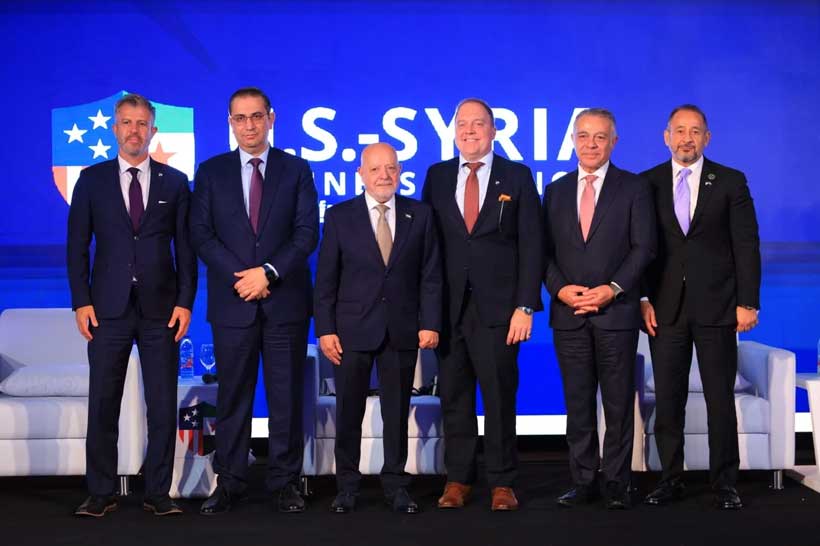
“Economic statecraft is not self-sustaining.” That is the wager embedded in America’s Syria policy, and the first Syrian-American business forum held on July 13, 2026, at the Dama Rose Hotel is where the wager became visible.
American and Syrian officials, business leaders, and investors gathered in Damascus for the first Syrian-American Business Forum, planned by the Ministry of Economy and Industry and the Syrian-American Business Council jointly. The event on its surface was about investment climate, banking integration, and reform priorities, the standard fare of post-conflict business diplomacy. However, when read against the trajectory of the past year and a half, the forum is better understood as an indicator of something larger, the consolidation of a new U.S. approach to Syria in which sanctions and isolation have been replaced by investment, reconstruction finance, and private sector access as the principal instruments of U.S. policy. The forum did not create this shift; rather, it ratified the shift. Understanding what made Washington make this pivot, what it is meant to achieve, and whether it can succeed requires situating the event within the wider logic of economic statecraft, the characteristic feature of the Trump administration’s approach to the post-Assad Syria.
The making of a policy reversal
The policy of the U.S. toward Damascus rested on comprehensive sanctions for nearly two decades, concluding in the 2019 Caesar Syria Civilian Protection Act, according to which secondary sanctions can be imposed on any entity, American or non-American, that engaged substantially with the Syrian state. In its purest form this was coercive isolation: an attempt to deny the Assad government resources or legitimacy by cutting Syria off from the international finance system. The policy was based on the premise that the targeted actor would continue to exist and remain in power. The collapse of the Assad regime in December 2024, after Hayat Tahrir al-Sham’s offensive, the premise disappeared, and with it goes the strategic logic of maintaining an architecture built to punish a government that no longer existed. In a deliberate sequence proceeded the dismantling of that architecture. General license 25 was issued by the Treasury’s Office of Foreign Assets Control on 23 May 2025, allowing transactions with the transitional government, its central bank, and state-owned enterprises, paired with a 180-day State Department waiver of Caesar Act sanctions. President Donald Trump, on June 30, 2025, signed an Executive Order 14312, terminating the Syria sanctions program outright and removing 518 individuals and entities from Treasury’s sanctions list, at the same time preserving sanctions authority against the officials of the Assad period, human rights abusers, and Captagon traffickers. In FY2026 the Congress itself repealed the Caesar Act and National Defense Authorization Act, removing the statutory threat of secondary sanctions that had continued to prevent banks and firms even after executive relief. On 8 July, 2026, at the NATO summit in Türkiye, Trump informed Syrian President Ahmed al-Sharaa that he would move to rescind the designation of Syria as a state sponsor of terrorism, a label first imposed in 1979 that continued to impose legal risk on some companies that are already exploring the Syrian market, like Chevron and ConocoPhillips.
Stay ahead of the geopolitical week.
MD Briefing delivers expert analysis across five global fronts — the Indo-Pacific, energy, geoeconomics, European security, and the Middle East — every Monday morning. Free.
Each of these measures removed a distinct legal hurdle to economic engagement, and collectively they constitute what several officials of the U.S. have termed a strategy of maximum pressure in reverse: using the withdrawal rather than the imposition of restrictions as the principal lever of influence over Syria. The very fact that the U.S.-Syria business forum took place—that American lawyers, energy executives, and State Department officials were able to organize in Damascus without inviting sanctions liability—offers the clear evidence that the reversal of policy has moved beyond rhetoric and become an operational reality.
The logic of economic statecraft
Economic statecraft describes the deliberate use of trade, investment, and financial instruments to advance the foreign policy objectives that might once have been pursued solely through diplomacy or coercion. Since David Baldwin’s foundational work on economic statecraft, scholars have contended that while sanctions can effectively deprive adversaries of resources, they are far less effective as tools of constructive influence once the political relations start to normalize. More recent work on “weaponized interdependence” by Farell and Newman claims that leverage accrues to whoever controls the chokepoints in a network—capital, technology, or logistics—rather than simply to whoever delivers the capital. That distinction matters for Syria.
By opening the door to American investment, Washington is betting that economic entanglement—banking relationships, energy contracts, and infrastructure concessions—will generate long-lasting U.S. leverage over the political trajectory of Syria more effectively than sanctions could while at the same time crowding out opposing influence from China, Russia, or, for that matter, Türkiye.
Among all stakeholders, there is a sense of urgency because the economic stakes are high. The physical damage assessment by the World Bank in October 2025 placed Syria’s reconstruction cost at a median estimate of $216 billion, a figure that is nearly ten times the country’s GDP of the year 2024. Other estimates place total reconstruction needs as high as $400 billion once wider economic rebuilding is included. Infrastructure alone accounts for over one-third of physical damage, with electricity generation, for much of 2025, running at roughly one-fifth of pre-war capacity, identified by the World Bank and Syrian officials alike.
Rather than pursue sovereign lending, Syrian President Ahmed al-Sharaa’s government has approached this gap by deliberately courting private investment. The Syrian government had publicly declined to seek IMF or World Bank loans and instead pursued a policy centered on foreign direct investment and government-to-government deal-making. In the year 2025, by the government’s own account, Syria attracted some $28 billion in investment commitments. Jacob McGee, Deputy Assistant Secretary of State, addressing the business forum, framed the role of Washington as enabling the reintegration of Syria into the global financial system, providing banking solutions and regulatory clarity that would permit private capital, rather than government aid, to drive recovery.
Why the United States chose this path
Three interlocking calculations underlie the shift. The strategic rationale for this transition rests on three interconnected pillars. Denying Syria to the strategic competitors is the first one. Beijing’s engagement with Syria, as shown by the Chinese customs data through 2025, remained modest and privately driven rather than state-financed, with a few hundred million yuan in aid, a few industrial-zone deals, and consumer-goods trade. But the majority of Syria’s mobile infrastructure is already controlled by Huawei. The Kmeimim airbase and Tartous naval facility are retained by Russia. Even after the fall of Assad, it is preserved through wheat shipments, currency printing, and security cooperation, thus representing a persistent foothold. The enduring presence of Russia in Syria represents a strategic foothold that Washington’s economic engagement wants to offset by positioning the West as the principal long-term partner of Syria, rather than Moscow.
Stabilization as a security objective in its own right is the second pillar. Successive U.S. governments have treated the collapse of the Syrian state as a driver of instability in the region, refugee flows, and resurgence of the Islamic State. In this framing, economic recovery is not only a humanitarian good but also a security investment: an effective Syrian economy reduces the pool of grievances and displacement that extremist recruitment feeds on. The government’s own rhetoric—Trump spoke of giving Syria “a chance at greatness”; also, Marco Rubio, the Secretary of State, argued that a stable and unified Syria would benefit “not only the region, but the entire world”—reflects this stabilization logic as much as any narrower commercial interest.
An emerging bargain in which Syria functions as a connective tissue rather than a battleground is the third pillar. The approach of the U.S. has been coordinated closely with Türkiye and the Gulf countries; both these have much larger reconstruction stakes and far more developed commercial footholds than the United States. The dominant economic actor in the post-Assad Syria had been Türkiye, with the Turkish firms securing more than $11 billion in infrastructure contracts and bilateral trade; in the first seven months of 2025 alone, approaching $2 billion, Qatar and Saudi Arabia together cleared outstanding World Bank debt of Syria and have pledged billions towards energy, tourism, and telecommunications projects. The United Arab Emirates had also committed to major port development at Tartous. The economic re-engagement of the U.S. functions as a permission structure that allows these allied capital flows to proceed without secondary-sanctions risk while carving out space for U.S. firms in energy to avoid ceding the sector entirely to Turkish and Gulf allies. Chevron and ConocoPhillips, both of the U.S., have both begun exploratory engagement with the state oil company of Syria.
Regional geopolitics: cooperation, competition, and unresolved fault lines
This recalibration reshapes the calculus of every major external player in Syria, even as many of its results remain beyond the direct control of Washington. The principal beneficiary has been Türkiye, the closest partner of the government in stabilizing Damascus, providing security assistance, training, and diplomatic cover in exchange for a dominant economic position and continued pressure on the Syrian Democratic Forces (SDF) led by Kurds to integrate into the national army. The Gulf countries like Saudi Arabia and Qatar have converged with Türkiye around a shared interest in the consolidation of the Syrian state and containment of the influence of Iran, jointly underwriting much of the visible reconstruction activity to date.
In this emerging order, Israel occupies the most awkward position. After the fall of Assad, Israel has continued to strike Syrian territory and maintain forces in the buffer zone it entered. Syrian President Ahmed al-Sharaa has publicly stated, including at a Chatham House address in London, that his government tried to direct normalization talks that Israel eventually declined to conclude, and Syria has shown no interest in joining the Abraham Accords. Analysts have described Israel as the player most inclined to see Syrian fragmentation as compared to consolidation, a position that sits in direct opposition with the stabilization logic driving both American and Turkish policy and constitutes the sole major source of tension within Washington’s wider Syria strategy.
The European Union has largely converged with the American shift, dispatching its own officials and lifting sanctions, including the president of the commission, Ursula von der Leyen, and the president of France, Emmanuel Macron, the first western head of any country to make an official visit to Damascus, motivated significantly by the prospect of decreasing flows of refugees through the facilitation of voluntary returns. However, that convergence is not uniform in all EU member countries, and the union’s own conditionality debates over further sanctions relief remain unresolved.
More complicated pictures are presented by Tehran and Russia. Under Assad, the influence of Iran was deeply entrenched through Hezbollah supply routes and networks linked to the Iranian Revolutionary Guards Corps (IRGC). The loss of that corridor was arguably the single largest strategic setback that Iran suffered from the fall of the Assad regime. Whether Iran now follows renewed covert engagement, accepts marginalization, or adopts a wait-and-see strategy pending Syria’s institutional consolidation is a live and consequential question.
Russia has proven more resilient than early post-Assad analysis predicted. Russia has retained Hmeimim and Tartous facilities through wheat and fuel diplomacy.
The Case Against the Bet
The skeptical reading is straightforward. Without multilateral oversight, the FDI-led reconstruction has a mixed record: the reconstruction of Iraq post-2003 and Libya post-2011 both saw large announced investment figures translate into far smaller disbursed capital. In both these cases the political leverage donor countries expected to get from economic engagement proved weaker than the security relationships and patronage networks already controlled by local and regional players. The structural position of Syria resembles these two cases more than it resembles a clean success story: Türkiye and major Gulf countries already possess the massive security relationships, commercial footholds, and physical proximity as compared to the United States that have historically determined the results in this kind of bargain.
However, there is a reasonable counter to this skepticism. Unlike Iraq or Libya, Syria’s transition did not involve a military intervention led by the United States, which eliminates one of the biggest drivers of reconstruction failure in those cases, the donor-driven contracting divorced from local institutions. Whatever its other liabilities, the government led by Al-Sharaa has consolidated authority faster and more completely than either post-invasion Iraq or post-Gaddafi Libya managed to, which enhances the prospects that investment commitments translate into disbursed capital and functioning institutions. Moreover, the National Defense Authorization Act (NDAA)’s certification requirement gives Washington a recurring statutory source of leverage, a mechanism that was absent from the U.S. policy frameworks governing the post-conflict transitions in Iraq and Libya.
As of now, both interpretations remain provisional. The strategic significance of the forum will only become clear over the period of the next one or two years, when the implementation gap between realized capital inflows and investment pledges, and between declared governance reforms and independently verifiable conduct, can be systematically evaluated.
Policy implications
The Syrian-American Business Forum should be viewed as evidence that the U.S. has embraced a coherent strategic framework, although it is still evolving. At its core is the belief that regulated commercial engagement, enabled through targeted sanctions relief and enhanced participation of the private sector, offers a more sustainable and cost-effective means of shaping the trajectory of post-Assad Syria. This approach, at the same time, seeks to restrict the strategic influence of rivals, especially Russia and China. This is a genuine exit from the coercive policy of the past two decades, and it has already produced tangible results. Whether this approach succeeds will depend on variables that are largely outside the direct control of Washington. The leverage of the U.S. in Syria is inherently limited, as Syria had an already-established dependence on the capital from Türkiye and the Gulf. There is also an absence of robust financial oversight mechanisms that could turn reconstruction, rather than genuine recovery, into a vector for corruption.
The central lesson is that in Syria economic statecraft is not self-sustaining. Whether this strategy succeeds will depend on coupling continued sanctions relief with measurable governance benchmarks, reinforcing international financial oversight through different mechanisms like FATF engagement. What is equally significant is that Washington must ensure that economic engagement is embedded within a wider political strategy capable of strengthening regional stability and institutional reform. The Damascus forum, hence, should be viewed as the opening phase rather culmination of a policy shift. Whether this changing policy succeeds will depend on the willingness of Washington to continually recalibrate its diplomatic and economic tools in response to transforming conditions on the ground. Only through this sustained engagement can the U.S. hope to advance its stated goal of an economically integrated, stable, and internationally connected Syria.
