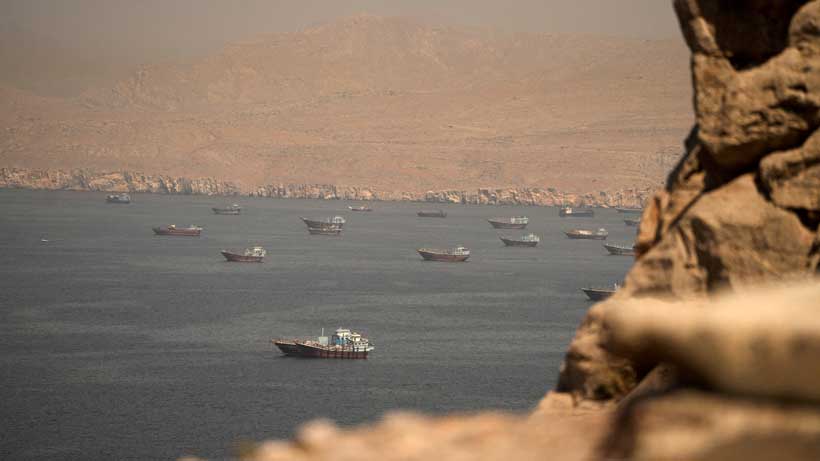
The Houthi threats remain in the stage of statements and have not yet translated into an actual closure of the Bab el-Mandeb Strait. However, markets are closely monitoring developments with caution, because the mere possibility of disrupting this strategic passage is enough to raise concerns about global energy prices. The two straits—Hormuz and Bab el-Mandeb—are not merely waterways; they are vital arteries of the global economy, and any disruption in them threatens to ignite a new wave of inflation that could return the world to the crisis of 1973 caused by war between Arabs and Israel.
Since the war between Iran, the United States, and Israel erupted on 28 February 2026, the Strait of Hormuz has become an open arena of confrontation. Iran, which has effectively closed the strait to international navigation, has employed every naval weapon in its arsenal — from mines and anti-ship missiles to fast attack craft and submarines — to impose its control over this passage through which 20% of the world’s oil shipments pass. The result has been crystal clear: Oil prices have surged to record levels, a real threat of global recession looms, and warnings from the International Energy Agency insinuate that the effects of this predicament will take years to reverse and a decade to recover.
The story of the Bab el-Mandeb Strait is somewhat different. The Houthis in Yemen, despite possessing the capability to close the strait — as they demonstrated in 2024 when they threatened navigation, raised shipping costs by 40%, and extended journey times by 14-21 days as ships had to use go via Cape of Good Hope in South Africa — have not yet taken the step of full closure. However, the threat remains, and the question that arises is: Are the Houthis waiting for the right moment, or are there factors preventing them from executing their threats? Or a green light from Iran will be given in tandem with the escalation of American strikes on Iranian civil infrastructure?
The reality is that the Houthis recognize that closing the Bab el-Mandeb would have enormous economic repercussions, not only for Israel and the West, but also for the Arab states along the Red Sea—Saudi Arabia, the UAE, Egypt, Jordan and Sudan — which depend on this passage for their trade and supplies. The Houthis themselves also bear part of the cost of any closure, as the ports of Hodeidah and Salif rely on Red Sea navigation for food and fuel imports. Nevertheless, in the event of a wider war involving American strikes on Yemeni territory, the Houthis may decide that the price is worth the risk.
Stay ahead of the geopolitical week.
MD Briefing delivers expert analysis across five global fronts — the Indo-Pacific, energy, geoeconomics, European security, and the Middle East — every Monday morning. Free.
If tankers are forced to reroute via the Cape of Good Hope, it would add 2-3 weeks to journey times, with a massive surge in transportation and insurance costs. Some estimates suggest that container shipping costs between East Asia and Europe could multiply several times over, which would directly impact consumer goods prices and fuel new waves of inflation in Europe and America.
However, the matter is not purely about economic calculations. The United States and its European allies, through the EUNAVFOR ASPIDES mission, have strengthened their military presence in the Red Sea. The European mission, headquartered in Larissa, Greece, has successfully protected more than 670 merchant vessels since its launch in February 2024. It recently signed a Status of Forces Agreement with Djibouti to secure logistical support, and has raised the threat level in the region to “Medium”. Should the Houthis attempt to close the Bab el-Mandeb, European and American forces in the region stand ready to respond. However, the issue now is that Israel is on the other side of the Strait of Bab el-Mandeb in Somaliland.
The larger question that arises is: Could we witness a simultaneous closure of the Strait of Hormuz and the Bab el-Mandeb? The Iranians, through their strategy based on the “Axis of Resistance”, have the capability to coordinate operations between their naval forces in the Gulf and the Houthis in Yemen. The simultaneous closure of both straits would amount to an economic atomic bomb for the world, but it could also mean a full-scale regional war beyond anyone’s control.
What is unfolding in the Strait of Hormuz and the Bab el-Mandeb is not merely a navigation crisis; it is a reflection of major strategic transformations in the Middle East. The United States, once the sole guardian of navigation in the region, now finds itself exhausted and depleted, and its ability to protect its maritime passages is in question. On the other hand, Iran and its allies are testing the limits of American power, discovering that the threat of closing the straits is an effective weapon in confronting American military superiority.
The most important message in all of this is that the world order dominated by the United States for decades is changing. The Strait of Hormuz and the Bab el-Mandeb are merely two small theaters in a larger drama, whose title is the transition from unipolarity to a multipolar world, where no one holds full control over global trade routes. As a result, the markets, which watch developments with high alert and attentiveness, recognize that the stability once taken for granted because of the unipolarity has today become a commodity as scarce as oil itself leading to multipolarity to stabilize the world order.