


In May 2026, Chief Justice of India Surya Kant stood before a courtroom and described unemployed youth activists as cockroaches and parasites. He almost certainly did not intend to name a movement. Within weeks, Abhijeet Dipke had founded the Cockroach Janta Party, roughly two million students had sat a medical entrance exam whose question papers were already circulating on WhatsApp before the test began, and India was watching the largest youth mobilization it had seen in a generation gather at Jantar Mantar and refuse to leave.
The name is not incidental, rather it is the argument. A generation that has been told its aspirations are a burden, its unemployment a personal failure, and its anger a nuisance has taken the worst thing a senior judicial official could call it and turned it into an identity. Cockroach. We are still here, we survive everything you do to us and we are everywhere. That reframing, from insult to declaration, tells you more about the political character of this movement than any policy demand on its list.
Beyond NEET: The Real Grievance
Due to leaked question papers, NEET-UG 2026 was cancelled after almost 2 million students appeared for the exam on May 3. A minimum of 12 student suicides have been attributed to the cancellation and the Education Minister Dharmendra Pradhan is facing calls for his resignation. These were the immediate demands that led to the first protesters being at Jantar Mantar in early June, and to their remaining there for weeks until the rest of the country caught up.
But NEET is not the cause of this movement, it is the detonator for something that had been accumulating for years. The 2024 NEET exam was also leaked. No re-test was ordered. Police constable recruitment examinations have been compromised. Teacher eligibility tests in multiple states have produced scandal after scandal. The pattern is systemic and documented: examinations that determine life outcomes for millions of young people are being routinely corrupted by a combination of negligence, criminal networks, and institutional indifference. The protesters are not angry about one cancelled test. They are angry about a meritocracy that was promised to them and does not exist.
Stay ahead of the geopolitical week.
MD Briefing delivers expert analysis across five global fronts — the Indo-Pacific, energy, geoeconomics, European security, and the Middle East — every Monday morning. Free.
India produces the world’s largest cohort of young people. Its demographic dividend, the economic windfall that arrives when a country’s working-age population peaks, was supposed to be the defining story of this decade. What a significant portion of that generation is actually experiencing is a labour market that cannot absorb them, an educational system whose gatekeeping examinations cannot be trusted, and a political establishment that describes their frustration as a law and order problem. The Cockroach Movement is what happens when a demographic dividend becomes a demographic debt.
When Every Religion Shows Up
The BJP’s political architecture, built and refined over twelve years in power, rests substantially on its ability to mobilize Hindu identity and to frame political contests along communal lines. It has been extraordinarily effective at that project. It has also, until now, been effective at ensuring that protest movements fracture along the same lines, that Muslim grievances remain Muslim grievances, that Dalit anger stays Dalit anger, that no coalition broad enough to challenge the government’s core support forms and holds.
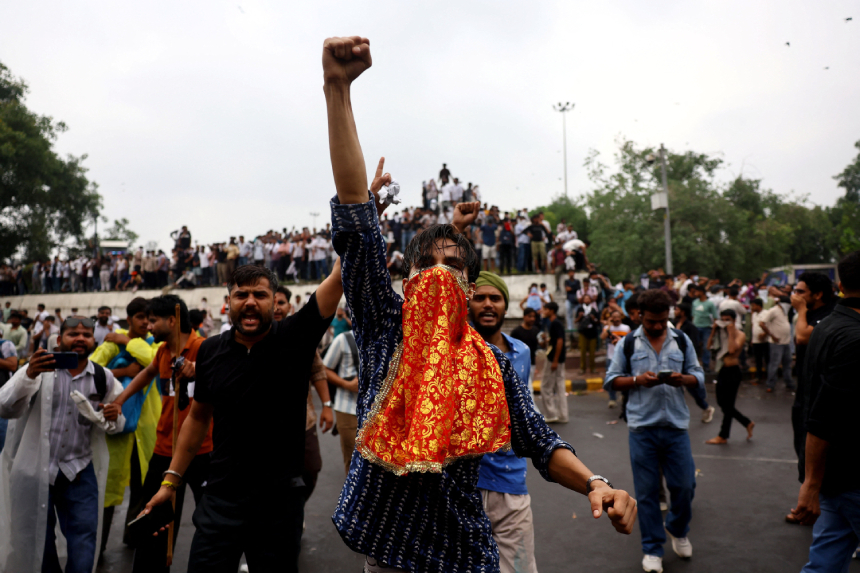
Jantar Mantar in July 2026 is something the BJP’s political strategists did not plan for. Hindu students, Muslim students, Sikhs, Christians, Dalits, OBCs, the photographs from the protest site show the full demographic complexity of India’s youth standing in the same place, chanting the same slogans, facing the same tear gas. The Bhim Army, a Dalit rights organization, is present. Left student unions are present. So are the children of BJP supporters who thought the party’s promise of a meritocratic, developed India was real and have discovered it is not.
This cross-communal unity is not ideological in the traditional sense. Nobody at Jantar Mantar is arguing for secularism as a constitutional principle or making the case that the BJP’s Hindutva project is wrong. They are making a simpler and in some ways more dangerous argument: that the examination system fails everyone regardless of religion, that a corrupted meritocracy has no in-group, that economic injustice does not sort by caste or community. When grievance becomes universal rather than communal, the BJP’s most reliable counter-narrative, that this movement is driven by a particular community’s interests, becomes unavailable. The government has called the protests anti-national. It has not been able to call them anti-Hindu, which is the move it knows best.
How This Generation Actually Organizes
There is no central committee to the Cockroach Movement. It is not party structured, nor is it registered with office-bearers and a party-manifesto. Abhijeet Dipke is one of the many voices that make up the CJP, and whose arrest wouldn’t be the end of the movement. It was Sonam Wangchuk who took his hunger strike to Jantar Mantar and garnered unprecedented attention before police forcibly hospitalised him in mid-July, according to the organisers. The movement wasn’t defeated. It grew.
This is the organizational model that has defined South Asian Gen Z protests and that governments and political parties keep underestimating. Bangladesh’s quota reform protests in 2024 brought down Sheikh Hasina’s government, which had been in power for fifteen years, within weeks of escalation. The protests had no central leadership. Nepal’s Gen Z movement in 2025 forced Prime Minister Oli’s resignation. Also leaderless. India’s Cockroach Movement is the third iteration of this regional pattern, and it has absorbed every lesson from the previous two.
The specific mechanics are worth understanding because they explain why the government’s standard playbook has not worked. Social media gives the movement reach that no organization could manufacture, videos of police baton-charging protesters outside Parliament spread across Instagram and X within minutes of the events they documented, reaching audiences that news channels with editorial constraints could not serve as fast. The internet shutdown the government ordered after the July 20 violence came hours after the most damaging footage had already been shared millions of times. The shutdown then became evidence for the movement’s claims about state repression rather than a tool for suppressing them.
The satirical branding is equally deliberate and equally effective. The Cockroach Janta Party is not a real party. Its name mocks the political establishment rather than competing with it. Its imagery: cockroaches as survivors, as creatures that outlast everything thrown at them, resonates with a generation that has been told repeatedly that its situation is its own fault. The memes, the posters, the slogans at Jantar Mantar are being created horizontally across thousands of individual accounts rather than broadcast from a communications team. This is not something a political party or government knows how to shut down, because there is no center to shut down.
The Repression That Backfired
On July 20, tens of thousands of protesters marched toward Parliament from Jantar Mantar. Police responded with tear gas and baton charges. Around 150 protesters were taken to hospital. Police reported 118 of their own officers injured. The government described it as a violent protest requiring a firm response.
What the government did not anticipate, or chose not to consider, is that footage of police beating students, young people with bruised faces, women being dragged, protesters crying and pleading, is not a deterrent for a movement organized through social media. It is accelerant. Every video of a baton charge shared ten thousand times is ten thousand more people who now know this is happening, ten thousand more who have to decide whether they care, ten thousand more potential recruits who had not been paying attention until the violence made it impossible not to.
The nationwide protests called for July 23 and 24 are a direct consequence of the July 20 crackdown. The metro station closures, the internet restrictions, the business curtailments in central Delhi, all of this tells every young person in India that the government is afraid of them, which is exactly the opposite of what a government trying to project strength should communicate. India ranks as the highest-risk country on Verisk Maplecroft’s Civil Unrest Index. Average protest participation has more than doubled in the past year. The geography of the unrest is dispersed, this is not a Delhi phenomenon. It is a national one, and the response from New Delhi is making it more so.
Modi’s Third Term Problem
After a decade in power, there is a specific political vulnerability that no incumbent can avoid: the promises made at the beginning are now measurable against the record. Modi came to power in 2014 partly on a promise of economic transformation, job creation, and a meritocratic India where hard work and ability determined outcomes. Twelve years later, the demographic cohort that was in secondary school when those promises were made is now at university and in the job market, and they are the people at Jantar Mantar.
Weak employment outcomes can be attributed to pandemic effects, to global headwinds, to the previous government’s legacy for only so long. At some point the record belongs to the person in office, and on youth employment and examination integrity, the record of Modi’s government is difficult to defend. The BJP’s standard counter-move, accusing the opposition of using students as political tools, which Defence Minister Rajnath Singh deployed on Wednesday, has limited traction when the students themselves are rejecting the framing. Modi’s response on Thursday, announcing fast-track courts for paper leak cases, was the government’s clearest acknowledgment yet that something more than a standard protest management response is required.
Whether it is enough depends on what the movement actually is. If it is primarily about NEET and examination reform, fast-track courts and the education minister’s eventual resignation could give it an off-ramp. If it is about the broader failure of the meritocratic promise, about unemployment, about a system where connections matter more than scores, about a generation that has been failed by institutions it was told to trust, then no single policy announcement resolves it. The evidence from Jantar Mantar suggests the second reading is closer to accurate.
South Asia’s Gen Z Pattern
It is worth stepping back from the specifics of NEET and Jantar Mantar to name what this fits into. Bangladesh 2024, Nepal 2025, India 2026. Three years in which a young-led, social media–driven, leaderless protest movement has surged in South Asia from a specific institutional complaint to a sweeping challenge to the legitimacy of the government in power. In Bangladesh, the movement succeeded in its most dramatic possible form. It brought about large-scale political transformation in Nepal. In India, it is greater than both and the results are yet to be seen.
The common thread is not ideology. This is the institutional failure on the one hand, and a generation that has been raised on the internet, organized without hierarchy, who do not shy from confrontation as their own generations were taught, and who have a legitimate grievance about the difference between what their societies promised them and what was delivered. Governments in the region are finding out that the same tools that they have for handling protests under the leadership of parties and unions are not effective against movement without a headquarters, a leadership to arrest and a source of funds to cut off.
India is the largest test case yet of whether those tools can be adapted in time, or whether the Cockroach Movement joins Bangladesh’s quota protests and Nepal’s Gen Z uprising as the moment a government discovered, too late, that something had changed.
