


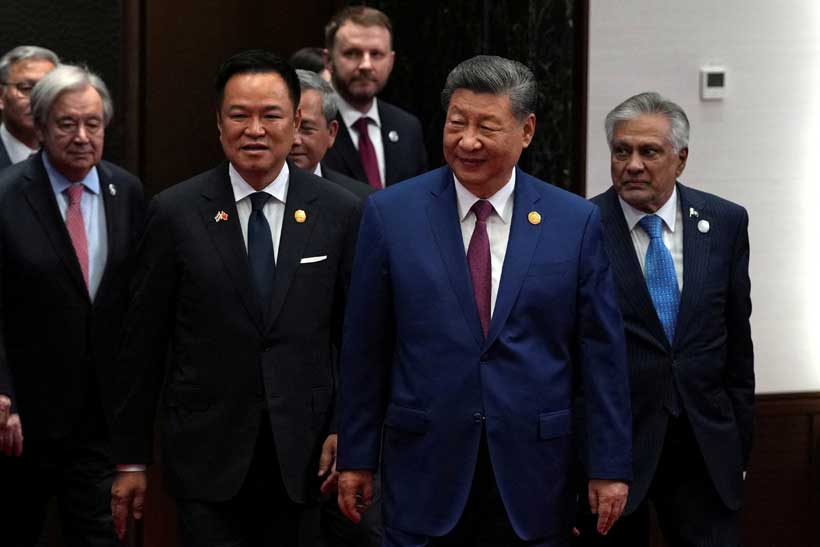
Evidence from 2026 shows that China is not simply filling the gap or staying out. Instead, China is acting strategically-getting involved where its own interests match global needs, but stepping back when leadership or political risk is involved.
The Scale of the American Retreat
On his first day in office, Trump signed orders for the US to leave the WHO and the Paris Agreement. He also announced that the OECD’s global minimum tax deal would not apply in the United States. A few weeks later, another executive order took the US out of the UN Human Rights Council and stopped all future funding for the UN Relief and Works Agency for Palestinian refugees (UNRWA).
The financial impact is significant. From 2024 to 2025 the US gave about $261 million to the WHO, which was around 18 percent of its total funding for projects like tuberculosis control and pandemic preparedness. This funding will officially stop when the US withdrawal takes effect on January 22, 2026. Shutting down USAID also ended what had been the world’s largest bilateral development-finance program until 2025. More broadly, the US has only made small payments toward its UN dues, paying about $160 million while its debt has grown to nearly $4 billion over several administrations.
Stay ahead of the geopolitical week.
MD Briefing delivers expert analysis across five global fronts — the Indo-Pacific, energy, geoeconomics, European security, and the Middle East — every Monday morning. Free.
The January 2026 memorandum marked that the United States would withdraw from 66 organizations. In which 31 were UN bodies and 35 other entities such as the Intergovernmental Panel on Climate Change (IPCC), the International Institute for Democracy and Electoral Assistance, and the International Union for Conservation of Nature. The central legal development within this memorandum is the planned departure from the UNFCCC. As a Senate-ratified treaty that has underpinned international climate cooperation since 1992, including the Paris Agreement. The decision to leave the Paris Agreement alone is projected to increase global temperatures by about 0.1°C. This is strengthening the negative consequences of climate change worldwide. This withdrawal undermines not only the international climate framework but also the financing and legitimacy of global environmental initiatives. By abandoning these multilateral commitments the United States signals a strategic shift from leadership and responsibility in global governance to an isolationist posture. This will have broad repercussions for international institutions and collective action.
Is China Filling the Gap? A More Complicated Picture Than It Appears
Generally it is assumed that China, as the world’s second-largest economy, is the obvious and eager beneficiary of America’s retreat. But the actual budget numbers tell a more cautious story.
China’s that Beijing’s donations to international organizations actually fell slightly in 2026, from 4.46 billion yuan to 4.44 billion yuan, while its budget for international cooperation fell by about 17 percent. Beijing’s diplomats have said this openly. China’s UN ambassador Fu Cong told reporters in May 2026 that his government had no interest in replacing the United States and rejected the idea that this is a ‘zero-sum game’ between the two powers. He described China as already the de facto largest contributor to the UN’s regular budget, but not willing to take on the programmatic roles the US once played, like funding malnutrition programs, HIV treatment, and election assistance. Notably, China’s 2025 UN dues of about $685.7 million arrived eight months late, and its 2026 payment was still outstanding as of mid-year. All these contributions are still far less than what would be needed to replace the American aid system, let alone USAID’s former global reach.
This is not because China lacks the ability, but because it chooses not to take on global leadership like the United States. Rather than taking over Western roles, China has focused on building its own institutions, such as the Shanghai Cooperation Organization (SCO) for security in Central Asia, the BRICS New Development Bank (NDB) for infrastructure and development outside Western channels and the Forum on China-Africa Cooperation (FOCAC) for economic, political and social ties with African countries. Unlike traditional Western groups these organizations set their own rules and development goals and promote South-South cooperation and mutual benefit as China defines them. This approach shows China prefers a more transactional and multipolar world where it can influence events without taking on the ongoing financial and governance costs of global leadership. China’s assertiveness is most visible in diplomacy and setting norms. It has tried to mediate regional conflicts, used high-level meetings such as hosting Russian President Vladimir Putin to promote a ‘new type of international relations,’ and used its rotating presidency of the UN Security Council to push its idea of ‘true multilateralism’ as an alternative to Western-led systems.
Where China Is Filling the Gap
China’s growing role is most obvious in the area of institutional infrastructure. According to the UN’s funding formula, the US is still officially the largest contributor to the regular budget (22 percent) and the peacekeeping budget (26.15 percent). However, China is now close behind at 20 percent and 23.78 percent, up from less than 1 percent of the regular budget in 2000. The US budget for 2026 plans to cut most UN funding, and in 2025, Washington withheld about $1.5 billion in unpaid regular dues and another $1.5 billion in peacekeeping arrears. But now China has become the UN’s most reliable major payer, even though its payments have often been late. Beijing has also become more assertive about peacekeeping, using its financial contributions to push for a bigger say in how UN funds are used.
The situation here is more complicated, and the numbers show why. After the US left, the WHO had to cut 25 percent of its staff and reduce its 2026–27 budget from $5.3 billion to $4.2 billion. China’s assessed contribution rose by 57 percent, from about $87.6 million to around $138 million a year, making it the WHO’s largest assessed state contributor for the first time. Beijing also promised an extra $500 million in voluntary funding over five years (about $100 million a year), making it the top donor after the US withdrawal.
But compare this to the actual gap. The US had been providing nearly $900 million a year in combined assessed and voluntary WHO funding, and the wider global health system-not just the WHO. But now, the WHO has lost an estimated $9–10 billion for the coming fiscal year alone, and this could be a $30–40 billion loss over three to five years. However China’s roughly $138 million a year in combined WHO contributions is significant, but it covers only a small part of that gap. China has also pushed back against a previously agreed 20 percent increase in member-state assessments, arguing for a smaller 5 percent hike instead, which does not suggest it wants to fund global health on its own. Instead, China prefers to channel resources through its bilateral ‘Health Silk Road’ infrastructure and medical-team deployments (77 countries as of 2026) rather than through the WHO’s own programs.
China’s biggest impact is in climate and clean energy, but its role is mainly industrial and commercial, not a direct replacement for the treaty system the US left behind. China has lowered global solar costs by almost 80 percent and built more wind and solar capacity in one recent year than the rest of the world combined. China has also signed 53 South-South climate cooperation agreements with 42 developing countries. Despite this activity, China avoids taking on formal financial leadership. At COP30, Beijing did not commit to the developed-world goal of raising $1.3 trillion a year in climate finance, and it also declined to contribute to Brazil’s Tropical Forest Forever Facility. China’s Cop delegation Wang Yi said China does not want to take the lead alone and called for comprehensive leadership shared among countries. This shows China’s focus on commercial strength rather than taking on treaty-level financial responsibility.
Looking at all these examples, a clear pattern emerges. China is most willing to take on leadership where it can use its financial commitments, manufacturing strength, and export power, such as with UN contributions, WHO funding, and spreading clean-energy technology. However, it mostly avoids filling gaps that require ongoing financial commitments without clear economic or political benefits. The evidence from 2026 shows that China is not fully replacing the United States, nor is it staying out completely. Instead China chooses roles that match its strategic interests, mainly where leadership brings commercial or industrial advantages. At the same time, it avoids areas that would require open-ended financial or governance responsibilities, like bilateral humanitarian aid, extra WHO programs, and formal climate-finance promises. This shows that the new global order is not about a single new leader, but about a more transactional and specific kind of leadership. China’s approach is practical and measured, helping to shape a multipolar system that is different from the broad global leadership the US once provided.
