


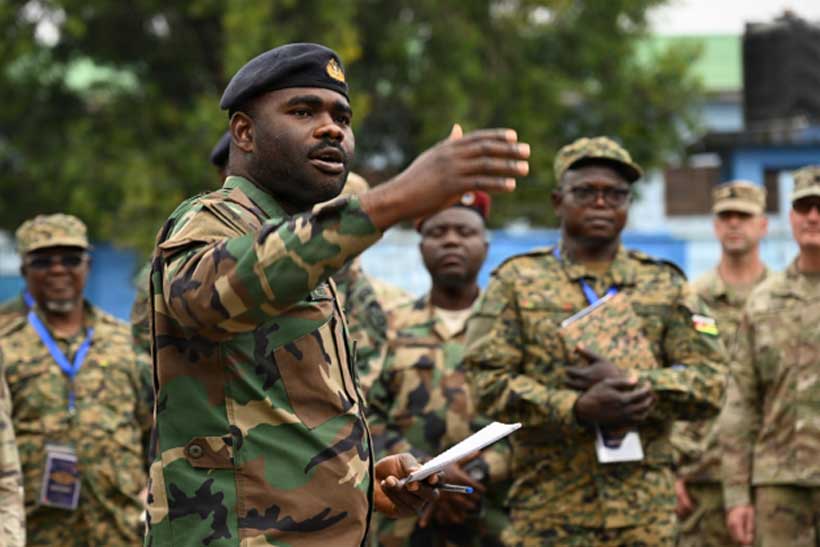
The West Africa Religious Affairs Symposium, held in Accra last week, was easy to overlook if one expected a conventional military conference. It was not about weapons systems, battlefield tactics, or counterterrorism operations in the narrow sense. Yet the gathering mattered because it illuminated a quiet but consequential front in contemporary security cooperation: the role of military chaplains and religious affairs personnel in sustaining cohesion, resilience, and legitimacy inside armed forces facing intense pressure.
Co-hosted by U.S. Africa Command and the Ghana Armed Forces, this first edition of the symposium brought together chaplains and religious affairs personnel from the United States and ten West African countries—Benin, Burkina Faso, Côte d’Ivoire, Gabon, The Gambia, Ghana, Liberia, Nigeria, Sierra Leone, and Togo. That lineup made clear that this was not a ceremonial faith gathering. It was a regional professional exchange built around a strategic question of how do militaries in plural societies preserve internal trust, religious freedom, and ethical discipline while operating under conditions of insecurity?
The answer, at least in part, runs through chaplaincy. Military chaplains are often misunderstood as uniformed clergy whose main role is to conduct worship services. In reality, they occupy a much broader institutional space. They counsel soldiers, advise commanders, support families, mediate religious tensions inside units, respond after attacks, and help translate broad principles of religious accommodation into the daily life of the military. In a region where religion remains socially powerful and security threats frequently exploit identity differences, that role is not peripheral. It is operational.
This is where the strategic significance of the symposium becomes clearer. Briefers from U.S. Africa Command — Chaplain Colonel Kevin Forrester and Sergeant Major Herinah Asaah — described the event as a means of strengthening spiritual readiness, deepening regional partnerships, and fostering ethical unity. They also emphasized themes such as post-traumatic stress disorder, moral injury, ethics, enlisted leader development, ministry in combat, and family care. Those are not secondary concerns. They speak directly to the human infrastructure of military effectiveness. A force that cannot manage trauma, moral strain, or internal tension will struggle to sustain discipline and public trust, no matter how capable it is on paper.
Stay ahead of the geopolitical week.
MD Briefing delivers expert analysis across five global fronts — the Indo-Pacific, energy, geoeconomics, European security, and the Middle East — every Monday morning. Free.
That is especially true in Nigeria. The Nigerian Armed Forces face Boko Haram, Islamic State West Africa Province, bandit groups, kidnapping networks, farmer-herder violence, and separatist tensions. These threats overlap but are not reducible to a simple Christian-Muslim binary. They are shaped by criminal economies, governance failures, communal grievances, and the manipulation of identity by armed actors. In such an environment, chaplains and military imams do more than provide ritual support. They help preserve cohesion in mixed-faith military units, support service members under stress, and keep religion from becoming a vulnerability inside the security forces.
That point is important for understanding the Nigerian case in particular. The Nigerian Army has publicly stated that it is a secular institution that upholds religious freedom for all personnel and accommodates multiple faith traditions within its ranks. Its internal chaplaincy structure reflects that reality. Christian and Muslim religious support exists within the military not because religion is a ceremonial afterthought but because a professional force in a plural society must manage belief with fairness and discipline. The West African symposium placed that reality in a regional frame.
This is also where one of the most useful conceptual distinctions should be made. Military chaplains are not diplomats in the formal legal sense. They do not negotiate treaties, and they are not foreign ministries in uniform. But they do fulfill a multilayered role that sits at the intersection of religion, command, legitimacy, and transnational professional exchange. They are institutional intermediaries. They move between faith communities and command structures, between moral language and operational requirements, and between the personal burdens of service members and the strategic needs of the state. That is why chaplaincy can be read as a form of defense cooperation without collapsing it into formal diplomacy.
These same West African forces and international military chaplain engagements—these same intermediary functions and skills extend across borders, bridging engagement between chaplains from different countries, across national boundaries. When military chaplains engage counterparts in partner armed forces, they exchange approaches to religious accommodation, military ethics, pastoral care, and the management of religious diversity within security institutions. These relationships cultivate professional trust, reinforce shared norms, and strengthen the human foundations of defense cooperation. In this sense, chaplain engagement constitutes a form of religiously informed defense engagement that complements, rather than substitutes for, formal diplomatic and military-to-military channels.
For West African states, that cooperation has clear utility. Ghana’s role as host reinforced its standing as a regional convenor in military professionalism and security dialogue. For Burkina Faso, the relevance is tied to the strain of insurgency and the need to support morale under sustained pressure. For Benin and Togo, it is connected to border insecurity and the spillover effects of instability from the Sahel. For Côte d’Ivoire, Sierra Leone, The Gambia, Gabon, and Liberia, it lies in professionalizing religious affairs as part of broader military modernization, peacekeeping readiness, and institutional legitimacy.
The symposium was also significant for the United States because it aligned with a broader logic of defense diplomacy. The conference signals that AFRICOM does not simply seek interoperability through exercises and equipment. This symposium suggests that it also invests in the professional institutions that help West African partner forces remain resilient. That is a strategic calculation. Military partnerships endure when they are anchored not only in tactical cooperation but also in shared norms and durable trust. Chaplaincy is one of the lesser-seen spaces where those norms are built.
That is why one question is so important: why is this the right time to convene the symposium, and what is its strategic value if explained to policymakers in Washington and West African capitals? The answer is that the timing reflected a convergence of pressures and priorities. West African militaries are operating in environments shaped by violent extremism, communal conflict, political fragility, and contested legitimacy. At the same time, religion remains a powerful social force that cannot be ignored in military planning or in stabilization efforts. Investing in chaplain partnerships at this moment means investing in the resilience of the security force and the credibility of the institutions that defend the state.
The U.S. and its African partners also used the symposium to model something often lost in discussions of security cooperation—operational pluralism. AFRICOM’s public messaging noted that the event brought together military religious leaders in a spirit of cooperation and used religion as a unifying force rather than a source of division. That matters because extremist actors often aim to fracture trust along religious lines. A military institution that visibly accommodates diversity and protects religious freedom inside its ranks sends a different signal: a signal that state authority can be both strong and plural.
The broader implication is that religion should be understood not as an external variable to security, but as part of the institutional environment in which security is produced. The symposium offered a rare glimpse into how military organizations in West Africa are dealing with that reality through professional religious affairs structures. It also showed how such structures can become channels for norm diffusion, mutual learning, and regional convergence. This kind of chaplain-to-chaplain strategic engagement creates foundations for durable professional relationships, facilitates exchanges on ethics, religious accommodation, and civil-military issues, and builds trust among partner militaries.
The lesson is similarly direct. Military chaplaincy may not attract the attention given to weapons deliveries or counterterrorism cooperation, but it speaks to the quality of the force itself in whether it can sustain morale, protect internal cohesion, and remain legitimate in the eyes of the societies it serves. In fragile environments, those are not soft issues. They are strategic ones.
This first West African Religious Affairs Symposium did not solve the West Africa region’s security problems, nor was it intended to. But it did make visible an important truth: in West Africa, military effectiveness increasingly depends on institutions that can manage not only violence but also the moral and religious terrain in which violence unfolds. That is why chaplains matter, why the symposium mattered, and why the strategic relationship between religion and security in the region is likely to grow more important, not less.
