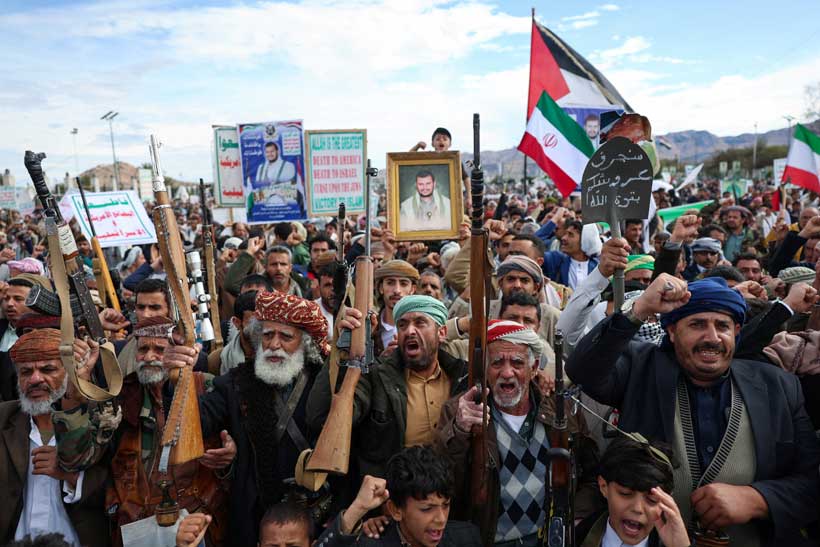
Two oil tankers carrying Saudi crude to Asia changed their course in the Red Sea on Tuesday after threats from Yemen’s Iran-aligned Houthis, highlighting the growing conflict in the Middle East that is disrupting vital shipping routes. U. S. forces conducted strikes on targets in southern and western Iran, while Iran targeted U. S. sites in Bahrain, Kuwait, and Jordan, escalating tensions further.
Iran claimed to have attacked infrastructure belonging to Amazon in Bahrain, where the company operates a regional data center, but Amazon did not respond to the claim. The Houthis announced a naval blockade on Saudi Arabia, threatening to attack any ships involved in the loading or unloading of Saudi oil. President Donald Trump stated that the Bab el-Mandeb strait, an important waterway leading into the Red Sea, had not been closed, but warned of potential U. S. action if it were.
Despite the threats, the impact was immediate, with two tankers that had loaded Saudi crude for China and India turning back towards the Suez Canal instead of continuing through the Bab el-Mandeb. British maritime group Vanguard indicated that this change in routing could disrupt Saudi crude exports and regional shipping.
As the conflict has closed the Strait of Hormuz, the Red Sea has become the main exit for millions of barrels of Saudi oil, which is now being transported through pipelines to the port of Yanbu. Oil prices rose by more than 2%, with Brent crude reaching over $91 a barrel and U. S. gasoline prices exceeding $4 a gallon.
The U. S. Central Command reported that their recent strikes targeted Iranian military sites, including command centers and missile launch sites, as attacks continued nightly. Reports detailed explosions around Shiraz and strikes in various other areas of Iran. Recent U. S. actions have resulted in the deaths of 50 civilians and three U. S. soldiers, with the U. S. stating these strikes are punitive actions against Iran.
Iran has launched its own attacks across the Gulf, including on desalination facilities, raising concerns about water shortages in Gulf countries. Kuwait reported responding to a drone and missile attack that had impacted power generation and water supply. Sirens were activated in Bahrain as Iranian forces claimed to have targeted Amazon’s infrastructure due to recent U. S. strikes on Iranian sites.
In a maritime incident, a tanker in the Strait of Hormuz reported being hit by a projectile, forcing the crew to evacuate. Other reports indicated that two oil tankers had caught fire from explosions in the strait. Shipping through the southern lane of the Strait has dropped significantly, with fewer vessels opting to cross due to the heightened risk.
While Saudi Arabia has managed to partly avoid disruption by using pipelines to Yanbu, a complete blockade by the Houthis would significantly impact global oil supply. A senior Iranian official mentioned a proposed 10-day ceasefire to restore a prior agreement, indicating ongoing diplomatic efforts. Trump, during talks at the White House, expressed a reluctance to engage with Iran until they are ready for serious discussions.
With information from Reuters