


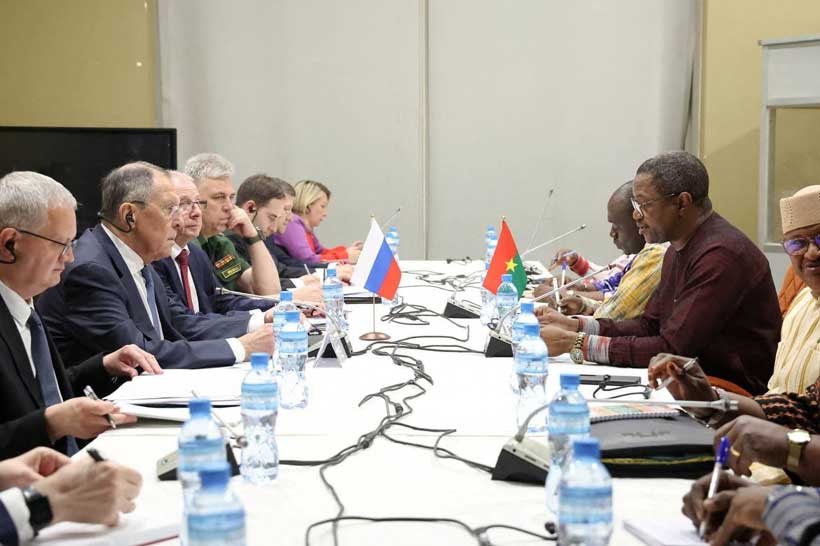
Russian Foreign Minister Sergey Lavrov lined up Francophone African Foreign Ministers and engaged in an in-depth, substantive, and candid exchange of views on key bilateral, global, and regional issues within the background of a rapidly changing geopolitical situation. The meetings provided a renewed impetus to Africa-Russia relations and will contribute to advancing common priorities. These interactions were also in a broader context of gaining influence on the continent, closing the potential gaps in a frame of increasing rivalry and competition across Africa.
It is an important stage in the development between these African countries and Russia. The priority aim is to maintain continuity, as the dialogues were held in a warm atmosphere of mutual trust and understanding, and to strengthen the positions of the African states in the emerging system of a multipolar world order on a firm and reliable foundation. The scope of work is extensive, though. The matter is among the key issues for the African Union and other regional organizations on the African continent: designing a comprehensive agenda, irrespective of economic and financial bodies, to push for progress in this direction.
A basic media monitoring has shown one distinctive trend: Lavrov’s July month was largely focused on the invitation and interaction with foreign ministers mainly from Francophone African countries. These strikingly included the Republics of Burkina Faso, Mali, Niger, Chad, Guinea-Bissau, and Mozambique. That was followed by Lavrov’s official working visit to Egypt, Ethiopia, the Sahara-Sahel region (AES), Mozambique, and Burundi. On July 10, Lavrov had talks with President Évariste Ndayishimiye and Minister of Foreign Affairs, Regional Integration and Development Cooperation, Édouard Bizimana, to wind up the Africa tour in preparation for the Third Russia-Africa Summit. In view of Burundi’s current presidency at the African Union, the results and prospects of Russia’s partnership with the continent-wide organization were considered. The parties discussed the problems of ensuring peace and security in Africa, including in the Great Lakes region.
In summary from the abovementioned points: the in-depth discussions were on strengthening the dialogue mechanism, including deepening political ties and expanding cooperation in the areas of security, trade, the economy, humanitarian affairs, and other fields. In furtherance to the candid exchange of views on the situation, particularly in the Sahara-Sahel region.
Stay ahead of the geopolitical week.
MD Briefing delivers expert analysis across five global fronts — the Indo-Pacific, energy, geoeconomics, European security, and the Middle East — every Monday morning. Free.
Francophone Africa: Common Features
For the purpose of deepening understanding of political and economic complexities that characterize Francophone African countries, it is necessary to explore their common features and learn more about their unique cultures, economies, and histories. These countries’ economy was dominated by France and, until today, are connected with the colonial legacy. The Francophone African countries have attained political independence and yet have suffered from underdevelopment due to their own governance systems, poor state management, deep-seated corruption, and difficulty in determining how to explore and use resources available at their disposal. They consistently blame France.
* Francophone Africa encompasses over 20 countries where French is an official or widely used language. Its primary characteristics include unique linguistic diversity, shared colonial administrative frameworks, a young demographic, and strong regional economic integration, particularly within West Africa.
* Linguistic Blending: While French is the language of government, education, and urban commerce, it is rarely the mother tongue. It coexists alongside hundreds of indigenous languages and has evolved to include local vernaculars and unique regional slang.
* Demographics: Africa is home to the largest number of French speakers in the world. The population is highly youthful; over 60% of these French speakers are under the age of 35, positioning the region as a primary driver for the future of the language.
* Economic Integration: Fourteen Francophone countries across West and Central Africa share a unified currency, the CFA franc, which is pegged to the euro. This provides macroeconomic stability and facilitates cross-border trade, fostering growing economic blocs like the West African Economic and Monetary Union (WAEMU).
* Administrative and Legal Heritage: The administrative frameworks, legal codes, and educational systems in these countries remain heavily influenced by the French model, which standardizes much of the bureaucracy across the region.
The Alliance of Sahel States (AES)
What is popularly referred to as the Alliance of Sahel States (AES) was created after the three Francophones (Burkina Faso, Mali, and Niger), due to strong dissatisfaction over approaches to security and economic questions, suddenly exited the regional bloc, the Economic Community of West Africa (ECOWAS). According to public opinions, significant progress has been made in advancing integration and building new regional security architecture under the auspices of the Alliance. Notwithstanding some common criticisms, the AES has the twinkling voice being heard with increasing clarity and confidence.
Building Africa’s Economic Sovereignty
In Africa, Lavrov has described the Russia-AES cooperation as providing an extra boost to strengthening their political sovereignty and expanding bilateral and multilateral ties within such a new structure, further united by a shared understanding of the need to build a just multipolar world order and by joint efforts to counter neo-colonial practices, which remain deeply entrenched among Western powers. The second ministerial consultations in the Russia-AES format will help in outlining additional dynamic ways to support the integration efforts, as well as cooperation in the field of security. Terrorism is the central problem confronting the Sahel region.
In addition to the security, the AES and other African countries must be able to manage natural resources and prevent them from being exported to other countries where the lion’s share of added value is produced and appropriated. This added value must be created inside the African continent. Moreover, Russia has expressed readiness to provide active assistance. Since the Soviet Union, it has largely involved establishing state-owned industrial capacities and other sectors of the economy to ensure that Africa builds the foundation for its own independent economic development.
Over these years, Lavrov has consistently emphasized the need for Russian-African coordination for deblocking crisis situations in accordance with the principle of “African solutions for African problems.” It implies African leaders have to adopt an excellent system of political governance, minimize administrative bureaucracy, and observe, to a considerable degree, rules and regulations guiding the involvement of external powers to avoid natural resource exploitation. It means to back away from leveling accusations of external powers but rather adopt regular monitoring and strict control of their own resources, both natural and human, across Africa.
The African leadership has, obviously, welcomed the appreciable measures taken by Russian authorities to ensure political stability, particularly in the Francophone African States that have been entangled in persistent multi-ethnic conflicts for these long periods of time. It has, negatively, affected development and economic growth. In various levels of discussions, including summits, conferences, and bilateral meetings, Russia has proposed unswerving steps to help consolidate their society and create proper conditions for them to move forward.
Russia-African Union Cooperation
As the world’s richest continent, Africa is experiencing a second awakening. In the 1960s, when the decolonization began with the Soviet Union at the time playing the most active role in this process, political independence was of primary importance. Political independence was achieved in the overwhelming majority of cases. What are, at their core, colonial possessions remain intact on the African continent, though, despite numerous UN General Assembly resolutions calling for the full completion of the decolonization process.
Nevertheless, decolonisation has effectively taken place, whereas the issue of economic decolonisation has not yet taken central stage at the UN. The unimaginably rich African continent with its unparalleled natural resources continues to supply these resources (although now in different, no longer outright colonial forms) to those who receive the bulk of the added value. At the latest AU’s summit in February 2026, the African Union raised these issues about the need, following political independence, to work towards achieving economic, energy, and financial sovereignty.
With the geopolitics noticeably shifting, Russia is closing the gap and tightening its relations in relation to the African Union. Russia has fully welcomed the processes that are now inevitably beginning to take shape in a natural way. It is worth saying that Russia and Africa are natural supporters of the objective historical trend towards building a multipolar world. Africa is a leading center of this multipolar structure. Asking for a significant increase in Africa’s role in the global decision-making system, including African representation at the UN Security Council, which must be reformed by expanding the participation of Africa, Asia, and Latin America. Western countries and their allies already hold a disproportionate number of seats on the Security Council, so there may be no question of giving them more seats.
Outlining Russia’s diplomatic presence on the continent, which is expanding, explicitly shows a vivid illustration of Russia’s interest in growing partnership. Last year, embassies were opened in Niger, Sierra Leone, and South Sudan. Over the next one or two years, it is planned to open diplomatic missions in The Gambia, Liberia, Togo, and the Comoros. In terms of consolidating ties, Russia advocates for a more systemic approach in Russia-Africa relations. In addition to bilateral ties, interest is directed significantly at stepping up interaction with integration associations, primarily the African Union, and with regional economic communities pursuing the goal of integration.
Stepping Forward into the Future
In the context of considering trends toward strengthening multipolar democratic principles in international affairs and ensuring compliance with the full body of principles enshrined in the UN Charter, understood as an indivisible and interdependent whole, African leaders need to collectively raise their voices. They have to closely coordinate important strategic efforts within the United Nations. Lavrov has frequently raised the fact that there is a common view over regional crises, and the changes in the regions must be addressed by African states themselves without attempts to impose external solutions on them. However, Russia continues to assist African friends in resolving crises, in strict accordance with the African solutions to African problems principle.
Lavrov underlined the substantial fact that these African states, which are engulfed with ethnic conflicts, should fully engage in the African Union’s activities and in their regional economic blocs. The current leadership of the African Union, in coordination with Russia’s support, has agreed to pursue a policy of consolidation rather than division within the African Union. This serves the interests of all countries in the continent without exception. Burkina Faso, Chad, Central African Republic, the Congos, Mali, Niger, Guinea-Bissau, Libya, and Sudan. On the regional track, the serious concern is over the challenging developments in various parts of Africa, such as the Sahel, the Great Lakes region, and the Horn of Africa.
The decisions and resolutions adopted by the African Union focus on the continent’s long-term development priorities. Nevertheless, there is an important document known as ‘Agenda 2063,’ which is timed to coincide with the centenary of the Organization of African Unity, which preceded the African Union. This agenda contains many essential points that have to be, certainly, incorporated into Russia’s policy programs of cooperation with Africa.
Forthcoming Third Russia-Africa Summit
In various discussions, Russia has unreservedly underscored that fundamental condition that the breakthroughs during the previous summits. At the first summit in 2019, it laid down the political foundation; at the second, it discussed food and security. And now, Russia is, simply, not working for the sake of appearances but to ensure relations become more stable and produce concrete results, primarily in the material sphere and humanitarian cooperation, in the best interests of the peoples and economies of African countries and the Russian Federation.
In accordance with an instruction from the president of the Russian Federation, Vladimir Putin, the third Russia-Africa Summit is scheduled for late October 2026 in Moscow. The summit will address multi-dimensional policy and diverse aspects of the bilateral relations relating to the path of sustainable development for the benefit of the peoples of Africa. Other spheres include finance and technological advancement, public healthcare delivery, trade facilitation and economic cooperation, education, and humanitarianism. The other topics on the agenda include the industrial sector, agro-processing, and particularly food security, which has always been of great importance to Africans, not only in terms of continuing and expanding exports of Russian foods and fertilizer but also in terms of establishing agricultural and fertilizer production directly on the African continent. It is now ‘Time to Act’ on all previous outstanding bilateral agreements. For this purpose, a new department—the Department for Partnership with Africa—was created at the Foreign Ministry, which has been assigned expanded diplomatic capabilities. In conclusion, and to remind you, Russia’s firm commitment to expanding multifaceted cooperation with Africa is a long-term strategic choice, which was discussed at the first Russia-Africa Summit in Sochi in 2019 and at the second summit in St. Petersburg in 2023.
* This is part of the forthcoming book: Putin’s African Dream: Emerging Challenges and Opportunities (Third e-handbook).
