


As Europe’s security environment evolves, EU-Turkey relations have acquired renewed strategic importance. Yet despite Europe’s focus on its defence capabilities and Turkey’s role as a key economic partner of the EU, one unresolved issue continues to cast a shadow over their cooperation: The Cyprus Question.
The unresolved Cyprus issue remains one of the longest political disputes at the crossroads of Europe and the Middle East and continues to act as a major obstacle in EU-Turkey relations. The European Union has consistently supported efforts towards a comprehensive political settlement, yet successive rounds of negotiations have failed to produce one. This absence of a political agreement has created a cycle of uncertainty that continues to influence EU-Turkey relations, mainly in the field of European defence programmes.
A New Phase in EU-Turkey Relations
While Turkey’s EU accession process remains frozen, EU-Turkey relations have entered a new phase. Russia’s invasion of Ukraine, in combination with the external pressure from the United States concerning European defence, has encouraged the European Union to reassess Turkey’s strategic importance. In general, the war in Ukraine has highlighted Turkey’s rapidly expanding defence industry and its ability to provide military equipment quickly, strengthening Turkey’s strategic value to European defence.
Stay ahead of the geopolitical week.
MD Briefing delivers expert analysis across five global fronts — the Indo-Pacific, energy, geoeconomics, European security, and the Middle East — every Monday morning. Free.
Conflicting European Approach
Germany, for example, views Turkey as a vital regional ally and a partner in NATO. This is reflected in Turkey’s participation in the European Sky Shield Initiative since 2024, a project designed to strengthen Europe’s integrated air and missile defence.
Other member states have a different approach than Germany’s regarding Turkey’s role in European security. France, for instance, continues to advocate for great European strategic autonomy and remains cautious about expanding defence cooperation with non-EU partners. This reflects the different views among EU member states regarding Turkey’s participation in European defence initiatives. Nevertheless, Ankara has continued to press for closer cooperation in European defence projects, something that was noted in the recent NATO Summit, where Turkish leadership stated their views to the EU’s leaders for reassessing the European approach in the matter.
Cyprus and Greece’s Constraints
The principal political obstacle, however, comes from Cyprus and Greece, whose opposition continues to constrain Turkey’s participation in initiatives such as SAFE and EDIP. SAFE is the European Union’s defence and technological programme, which aims to provide €150 billion to a joint defence instrument and a broader part of the Re/Arm Europe Plan/Readiness 2030. Additionally, EDIP aims to strengthen the defence capabilities and defence industrial base of the European Union. Under its current framework, Turkey is excluded from both programmes.
Not everyone agrees that exclusion is the right approach. Riccardo Gasco, a foreign policy analyst at the Istanbul-based IstanPol Institute, told Euractiv that the EU ‘cannot live without’ Turkey in its defence architecture, pointing to Turkey’s status as NATO’s second-largest army and its increasingly self-sufficient defence industry. Yet this is precisely why the Cyprus Question remains central to the EU-Turkey relations. Cyprus’s accession to the European Union transformed a regional dispute into a European matter, with direct implications for European foreign and security policy. Despite decades of UN-supported negotiations, no comprehensive political settlement has been achieved. The European Union is also assuming a more active role in the Cyprus issue.
Brussels’ Renewed Engagement
The important role of the European Union in the Cyprus Question is demonstrated in the EU’s stance in the current political mobilisation and the informal five-party meeting (between Greek Cypriots, Turkish Cypriots, the three guarantor states and the United Nations as coordinators) regarding the potential resumption of negotiations. No date has been set for this meeting, with Greek diplomatic sources saying it is unlikely to take place in the summer. This is reflected in the appointment of Raffaele Fitto, who serves as Executive Vice-President of the European Commission for Cohesion and Reforms. This move underlined Brussels’ commitment to supporting the UN-led negotiation process and creating conditions for resuming substantive talks.
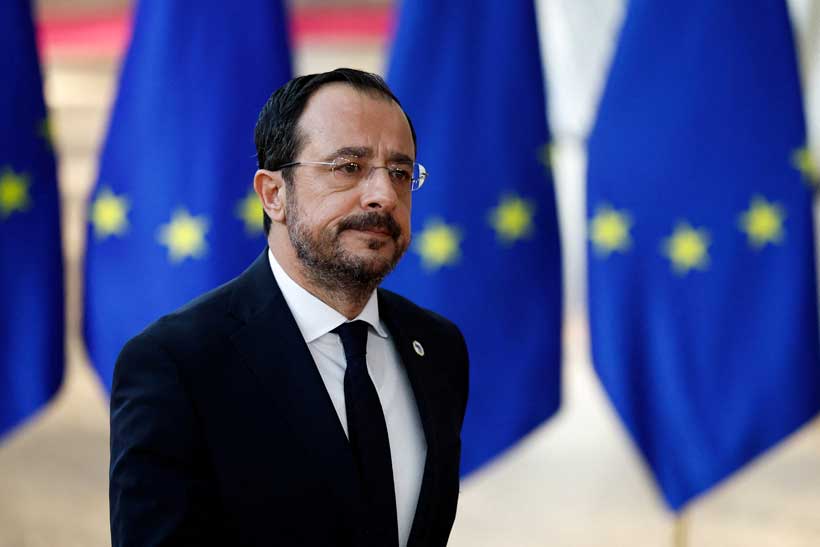
Cyprus itself continues to frame the appointment as a vindication of its European strategy regarding the Cyprus issue. Cypriot President Christodoulides welcomed it as ‘another tangible result of the consistent strategy’, underscoring the importance that the European Union bodies give to the Cyprus issue as a broader problem of the European continent.
Why Nicosia Won’t Move
Why does Cyprus continue to oppose Turkey’s participation in the European Defence Industry Programme (EDIP) and the Security Action for Europe (SAFE)? The answer lies in what has become a consistent principle of Cypriot established policy in the Cyprus Question. Nicosia’s approach maintains that a meaningful defence cooperation with Turkey cannot be separated from the unresolved security situation on the island. As long as Turkish troops are kept stationed in the northern part of the island, successive Cypriot governments have argued that Turkey’s participation in EU defence initiatives would be incompatible with Cyprus ‘ security interests and against the European defence strategy. This perspective reflects Cyprus’s long-standing attempts to externalise and internationalise the Cyprus issue, particularly through the European Union. This demonstrates why Cyprus seeks to frame the dispute as a European matter rather than as a bilateral or regional frozen conflict. From this viewpoint, Cyprus argues that a state maintaining military forces in part of an EU member state should not participate in European defence programmes until the underlying political dispute is resolved.
A Persistent Standoff
Without a settlement that addresses Cyprus’s security concerns and provides credible security guarantees, Nicosia is unlikely to alter its position on Turkey’s participation in initiatives such as SAFE. Whether this change depends less on Ankara’s growing strategic value than on developments within the UN-led process itself. Fitto’s appointment signals that Brussels is prepared to invest more in creating conditions for a settlement. However, both Turkey and Turkish Cypriot leadership have responded with scepticism rather than welcome: Ankara has described the appointment as an internal EU matter and repeated the argument that the EU lost its impartiality when it admitted Cyprus in 2004, while the Turkish Cypriot side has flatly refused it. As long as the Cyprus Question remains unresolved, Europe’s strategic need for Turkey will continue to coexist with the political limitations imposed by one of the European Union’s longest-running disputes.
