


Economically it is fair to ask how long the Americans, set on their current fiscal path, will be able to support their current defense spending and economy. Now, President Trump is intent on driving most of the Western countries in NATO into the same financial crisis to which America is headed. The Americans almost certainly have a fiscal and monetary crisis looming ahead that is like an immoveable iceberg. America now routinely requires around 6% of their annual GDP to finance their fiscal deficit just to support their current level of expenditures in a growing economy. Their defense budget in 2024 was 3.4% of GDP, which means that bondholders financed the entire US Department of Defense budget. In FY 2026-2027 there is the request to add a further $500 billion, or almost 50% more, to the prior year budgeted amount. Have legislators proposed any tax increases to help pay for it? No, they cut taxes in 2025 in the GOP’s signature OBBBA. Debt financing expenses accounted for a further 3.2% of GDP, or $1.0 trillion US dollars, for FY2026. Just putting that amount of interest paid in context, that amount of money is more than the entire Canadian federal government’s net debt owed to borrowers, which at the end of 2025 stood at $1.2665 trillion Canadian dollars.
The United States, as the global reserve currency, can monetize the debt it has if it wishes by printing dollars to repay it, but that would add significant inflationary fuel to an economy with elevated levels already and hasten the inevitable. The appointment of Kevin Warsh as Federal Reserve Chair was supposed to allow President Trump to lower the Federal Reserve rate and reduce overnight borrowing costs, which the Fed controls, but Trump’s disastrous war with Iran has short-circuited those plans. It now looks like the Fed will be forced to raise rates before lowering them. That will mean US borrowing costs are going to rise even further. Just as all the simulative effects of the tax cuts from the OBBBA have run their course of boosting growth. To make matters worse, the US Social Security Trust Fund is projected to be exhausted in 2032, meaning that American taxpayers will have to pay for the difference in contributions and retiree payouts. In reality, they already are, but over-contributions count as government revenue, so it lowers the deficit figure on paper.
America is truly on an unsustainable fiscal trajectory and saddled with a very partisan and divided government, incapable of providing real sound fiscal management, regardless of which party is in power. Neither party seems politically willing to make the truly hard choices confronting them on spending, taxation, and budget cuts. Like Rome, America has grown very affluent and powerful but has become increasingly inward and grievance-focused. The inevitable fall, when it comes, I fear it will not be the gradual sunset of the British Empire but more like the fiscal sacking of Rome this time by bond vigilantes. As Professor Sir Niall Ferguson wrote, great powers that spend more on interest payments than on their defense budget are not great powers much longer. That day came in 2025, and the Iran war results seem to reinforce that thesis.
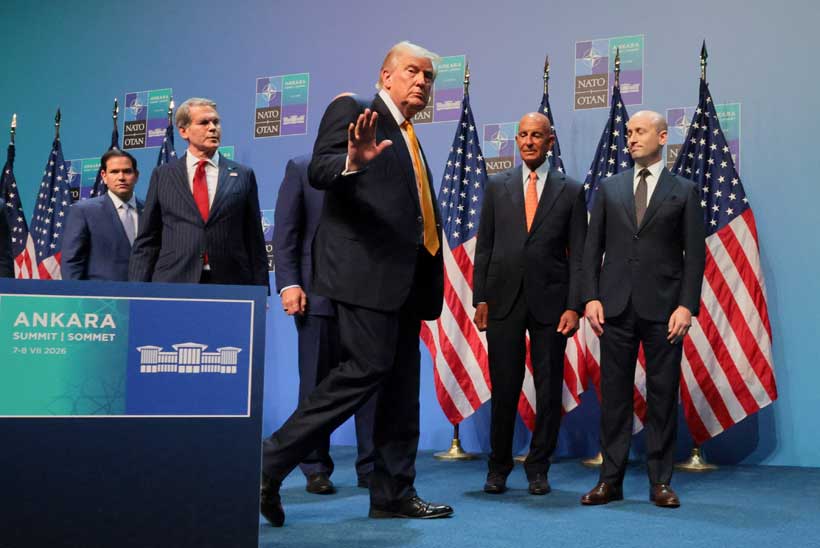
Why should this concern NATO? In 2025, all member states collectively agreed to raise their defense expenditures to 5% with 3.5% core defense spending by 2035. Canada was one of the nations that agreed; Prime Minister Carney had in fact just raised Canadian defense spending to the older 2% target in 2025, years earlier than his predecessor PM Trudeau had said Canada would. Now at the NATO summit just held in Ankara, Türkiye, we saw pushback on the 5% level from Spain and Italy and some waffling by others. Spain, Italy, Greece, France, and the UK, amongst others, already have very large national debt burdens and large fiscal deficits, which support large social programs, and have populations that do not welcome the massive defense spending increases requiring social spending cuts. They are all increasingly acutely aware of the domestic consequences all this additional spending will have on their already precarious fiscal situations.
Stay ahead of the geopolitical week.
MD Briefing delivers expert analysis across five global fronts — the Indo-Pacific, energy, geoeconomics, European security, and the Middle East — every Monday morning. Free.
Europeans are already facing high VAT taxes and higher personal and corporate tax rates, and the continent is experiencing suboptimal growth along with a rapidly aging demographic. That is not a combination one relishes while having to pay for a steeply rising defense bill. Countries like Germany, Finland, Sweden, Norway, and Poland face much lower debt burdens, having practiced fiscal prudence before, allowing them borrowing flexibility in deciding immediately between funding either social or military spending priorities with their aging demographics. Canada is a NATO outlier of sorts, with a younger demographic, due entirely to open government immigration policy up until recently. Canada also enjoys a lower federal debt position, gained from years of fiscal austerity from the mid-1990s to 2015, and thus seems also better able to weather the ability to ramp up spending.
In 2025, with Donald Trump’s re-election, came the Trump tariffs, CUSMA uncertainty, 51st State threats, and threats against Greenland and NATO. European NATO partners, as the Wall Street Journal is reporting, were actually prepared to engage in combat against the US if Donald Trump had carried out his threat to seize Greenland in January of 2026. America, an empire in decline, has become increasingly predatory as its relative strength weakens, and weakening it is a fact. The Iran War, which America began without seeking prior NATO consultation or assistance to weaken Iran, has instead turned the Strait of Hormuz into an Iranian point of strength, curtailing 20% of the world’s petroleum and some critical resources from markets, causing inflation and cutting growth worldwide.
Led by the Secretary General Mark Rutte, NATO has taken an appeaser’s tack with Trump, using flattery and yielding to mollify him. The problem with the 3.5 and 5% goals is they are unyielding numbers. NATO nations do need to ramp up spending on the militaries to defend against the very real threat of war, and everyone is. But leaders also need to keep an eye out for the threat to the very fabric of their societies and finances as well. The world’s largest debtor has demanded some of them essentially also bankrupt their finances and join America in the march to fiscal insolvency. That pressure puts the entire banking and financial system under threat right now. America is a thermonuclear debt bomb that by all logic will go off and likely soon. Since George W. Bush and the end of the Clinton era budget surpluses, Americans have piled on debt, buying themselves prosperity and paying for wars with unconstrained borrowing, and now in displays of unadulterated crony capitalism and political decadence, billions in treasury funds are doled out to supporters of the president’s pet projects. Further, America is embarking on military adventures of choice, like Iran, adding even more debt to the mountain.
The time to pay the piper is approaching, and this time it will not be like Argentina or a peso crisis or even 2008 again. The epicenter will be the heart of the financial universe, the American sovereign debt market. America’s fiscal mismanagement is marching them headlong towards a debt default, led by a president who has previously used bankruptcy 6 times to escape his debt and a Congress that cannot do anything but cut taxes and starve revenue. President Trump knows foreign bondholders will get stiffed, but he doesn’t care; to him, they have been taking advantage of America anyway. If the Democrats win in the November midterms, they might attempt to restrict the Trump administration with funding constraints via the debt limit. Can we trust President Trump to prevent any default? Regardless of the spark, since the US dollar is entwined everywhere in our world, central to the global financial system, what happens to the holders of those dollar debts if they become worth significantly less?
A US debt default will be an event that will wipe out nations and wealth on a scale unheard of, and like all bankruptcies, it is coming slowly at first and then all at once. Any haircut on US debt, since it is held everywhere so widely as safe capital, will blow up balance sheet collateral on a scale that makes AIG in 2008 look like a firecracker. Where does one put money if the safe bet is no longer safe? If one believes the American dollar as well as other paper currencies tied to the dollar are indeed headed to Weimar status and is looking to preserve wealth, cryptocurrency and gold seem today’s go-to alternatives. Donald Trump coincidentally loves both, having asked repeatedly if Fort Knox does indeed hold “all that gold” and having made billions in cryptocurrency ventures personally as president already. It is noteworthy, despite the veneer of financial market calmness, to observe the moves in gold holdings and diversification by central banks since 2025. The markets are herd oriented, and as 1929 and 2008 showed, once momentum shifts, it can shift very violently.
European NATO nations and Canada need to radically adjust their paradigm and adopt a more flexible policy for members increasing defense spending based on a realistic assessment of the fiscal risks and burdens of 5% on each nation and its populace, regardless of American demands. Those same NATO nations, being part of more than just a military alliance but economic partners as well, also need to be actively planning to not only deal with the military threats of Russia and to the Arctic but also a diminished American NATO presence. They also need to actively involve their central bankers and treasury officials and begin wargaming their political, military, and financial options for how to survive the almost inevitable financial crisis barreling down upon them all from their largest alliance member and the greatest potential threat to their continued existence, continued American fiscal mismanagement. Interestingly, Mark Carney, a former central banker, is the ideal choice to lead this whole-of-government effort to prepare Europe and Canada to survive an economic Armageddon.
