


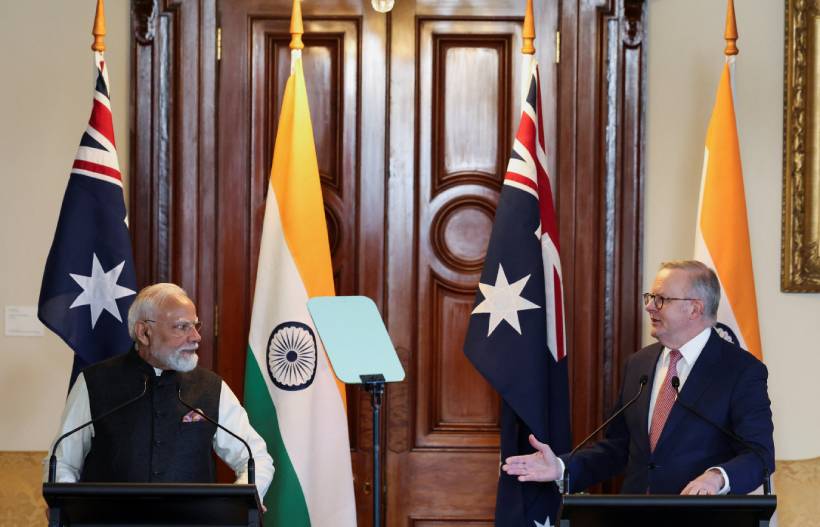
Australia and India reached an agreement on Thursday to allow Australian uranium exports for India’s civilian nuclear energy programme, marking a significant step in bilateral ties as the two countries deepen cooperation on clean energy, critical minerals and strategic trade.
The agreement was announced during Indian Prime Minister Narendra Modi’s visit to Australia, where he held talks with Australian Prime Minister Anthony Albanese in Melbourne.
“Australia and India are close partners and even closer friends,” Albanese said after the deal was finalised.
He said the arrangement would help India expand its non-fossil fuel electricity generation while creating another export market for Australia’s resource sector.
Stay ahead of the geopolitical week.
MD Briefing delivers expert analysis across five global fronts — the Indo-Pacific, energy, geoeconomics, European security, and the Middle East — every Monday morning. Free.
Deal supports India’s nuclear expansion plans
India has been seeking access to Australia’s large uranium reserves to support its ambitious goal of reaching 100 gigawatts of nuclear power generation capacity by 2047.
Although Australia and India signed a civil nuclear cooperation agreement in 2014, uranium exports have remained limited because of concerns over ensuring Australian uranium would be used solely for peaceful purposes.
The new arrangement is expected to remove a major obstacle to expanding nuclear energy cooperation between the two countries.
Clean energy partnership expands beyond uranium
Alongside the uranium agreement, Australia and India agreed to strengthen collaboration across several emerging sectors, including renewable energy, critical minerals, green hydrogen and low-carbon industrial development.
Modi said Australia’s expertise, investment capacity and natural resources could play an important role in supporting India’s transition towards cleaner sources of energy.
He also highlighted opportunities to cooperate on low-carbon aluminium production and other sustainable manufacturing industries.
“We have historic opportunities to cooperate in this field,” Modi said.
Modi encourages Australian investment in India
Addressing Australian business leaders, Modi invited long-term investment in India’s rapidly expanding infrastructure sector, including roads, ports, railways and urban development.
“India provides a safe, stable and sustainable growth option for your funds,” he said.
His remarks came as Australia’s largest pension fund, AustralianSuper, announced it would invest an additional A$500 million (US$347 million) in India’s National Investment and Infrastructure Fund.
The investment reflects growing confidence among Australian institutional investors in India’s long-term economic growth.
Trade relationship continues to deepen
India has become Australia’s fifth-largest trading partner after China, Japan, the United States and South Korea.
At the same time, Australia is seeking to diversify export markets beyond its heavy dependence on China, making India an increasingly important strategic and economic partner.
Albanese described Modi as “a living bridge” between the two countries, saying his leadership had reshaped Australia’s approach to economic engagement with India.
Strong people-to-people links also underpin the relationship. Around one million Australians trace their ancestry to India, making the Indian diaspora one of Australia’s largest migrant communities.
Modi continues Indo-Pacific diplomatic tour
Australia is the second stop on Modi’s regional tour after Indonesia, where he signed agreements covering agriculture, defence cooperation and the BrahMos cruise missile system.
During his visit to Australia, Modi is also expected to address thousands of members of the Indian diaspora at a large gathering in Melbourne, continuing a tradition of major overseas events attended by expatriate Indian communities.
He is scheduled to travel to New Zealand on Friday before returning to India.
Analysis
The uranium export agreement reflects the growing strategic convergence between Australia and India as both countries seek to strengthen economic resilience and diversify critical supply chains across the Indo-Pacific. For Australia, expanding uranium exports opens a new long-term market while reducing reliance on China. For India, securing a stable uranium supply supports ambitious plans to expand nuclear power as part of its broader energy transition and climate goals.
The deal also signals that bilateral ties are moving beyond traditional trade into strategic sectors such as critical minerals, green hydrogen and clean manufacturing. These industries are increasingly viewed as essential to future economic competitiveness and energy security.
Beyond energy cooperation, the agreement highlights India’s growing importance in Australia’s foreign and economic policy. With investment flows increasing and defence cooperation expanding, both governments appear committed to building a broader strategic partnership that extends across infrastructure, technology and regional security.
Future outlook
The uranium agreement is likely to pave the way for increased Australian resource exports to India and deeper collaboration on clean energy technologies. If successfully implemented, the partnership could expand further into nuclear fuel supply, critical mineral processing, green hydrogen projects and infrastructure investment, strengthening both countries’ roles in the Indo-Pacific’s evolving economic and strategic landscape.
With information from Reuters.
