


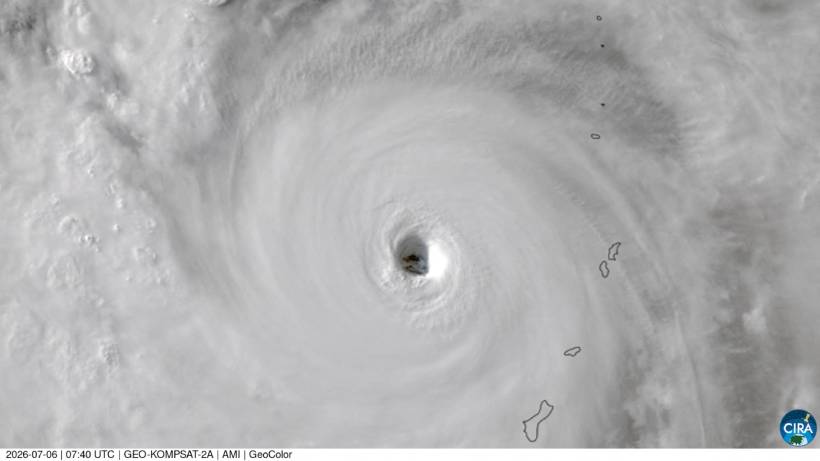
China and Taiwan are preparing for what forecasters say could become one of the most powerful tropical storms to strike the region in years, as Typhoon Bavi approaches with sustained winds nearing 200 kilometres per hour.
Authorities have urged residents to stock up on supplies, secure homes and prepare for possible evacuations as the storm advances across the western Pacific.
The preparations come while parts of southern China are still recovering from the deadly destruction left by Typhoon Maysak earlier this week.
Massive storm expected to hit Taiwan and eastern China
According to China’s National Meteorological Centre, Typhoon Bavi is expected to skirt northern Taiwan before making landfall in China’s eastern Fujian province on Saturday evening.
Stay ahead of the geopolitical week.
MD Briefing delivers expert analysis across five global fronts — the Indo-Pacific, energy, geoeconomics, European security, and the Middle East — every Monday morning. Free.
The storm currently spans roughly 1,000 kilometres in diameter about the width of France making it unusually large by regional standards.
Taiwan’s Central Weather Administration said Bavi could become the island’s largest typhoon by size since 1987.
Forecaster Jason Chang said storms of this scale have become relatively rare in recent years.
Authorities also warned that Bavi could be Taiwan’s strongest typhoon since Typhoon Kong-rey struck in 2024, killing three people.
Residents rush to prepare
In Taiwan’s northeastern fishing port of Suao, hundreds of fishing vessels crowded into harbour seeking shelter ahead of the storm.
Residents lined up to collect sandbags from local authorities, while farmers rushed to harvest rice before weather conditions deteriorated.
Fishing boat captain Chen Ming-hui said previous typhoons had sunk vessels and flooded the town.
“Don’t be fooled by the nice and calm weather now. A storm like this could be the most terrifying,” he said.
China still recovering from Typhoon Maysak
The arrival of Bavi threatens to compound the damage caused by Typhoon Maysak, which swept through China’s Guangxi region earlier this week.
Chinese officials said Maysak killed at least 39 people, while nine others remain missing.
Rescue teams continue searching damaged communities as residents attempt to recover homes, businesses and farmland before another major storm arrives.
State media showed rescue workers evacuating trapped residents, while drones were used to deliver emergency supplies to isolated communities.
Floodwaters also devastated livestock farms, while local media reported that three lions died at Guigang Zoo and around 100 animals remained missing after flooding destroyed enclosures.
Japan also prepares for severe weather
The storm is expected to affect Japan’s Okinawa Prefecture before moving toward China.
Japan’s Meteorological Agency warned residents to prepare for violent winds, storm surges, flooding and landslides.
Airlines began cancelling flights ahead of the storm.
Japan Airlines cancelled 50 flights for Friday, affecting more than 7,600 passengers, while All Nippon Airways cancelled dozens of domestic services serving Okinawa’s island airports.
Scientists warn climate change is increasing storm risks
Scientists say East Asia is becoming increasingly vulnerable to destructive tropical cyclones as climate change raises sea temperatures and increases atmospheric moisture.
This year’s expected development of El Niño conditions could further strengthen storms by providing additional ocean heat energy.
AccuWeather meteorologist Jason Nicholls said Bavi would remain a dangerous storm even if it weakened slightly before landfall.
Xiangbo Feng, a tropical cyclone researcher at Imperial College London, warned that Bavi had spent an extended period intensifying over warm Pacific waters.
“When it makes landfall or gets close to coastal regions, the damage could be catastrophic,” Feng said, adding that even small changes in the storm’s track could significantly alter the areas most heavily affected.
Analysis
Typhoon Bavi underscores the growing vulnerability of East Asia to increasingly powerful and destructive weather events. Its arrival immediately after Typhoon Maysak raises concerns about “compound disasters,” where communities already weakened by one catastrophe have little time to recover before another strikes.
The storm also highlights the mounting economic risks posed by climate change. China, Taiwan and Japan are major manufacturing and shipping hubs, meaning prolonged disruption could affect global supply chains, transportation and agricultural production. The potential emergence of El Niño, combined with warmer ocean temperatures linked to climate change, is expected to increase both the intensity and frequency of tropical cyclones across the region.
For emergency authorities, Bavi will test disaster preparedness systems developed after recent deadly storms. Effective early warnings, evacuations and infrastructure resilience will be crucial in limiting casualties and economic losses.
Future outlook
Forecasters expect Typhoon Bavi to remain a powerful system through the weekend as it approaches Taiwan and eastern China. Emergency agencies across Taiwan, China and Japan are likely to maintain high alert levels, with further evacuations, transport disruptions and flood-control measures expected. Scientists also warn that the western Pacific could experience an above-average typhoon season in the coming months as El Niño conditions develop and ocean temperatures remain exceptionally warm.
With information from Reuters.
