


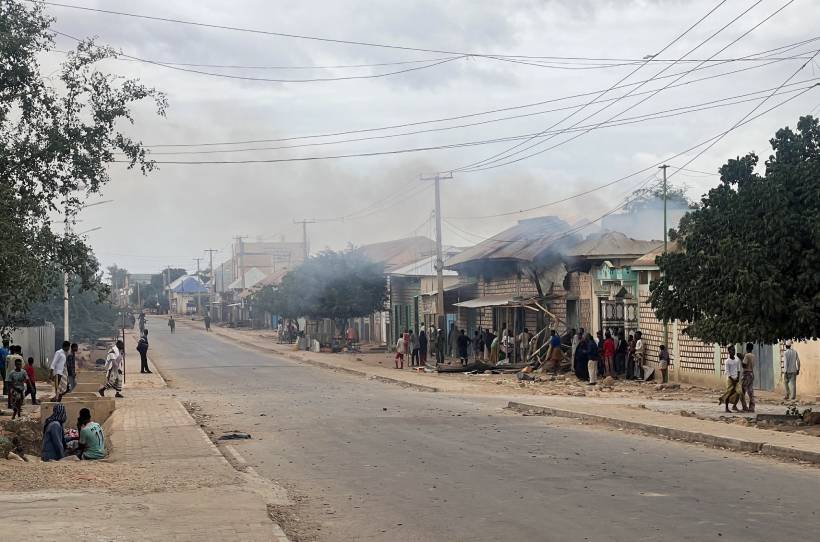
Federal Troops Regain Control
Somali federal forces pushed opposition fighters out of Baidoa on Monday after hours of intense fighting in one of the country’s largest cities, residents told Reuters. The clashes left a number of people dead and marked the most serious fighting in the city since federal forces seized control in March.
The fighting involved federal troops and forces loyal to former South West state president Abdiaziz Hassan Mohamed Laftagareen. Residents said federal forces eventually regained control of the city centre after fierce exchanges.
Somalia’s Defence Ministry said its forces came under attack before dawn from fighters using vehicles loaded with explosives. The ministry said federal troops repelled the assault and killed around 30 attackers.
Reuters verified social media footage showing federal soldiers firing from an armoured vehicle and civilians carrying wounded people through Baidoa’s streets.
Stay ahead of the geopolitical week.
MD Briefing delivers expert analysis across five global fronts — the Indo-Pacific, energy, geoeconomics, European security, and the Middle East — every Monday morning. Free.
Political Rivalry Fuels New Violence
The fighting reflects a broader political struggle between Somalia’s federal government and powerful regional administrations.
Laftagareen’s administration had previously severed ties with Mogadishu, accusing the federal government of attempting to expand its authority over regional affairs. Federal forces subsequently took control of Baidoa in March, after which Laftagareen resigned.
His supporters have continued opposing the federal government, adding another layer of instability to a country already battling the al Shabaab insurgency.
Regional authorities have also resisted Mogadishu’s influence over state elections and rejected proposed constitutional changes that they argue would concentrate greater power in the executive.
The latest clashes therefore cannot be viewed solely as a security confrontation. They also expose the unresolved struggle over Somalia’s federal political structure and the distribution of authority between Mogadishu and the states.
Conflicting Claims Over Baidoa
The situation remained contested during the fighting.
Laftagareen’s camp claimed earlier on Monday that its forces had captured the city centre. The group could not immediately be reached for comment after federal troops pushed the fighters out.
Somalia’s Defence Ministry, meanwhile, portrayed the fighting as an attack against government forces and said its troops had successfully defeated the assailants.
Residents offered evidence of significant casualties. Local elder Farah Ibrahim told Reuters he had seen 10 dead people, including civilians and soldiers from both sides.
The competing claims underline the difficulty of establishing the full scale of the fighting while the political confrontation remains unresolved.
Baidoa’s Humanitarian Crisis Deepens the Stakes
The violence is particularly significant because Baidoa is home to hundreds of thousands of people displaced by conflict and hunger elsewhere in Somalia.
The city is already facing severe humanitarian pressures. A July survey by Médecins Sans Frontières found that one in four children living at displacement sites in Baidoa was severely malnourished.
Renewed fighting threatens to worsen those conditions by restricting movement, disrupting aid operations and creating further displacement.
For civilians, the political struggle between federal and regional authorities is therefore taking place against the backdrop of an already critical humanitarian emergency.
Analysis: Somalia Faces a Two Front Political and Security Crisis
The fighting in Baidoa highlights a fundamental problem confronting Somalia: the federal government is attempting to consolidate national authority while simultaneously relying on regional cooperation to fight armed groups and address humanitarian crises.
That creates a dangerous contradiction.
Mogadishu needs stronger central coordination to confront al Shabaab and manage national security. But aggressive attempts to consolidate authority can provoke resistance from regional leaders who fear losing their political and constitutional autonomy.
Baidoa has consequently become more than another conflict zone. It represents the broader struggle over what Somalia’s federal system will look like and who ultimately controls the country’s security and political institutions.
The timing is especially problematic for the federal government. Somalia is already confronting the long-running al Shabaab insurgency, while famine and displacement continue to place enormous pressure on state institutions. Fighting against regional opposition forces risks diverting troops, resources and political attention away from the militant threat.
At the same time, allowing armed opposition forces to challenge federal authority without a response could encourage other regional actors to pursue similar confrontational strategies.
The Risk of a Wider Fragmentation
The immediate federal victory in Baidoa may restore government control over the city, but it does not necessarily resolve the political dispute that produced the confrontation.
If regional grievances remain unresolved, military control could provide only a temporary solution.
The greater risk is that Somalia develops competing centres of armed authority at precisely the moment when the government needs political cohesion. Such fragmentation would complicate the fight against al Shabaab and make humanitarian operations even more difficult.
The Baidoa clashes therefore carry significance beyond the city itself. They demonstrate how Somalia’s security crisis is increasingly intertwined with its constitutional and federal power struggle.
Unless Mogadishu and regional authorities find a political mechanism for resolving disputes over elections, constitutional reform and the distribution of power, military victories may repeatedly give way to new confrontations.
For Somalia, the challenge is no longer simply defeating insurgents. It is building a political system strong enough to prevent internal rivalries from becoming another source of armed conflict.
With information from Reuters.
