
Passage by Passport
On Tuesday, as Americans voted in the midterms, an Iranian lawmaker announced that ships from India, China, Iraq and Qatar would be exempt from Hormuz transit restrictions. Indian and Chinese ships would pay a fee, and everyone else would stay at risk. That same week, a tanker of Russian diesel was sailing for New York, sent after a Trump-Putin deal to ease US fuel prices. The US Strategic Petroleum Reserve held 283.8 million barrels, its lowest level since 1982.
Read together, these are not three separate stories. They show that the world’s emergency oil system rests on an assumption that no longer holds. It was built on the idea that a supply shock hits every importer alike and that shared stockpiles can bridge it. In 2026 access to oil is allocated by flag, and the largest buffers sit outside the system altogether.
A Bridge Built for Weeks
The International Energy Agency was created after the 1973 Arab oil embargo around one rule: members hold stocks equal to at least 90 days of net imports and release them together in a crisis. In March its members pledged 426 million barrels, more than twice the 2022 total and the largest action in its history. About 330 million had reached the market by mid-October. On 2 October the G7 agreed to release up to 100 million more barrels over four months, most of it diesel.
Stay ahead of the geopolitical week.
MD Briefing delivers expert analysis across five global fronts — the Indo-Pacific, energy, geoeconomics, European security, and the Middle East — every Monday morning. Free.
The shock those stocks are meant to bridge is still running. About 20 million barrels a day passed through Hormuz before the war began on 28 February. When protection-and-indemnity insurers withdrew war cover in early March, tanker traffic fell to zero. Bypass pipelines can carry about 9 million barrels a day. MD warned last month that the reserves are running dry. The deeper problem is the design of the system itself.
Four Assumptions, All Broken
The 1974 system rested on four assumptions: that shocks are short, that the big stockholders are inside the club, that its anchor member wants to hold oil, and that disruption means a cartel turning off taps. In 2026 all four have failed.
Start with time. March’s record release equalled about four days of world consumption, or roughly 20 days of pre-war Hormuz flows. Stockpiles are measured in barrels, but a closure is measured in time. A finite buffer cannot cover an open-ended outage. It can only buy time for a deal, new routes or lower demand, and eight months in, none of those has arrived at the scale needed.
Second, the largest stockholder is not a member. China holds an estimated 1.2 to 1.4 billion barrels), more than the US reserve several times over. Since a 2025 energy law made reserve-holding a legal duty for its companies, it has kept building. During the war, Beijing drew on commercial stocks at about 1 million barrels a day and kept adding to its strategic reserve. That eased the global market, but on China’s terms, with no coordination and no obligation to continue. Now that its ships can pay their way through Hormuz, its buffer is backed by access as well as barrels.
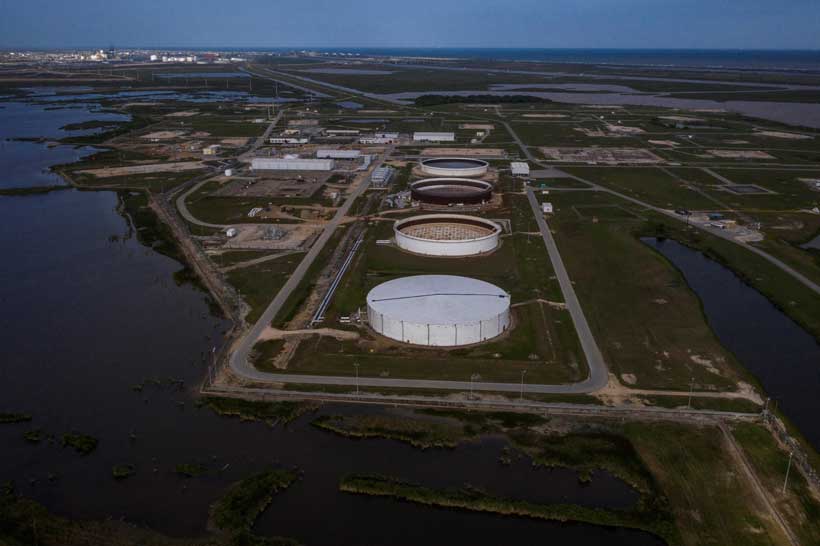
Third, the anchor member has stopped acting as one. As a net exporter, the United States has no 90-day obligation, yet it supplies more than 40% of any collective release. Its reserve is physically worn out. The Government Accountability Office warned in June of a growing maintenance backlog, and an Atlantic Council brief cites GAO findings that drawdown capability stood at 61% of design and fill capability at 56%. Politically, the reserve was spent into a midterm campaign, and Washington’s last-minute fix was Russian diesel.
Fourth, the threat has changed shape. In 1973 Arab producers cut supply. In 2026 the strait is legally open but commercially closed: insurers refuse cover, mines and drones do the rest, and Iran’s new Persian Gulf Strait Authority sells permits for safe passage. Washington has warned that paying those tolls risks US sanctions. The law of the sea allows only transparent, non-discriminatory fees. Iran is selling discriminatory passage, and none of the 20th-century institutions has stopped it.
So who holds the spare capacity now? Not OPEC, whose idle wells sit mostly behind the closed strait. As one analysis put it, a barrel trapped behind Hormuz is not spare capacity. Saudi Arabia’s East-West pipeline was already running at its 7 million barrel-a-day limit in March. The real spare capacity now takes three forms: access through the strait, which Iran grants to China and India; refining, held by the US, India, China and Russia; and demand destruction, which falls hardest on poor importers. China holds the biggest buffer, but as a national hedge. The United States holds a political lever, export bans and side deals, but not the barrels.
The strongest objection is that the system is working. IEA governments still hold over a billion barrels, and the March release did calm prices. Both points are true, but the large total is misleading. Much of what remains is the operating stock refiners need to function, and the US share sits in a degraded reserve that will take months to refill. The forecast surplus for 2027 that would refill the tanks assumes Gulf output returns to pre-war levels by the second quarter. Without that, the expected glut turns into a second winter of shortage. A buffer is only as good as what governments do with the time it buys. They have used it to wait.
Three Ways the Stocks Run Out
Base case (roughly 50%): scraped through, then expensive. A US-Iran deal after the midterms brings a phased reopening in the first half of 2027. IEA members finish the winter with stocks at multi-decade lows, and buying back hundreds of millions of barrels keeps prices high just as consumers expect relief. The IEA opens talks on coordination with China and India, but nothing binding results. The key assumption is that post-election talks move within weeks.
Downside case (roughly 30%): the tolled strait becomes normal. Iran’s permit regime hardens into a two-tier market. Exempt Asian flags pay a fee and pass, while Western-linked shipping stays out. A third collective action forces governments into obligated industry stocks, and export bans spread, starting with diesel. Thin-buffer importers such as Pakistan and Vietnam face physical shortages. For businesses this means oil priced by flag and route, not only by grade. The early warning is a third IEA action proposed before the end of January.
Upside case (roughly 20%): a second 1974 moment. An early reopening brings the expected 2027 surplus forward, and governments refill at lower prices. The crisis then becomes the reason to rebuild the system. That would mean dedicated diesel and jet-fuel reserves, a coordination deal with Beijing and New Delhi, funded repairs to the US reserve, and a government-backed war-risk insurance scheme for chokepoints. This requires the US and China to treat stock coordination as a shared interest at a time of rivalry.
Permission, Not Barrels
The world’s oil buffer is not empty, but it is badly located, partly unusable and mostly owned by the wrong people. The 1974 system can still release oil. It cannot decide who gets through the strait, refine crude into diesel, or make China share its reserve.
Watch for: whether the IEA or G7 moves toward a third collective release before the end of January, and whether Beijing joins it. A third release without China confirms the club is shrinking to its weakest members. China at the table would be the first real reform since 1974.
The emergency system was built to share out scarcity. This crisis is teaching governments that what is scarce now is not oil, but permission to move it.