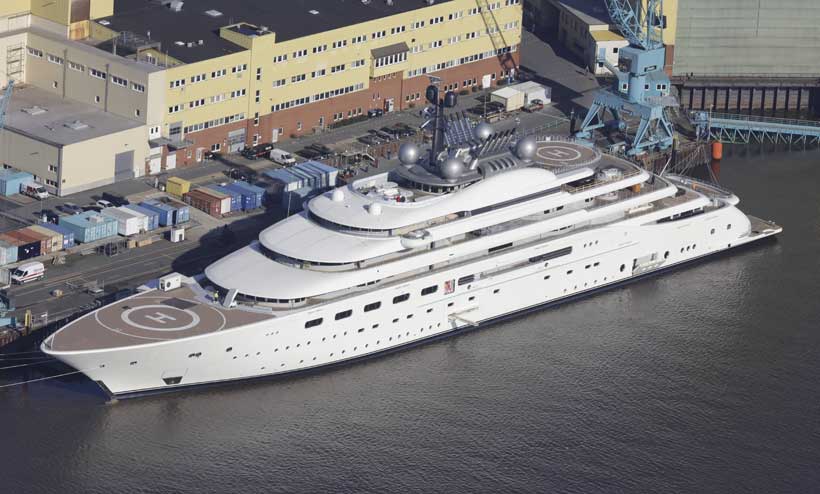
At Lürssen’s Berne yard on the Weser River, Floating Dock 10 holds a superyacht that isn’t going anywhere. The Dilbar — 156 metres long, with a 25-metre pool and two helipads — has sat there since 2022, frozen under EU sanctions once linked to the Russian-Uzbek billionaire Alisher Usmanov, costing roughly €50,000 a day just to keep its systems alive. A few piers over, between March and June this year, six entirely different yachts left the same shipbuilder’s other berths for owners with no such legal complications: 655 metres of hull, worth a combined $2.2 billion, delivered in just 105 days.
Lürssen calls it a record — the fastest run of deliveries in the yard’s 148-year history, four of the six vessels over 100 metres long. “Delivering six yachts in a single year is a remarkable achievement,” said chief executive Peter Lürssen, crediting “the commitment of everyone involved.” But the compressed timeline says less about a sudden burst of shipyard efficiency than about who, exactly, was ready with cash in the same fifteen-week window — while the yard’s highest-profile asset of the past four years has been one it cannot sell, launch, or even legally maintain without suing its own government for relief.
Set against the Dilbar case, the six deliveries chart where superyacht money has actually moved since the sanctions era began. Deep Blue, the largest of the batch at roughly 134 metres, was built for Liu Qiangdong, the JD.com founder sometimes called China’s Jeff Bezos. Boardwalk, at 117 metres, went to Tilman Fertitta, the Texas restaurateur now serving as US ambassador to Italy. O3, a 109-metre explorer yacht fitted for Greenland and Antarctic waters, is reportedly bound for Len Blavatnik, owner of Warner Music. A Lürssen order book this size a decade ago would likely have carried at least one Russian name. Today it reads like a partial map of where the industry’s money went instead — Chinese tech wealth, American media and hospitality fortunes, diversified Gulf and Western capital — while Usmanov’s yacht sits in dry dock as the visible remainder of a clientele the yard no longer builds for.
The other three vessels make the same point a different way: this isn’t one design repeated at speed, but six genuinely different bets on what a superyacht is for. Nausicaä, styled by the designer Marc Newson, wraps 114 metres of hull in curved glass and a sculptural dome that has split opinion among brokers. Nixie, at 102.4 metres, carries a six-metre floating glass pool and is heading straight into charter, at a reported $3 million a week. Odisea, the smallest at 78.2 metres and the first Lürssen hull built to a single outside studio’s full design brief, is built around a beach club, an outdoor cinema and sports courts rather than a formal dining room. Custom shipbuilding, in other words, is not a marketing line here — it is six clients answering the same question, “what do you actually want to do with a boat this size,” in six incompatible ways.
Stay ahead of the geopolitical week.
MD Briefing delivers expert analysis across five global fronts — the Indo-Pacific, energy, geoeconomics, European security, and the Middle East — every Monday morning. Free.
The production math behind the record is less dramatic than the headline number suggests. A custom Lürssen build typically takes about four years from keel-laying to handover, involving hundreds of thousands of manufacturing hours; six boats landing in one 105-day window reflects years of overlapping order-book decisions converging, not a new production model. Across the wider industry, yards deliver roughly 184 superyachts a year against order books that still run 24 to 36 months, even as Asia-Pacific’s superyacht fleet grew 43 per cent between 2022 and 2024 and China’s domestic market alone is forecast to reach $1.3 billion in 2026.
The Dilbar saga complicates the celebratory reading. A Frankfurt court ruled in June that EU sanctions no longer apply to the vessel, after finding insufficient evidence tying Usmanov to the trust that formally owns it — a decision still open to appeal, but one that suggests the sanctions regime built in 2022 is loosening at almost the same moment the industry’s buyer base has already moved on without it. Lürssen itself brought the case, arguing it had been left holding a liability running above $70 million a year in upkeep, with no clear legal owner left to bill.
Whichever way the appeal goes, the yard’s next order book has already answered the more interesting question. Six new owners didn’t wait to find out whether sanctioned wealth would return to the market — they simply took its place. The Dilbar may eventually sail again. It just won’t be sailing back into the same industry it left.