


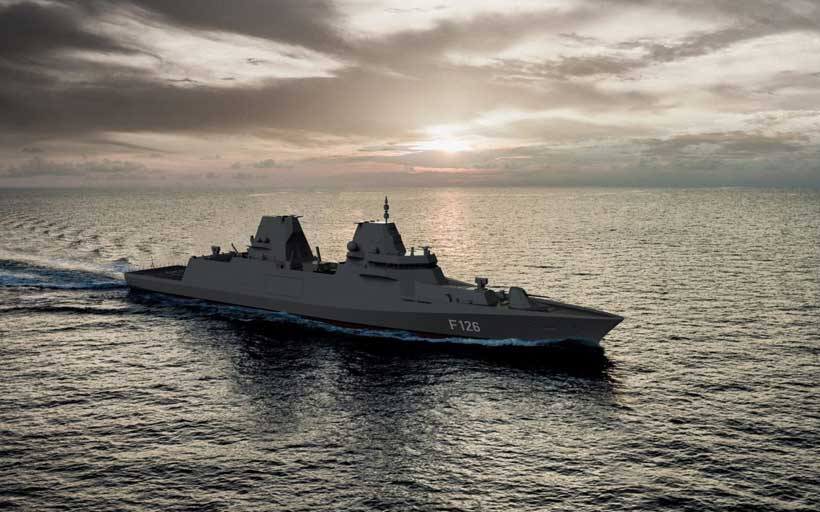
German Defense Minister Boris Pistorius has announced that Germany has officially cancelled procurement of the F126-class frigate. This decision follows numerous issues plaguing the project, such as cost overruns, delays, and industrial bottlenecks. The prospective German warship was intended to replace aging hulls to increase the German Navy’s anti-submarine warfare (ASW) capabilities, improving NATO’s ability to deter threats from Russia’s growing fleet of modern nuclear submarines. In lieu of a bespoke 2020s design tailored to the German Navy’s specifications, German leadership has decided to modify an off-the-shelf design to replace the cancelled project. Rapid German reactions to crises in the F126 project aim to minimize delays in the deployment of new warships, attempting to avoid a reduction in operational readiness that could result from extending the service life of older ships. However, the F126 program’s collapse highlights broader structural problems in German defense procurement that continue to consume time, money, and industrial capacity.
Understanding the German Navy
German naval doctrine calls for the simultaneous operation of three classes of principal warships. The first of the three ships is the Brandenburg-class frigate, or F123. This is primarily an ASW frigate with a displacement of approximately 3,600 tons and an introduction date of 1994. Given its mix of offensive and defensive equipment, this ship is well positioned to act independently or as a part of a larger group to engage in most missions that could be assigned to a frigate.
The Sachsen-class frigate, or the F124, is often characterized as the F123’s larger cousin. Displacing approximately 5,700 tonnes and first commissioned in 2003, the F124 is Germany’s mainstay air-defense frigate. Although it shares many of the anti-ship and anti-submarine capabilities of the F123, its larger size and crew require the dedication of greater resources to this ship’s operation. These additions give it a more sophisticated sensor suite, positioning the vessels as squadron leaders due to improved situational awareness.
Stay ahead of the geopolitical week.
MD Briefing delivers expert analysis across five global fronts — the Indo-Pacific, energy, geoeconomics, European security, and the Middle East — every Monday morning. Free.
The third principal warship operated by the German Navy is the Baden-Württemberg-class frigate, or F125. This vessel has garnered some criticism for its lackluster armament, despite its relatively large displacement of 7,200 tonnes. The F125 lacks any anti-submarine capabilities and carries only short-range anti-air assets. This raises doubts about the F125’s utility on independent front-line operations, instead acting as an anti-ship missile carrier to support more capable smaller German warships. Plans to update the ship to sport medium-range anti-air missiles would considerably increase this class’s capabilities, allowing it to operate comfortably into the future, as it will be the last of these three ships to be replaced.
Existing and Scrapped Procurement Projects
The F126, as an ASW frigate, was intended to replace the F123 but also to increase its capabilities in all respects. Displacing about 10,000 tonnes and intended to significantly expand anti-air and anti-ship capability relative to its predecessor, the F126 was also planned to incorporate modular mission modules which would have allowed the rapid installation of kits that increased its capabilities for certain missions. Additionally, the class was planned to encompass six hulls, an increase over the four hulls of the F123 class. These qualitative and quantitative improvements over its predecessor gave the frigate a considerable estimated price tag of more than €1.4 billion per ship. As the project began to bear fruit in the mid-2020s with the first keel laid in 2024, it became apparent that additional funding was needed to bring the project to completion, on a delayed schedule no less. Reportedly, the German Navy had spent billions on the project that was certain to be years late and over budget. These difficulties appear to have contributed to the decision to scrap the F126 project in favor of a mature design known as the MEKO A-200.
The A-200, another German frigate focused on export rather than domestic use, is a modification of the MEKO 200, which first saw its entry into service in 1987. Despite its design dating to before the ship it is planned to replace, this is a successful design that is operated by no less than eight navies and has seen numerous upgrades over its nearly 40-year service life. The German Navy will be ordering a modernized design planned to displace nearly 4,000 tonnes. The smaller displacement will be compensated for by the purchase of two additional hulls, bringing the planned class to eight vessels. However, it must be noted that these ships, despite displacing only half of what the plans for the F126 called for, will carry a nearly identical price tag of €1.45 billion each. This likely does not reflect an inflated price tag of the A-200 but rather illustrates the scale of the miscalculation of the F126’s initial price estimates.
Unexpected Industrial Difficulties
The F126 project was initially announced as a collaboration between the Dutch shipbuilding conglomerate, the Damen Group, and the German corporation known as the Lürssen Group. This announcement drew controversy from the outset, with competing manufacturer German Naval Yards Kiel tying up procurement for years through a lawsuit contesting the award of a contract regarding what GNY Kiel described as a “key technology” with a foreign company. Despite the lawsuit being settled with the acceptance of GNY Kiel into the project, issues persisted following incompatibilities between the partners. According to industry professionals, the Damen Group’s software had integration difficulties with their German partners, delaying the transfer of technical documents to their German partners. Damen Group was removed from the project in 2025, being replaced with Rheinmetall’s newly acquired naval department. By bringing in an experienced, well-funded defense contractor, it was hoped that the project could be brought back on track through improved integration and streamlining of the different members’ strengths. After assessing the state of the project, Rheinmetall provided the German government with a revised timeline that brought the total cost of six F126 vessels to €18 billion and a delivery date beginning in 2032, constituting an increase of about €10 billion and five years. This proved to be unacceptable for the German Ministry of Defense and heavily contributed to the project’s cancellation.
Another German Procurement Mishap
This cancellation follows the recent news of delays and cancellations of other German military procurement projects, raising questions as to whether German rearmament can proceed as smoothly as intended. The threat of a Russian incursion into NATO territory as soon as 2030 has been reported by numerous NATO leaders and intelligence agencies, resulting in a historical investment by Germany into its military. Following decades of underfunding and atrophy, the German military suffered from low readiness rates and an inability to generate forces sufficient to fight a full-scale land war in Europe. Due to the resurgence of Russia as a credible threat to European security, German investment was envisioned as a necessary step to turn the largest European NATO ally into a bulwark against threats from the East. However, cancellations and delays could result in severely limited increases in readiness if the projects have all been shelved or arrive too late to make a difference in a hypothetical war. The industrial deficiencies that drove the price increases and delays of the F126 are not limited to that project or German ship building in general. Failures for European partners to effectively cooperate in defense matters signal concerns over other joint projects undertaken by European allies. Without careful management of resources and substantive efforts to reform German procurement and manufacturing, additional funding issues could feasibly disrupt the A-200, along with other modernisation efforts.
