


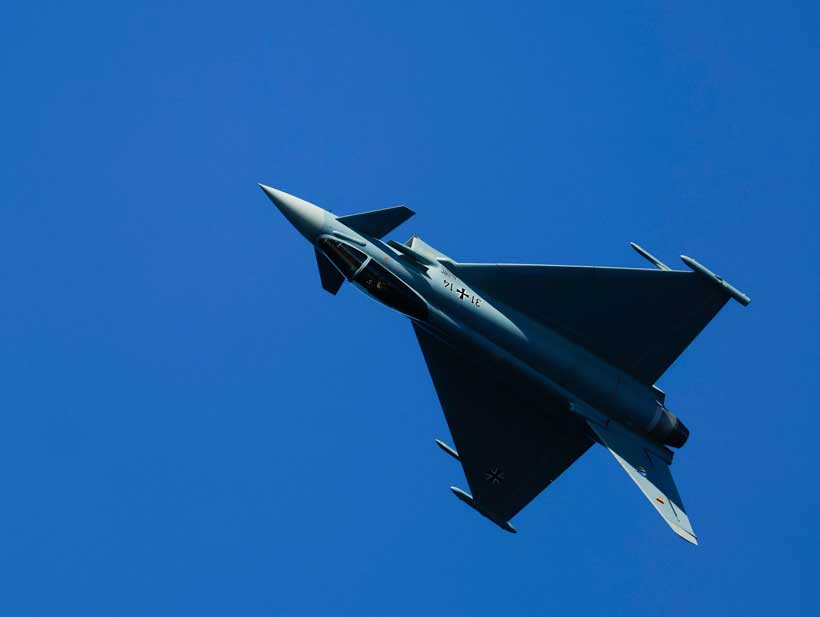
The joint Franco-German-Spanish Next Generation Fighter (NGF) programme was reported officially cancelled on 8 June, 2026. The NGF began development in 2017 as the first, and to date only, entirely European sixth-generation fighter jet programme. NGF was intended to be the centrepiece of a “system of systems” known as the Future Combat Air System (FCAS) project. FCAS is intended to create a network-centric suite of weapons that integrates fighter aircraft, unmanned drones, ground radar, and other information sources to share data and ensure that the combat responsibilities of any one asset are optimised. By operating as a central node for all of these disparate systems, NGF, the manned fighter of the FCAS programme, performs a vital function of implementing human oversight of distributed autonomous systems, ensuring that the many autonomous systems in this network operate as expected.
NGF was envisioned to be a highly stealthy, long-ranged, front-line fighter jet, capable of both controlling high numbers of autonomous drones and performing combat operations itself. Due to concerns about strategic autonomy regarding the recent fallout of Europe and the United States, it was considered highly favourable for the FCAS project to be funded and developed entirely by European partners, unlike the Italo-British GCAP, which partnered with Japan for development. France’s Dassault, Germany’s Airbus, and Spain’s Indra began to develop the FCAS programme in 2012, with work on the NGF being announced in 2017. This portion of FCAS came to an end after 9 years of development. However, FCAS as a wider procurement project persists, providing some optimism for attempts at further cooperative Franco-German next-generation air systems.
Historical Franco-German Joint Projects
Concerns arose early in the project’s history, with pressure arising from disagreements surrounding issues of differing national requirements, export doctrines, and Franco-German competition for status as the project leader. This clearly echoes back to past and present attempts at Franco-German defence industrial cooperation. Past attempts to create military helicopters, such as the NH90 and Eurocopter Tiger attack helicopter resulted in both projects entering the market over-budget, delayed, uncompetitively priced, and mechanically unreliable. In the NH90’s case, to the point where Norway demanded to return its NH90 fleet for a refund. Collaborative issues outside of FCAS persist to today, with the Main Ground Combat System (MGCS), a Franco-German next-generation tank programme, having its mid-2030s timeline already pushed to the mid-2040s. In a case highly reminiscent of NGF, France and Germany had previously participated in a multinational study to develop a fighter known as the European Combat Aircraft (ECA), from which France withdrew amid disagreements over operational requirements, leadership, and design priorities. While these projects all have unique and complicated histories, and failed military procurement projects are not limited to France and Germany, there is a pattern of disputes between these two nations’ military industries.
Stay ahead of the geopolitical week.
MD Briefing delivers expert analysis across five global fronts — the Indo-Pacific, energy, geoeconomics, European security, and the Middle East — every Monday morning. Free.
Design Disputes of NGF Participants
What did the members of NGF seek to achieve with their future fighter programme? Germany is a continental power that tailors its entire military to protecting Europe’s eastern flank from Russian aggression. It will almost always operate aircraft from NATO-standard runways and bases, and almost always on European soil. Germany operates a mixed fleet of air superiority fighters and strike aircraft, allowing the air superiority fighter to focus more heavily on its dedicated task. As Germany already operates a stealthy jet capable of strike missions, the American F-35, the German Luftwaffe requires a stealthy air superiority fighter to replace the non-stealthy Eurofighter. This entails a design more focused on speed, payload, and range. France’s military reflects its status as a global, nuclear power. It holds overseas territories, which it protects with a navy built around aircraft carriers. Carrier-capable fighters require design compromises to ensure they can take off from short runways.
This generally leads to fighters that are smaller, with larger wings and heavier landing systems. France’s air doctrine relies on multirole fighters like France’s current fighter, the Rafale, which is capable of conducting both air superiority and strike missions without significant modifications. From a design standpoint this multirole mission set can dilute characteristics favourable for air superiority performance. Among the most contentious issues is France’s status as a nuclear power, and its nuclear doctrine requiring fighter-launched nuclear cruise missiles. Nuclear missiles are large, heavy, and require specialised equipment. NGF would have required internal accommodation for France’s ASMPA-R, and future ASN4G, nuclear-capable cruise missiles in an internal weapons bay to maintain stealth capabilities. Replacing the Rafale with a jet that can fill the same roles would require compromises that their German partners would have to pay for, while potentially degrading the characteristics they sought in their Eurofighter replacement.
Potential Paths Forward Rejected
This begs the question: did these disputes result in irreconcilable problems? France and Germany, as the two industrial leaders of Europe, both intended to be leaders in the design and procurement of the NGF programme. While this does contribute to increased financial gain from the programme and political prestige, it is an effect of differing design philosophies and doctrinal requirements. A French NGF would have likely been smaller, with much more of its weight and volume dedicated to enabling carrier-capable operations and internal storage of relatively large nuclear missiles. It would likely have had more of a focus on multirole capabilities with air superiority being one of many missions it could have conducted. A German NGF would have likely required heavier emphasis on air superiority, while allowing drone wingmen to conduct strike missions. This likely would have entailed a larger airframe and engines, taking space away from the internal weapons bay, and a smaller wingspan, which would likely be insufficient to launch from an aircraft carrier. This issue is reminiscent of the problem the US military faced as it designed the F-35 fighter jet.
The US military addressed these issues by creating three variants of the F-35 for different purposes. This design philosophy introduces problems, which the NGF designers clearly considered unnnecessary. The F-35 has become a highly capable fighter, but during its development, it was highly criticised for delays, budget overruns, and mechanical complexity. Among the causes of these problems was the three-variant solution, as it required vast resources to stretch the capabilities of the jet to meet all three roles the US military desired. Franco-German-Spanish designers may have considered this option but decided it was too financially risky and technically challenging to consider for a multi-decade development project.
The Future of French and German Fighter Development
How will France and Germany proceed? If history is to be repeated, the parties will roll their design work into other projects to meet their own needs. After France left the ECA, it independently designed the Rafale, while Germany and the remaining ECA members continued collaborations, eventually creating the Eurofighter Typhoon under the European Fighter Aircraft (EFA) programme. Germany has already made inquiries to Sweden and Italy as to possibilities of combining next-generation fighter jet efforts. However, neither of these options is set in stone. The Italo-British-Japanese GCAP sixth-generation fighter jet has a strict 2035 timeline, which may not be sufficient to accommodate a new member with unique national requirements. Sweden’s Flygsystem 2020 programme has its own unique requirements that do not necessarily align with Germany’s.
There have been suggestions that France and/or Germany could continue to develop their projects independently. They have some experience in engine, radar, stealth, and unmanned drone technologies. Both have shown that they are capable of designing and building stealth weapons in the form of the French SCALP and German Taurus stealth cruise missiles. However, neither has developed stealth aircraft, and only Germany operates them. This raises valid concerns as to whether either of them could successfully develop a sixth-generation jet on their own, especially due to France’s requirement to remain strategically independent from US technology.
Reflections on European Industrial Defence Cooperation
All of these issues raise serious concerns about the strategic autonomy of Europe. With American references to decoupling from NATO and other international responsibilities, some European leaders have strongly called for European defence industries to be autonomous from American industries where possible. This includes stealth jets, but also long-range air defences, advanced software, and AI networks. While there are European projects working to bridge capability gaps in all of these categories, the breakdown of an important cooperative project between two of Europe’s largest economic and military powers suggests that the infighting that stifled European defence autonomy in the Cold War still persists. Threats to Europe in the form of American retraction regarding existing defensive agreements are clearly sufficient to raise attention to the problems faced by the European defence industry, and they create a public desire to solve them, but these problems are not solved with public awareness alone. Ultimately, the future of European strategic autonomy will depend on the ability of European states to sustain compromise within multinational defence programmes.
