


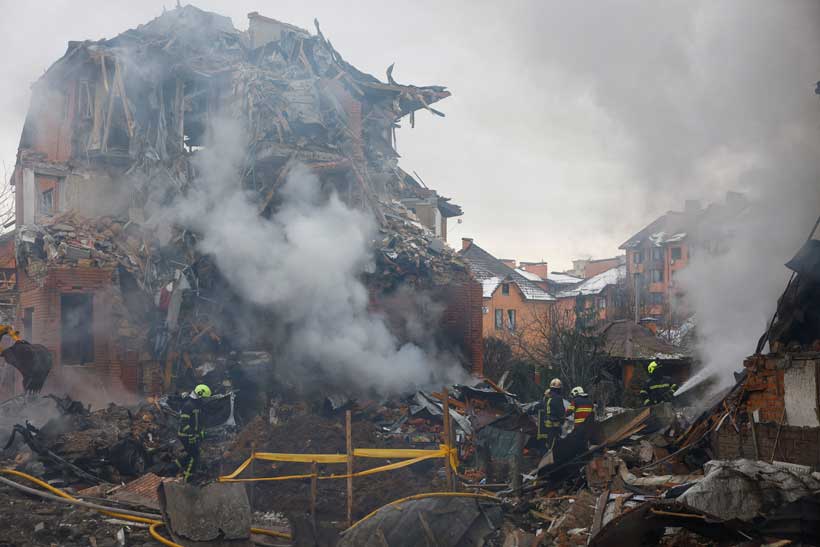
We are living through a moment that feels both historic and disturbingly ordinary. Wars are multiplying, economies are diverging and technology is creating unimaginable wealth, yet the world moves through these contradictions with a calm that borders on numbness. The danger today is not only that conflict has returned. It is that we have quietly accepted it as part of the “new normal,” a phrase once associated with the post‑Covid world but now repurposed to describe the far more volatile reality we inhabit. What was once a temporary adjustment has hardened into a permanent condition: a world where crisis is routine, contradiction is effortless and emotional fatigue is universal.
The unsettling part is not merely the violence itself, but the way it blends into the background of daily life. A missile strike in one region competes for attention with a sports highlight from another. A humanitarian disaster unfolds at the same moment a tech company announces record‑breaking profits. The world no longer pauses, no longer absorbs, no longer reacts. It simply scrolls. This quiet desensitisation – this ability to move seamlessly between tragedy, entertainment and wealth – is becoming the defining psychological feature of our era. And it raises a deeper question: what happens to a global society that stops feeling the weight of its own crises?
A world at war
Across continents, conflict has become a constant backdrop. Russia and Ukraine remain locked in a grinding war that has reshaped Europe’s security architecture. Israel and Gaza continue to suffer devastating cycles of violence with no political horizon in sight. The Iran–US confrontation has spilled into the Strait of Hormuz, a maritime artery that carries a fifth of the world’s oil. The Red Sea has become a contested zone, with commercial shipping repeatedly targeted. Sudan’s civil war has displaced millions. Myanmar’s collapse has erased a decade of democratic gains. The Sahel has become a corridor of coups and insurgencies. The list grows, and the world scrolls.
Stay ahead of the geopolitical week.
MD Briefing delivers expert analysis across five global fronts — the Indo-Pacific, energy, geoeconomics, European security, and the Middle East — every Monday morning. Free.
The human cost is no longer limited to the countries fighting. Neutral nations are now losing citizens in wars they did not start and cannot control. India’s loss of three sailors in the Strait of Hormuz – a conflict zone it neither escalated nor participated in – is a stark reminder that modern wars no longer respect geography or intent. They spill across borders, into shipping lanes, into global markets and into the lives of people who never chose to be part of them. A single miscalculation, a misidentified vessel or a drone strike gone astray can pull the uninvolved into the vortex. Conflict is no longer an event. It is an ambient condition.
A world getting richer
At the same time, another world is accelerating upward at a pace that often feels detached from the turbulence elsewhere. US markets are delivering strong, sometimes generational returns. AI‑driven companies are reshaping valuations across sectors, and technology‑linked indices continue to set new records. Alongside this tech‑led surge, traditional safe‑haven assets have also strengthened. Gold has risen steadily as investors look for stability in an uncertain geopolitical environment, while key industrial metals such as copper and lithium – central to the green and digital transitions – have drawn heightened demand and strategic attention.
This is not an argument against capitalism, nor a nostalgic plea for socialism or communism. Markets will rise, fortunes will be made and innovation will continue. The concern is something else entirely: the divergence. While a small segment of the world benefits from the AI boom and broader market gains, millions across the Global South are deciding whether they can afford two meals a day or a cylinder of cooking gas. Inflation, supply‑chain disruptions and energy volatility have pushed basic necessities out of reach for many households. The contrast is not ideological. It is structural. It is human.
The ‘new normal’ of contradiction
These two realities – escalating conflict and accelerating wealth – now unfold in parallel with almost no friction. A missile strike appears on a newsfeed, followed by a market milestone, followed by another crisis alert. The world moves between these speeds effortlessly, and that ease is the problem. We have become fluent in contradiction. The “new normal” is no longer stability after disruption. It is disruption becoming routine.
The post‑Covid world taught societies to adapt quickly to uncertainty, but that adaptability has now morphed into something more troubling: a quiet acceptance of volatility as a permanent state. The psychological muscle memory of the pandemic – the ability to compartmentalise fear, to continue daily life amid crisis – has carried over into geopolitics. What was once a survival mechanism has become a societal reflex. Crises now unfold simultaneously, overwhelming emotional bandwidth. Algorithms blend tragedy and entertainment into the same digital space, flattening the distinction between the urgent and the trivial. The world is connected economically but disconnected emotionally.
The strategic danger
The strategic danger is profound. When war becomes normal, escalation becomes easier and outrage becomes weaker. Conflicts begin to drift not only through intent but through indifference, and the absence of global attention becomes a form of permission. In a world already saturated with crises, a single miscalculation – a misread radar signal, a drone strike gone astray, a naval encounter in a crowded chokepoint – could alter the global order in ways no one is prepared for. This is the deeper contradiction of our time: even as the world grows numb to conflict, the risks embedded within these conflicts grow sharper. Nuclear capabilities, once discussed only in the gravest terms, now appear more frequently in strategic signalling, and references that once provoked alarm increasingly pass without notice.
In such an environment, the margin for error narrows dramatically. A crisis that begins as a regional confrontation can, through miscalculation or overconfidence, escalate far beyond its original boundaries. The world has lived through close calls before, but rarely in a moment when attention is fragmented, institutions are strained and public pressure – the force that once demanded restraint – is weakened by distraction. The victims of this new era are not only those in the warzones. They include sailors on neutral ships, workers whose incomes collapse with global shocks, families choosing between food and fuel and civilians caught in the crossfire of someone else’s conflict. The world’s numbness does not shield them. It leaves them exposed.
Losing more than peace
The threat today is not that war has returned. It is that we have learned to scroll past it. We now live in a two‑speed world – one at war and one getting richer than ever – and the distance between these worlds widens each month. The challenge is not only to prevent conflict, but to resist its quiet normalisation. Because once war becomes background noise, the world loses more than peace. It loses its sensitivity, the instinct that once made global solidarity possible. The post‑Covid era showed that societies can adapt to almost anything, even to realities that should never be normalised. But adaptation without reflection becomes surrender.
The “new normal” cannot be a world where neutral sailors die in distant seas and where families choose between food and fuel as cities burn and where vast fortunes rise beside humanitarian catastrophes. The real danger is not that the world is fractured. It is that we are learning to live comfortably within the fracture. And unless we reclaim our ability to be unsettled – to be moved, to be outraged, to be human – we risk becoming spectators in a world that urgently needs participants.
