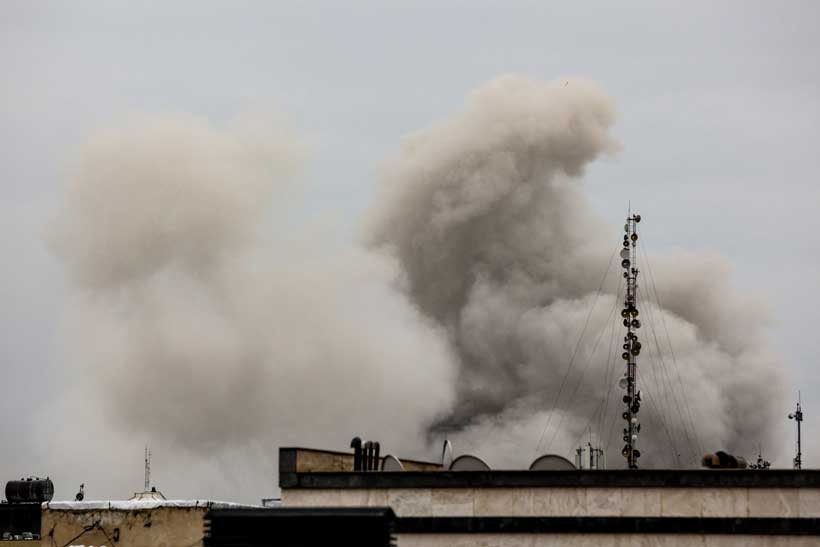
This is not the end of the Gulf War—it is merely an intermission in a much longer struggle. The memorandum may have eased immediate tensions, but unresolved rivalries, strategic mistrust, and regional fault lines suggest that the conflict is far from over.
“War does not determine who is right—only who is left” (Bertrand Russell).
“Ships are starting to move, many loaded up with oil, out of the Strait of Hormuz.” This is what President Trump stated soon after virtually signing the memorandum of understanding with Iran on 15 June 2026. Both Iran and Pakistan have also confirmed the agreement. Is this the end of the Middle Eastern instability, or is a new regional security landscape in the pipeline? These are all questions that are looming over. One thing should be kept in mind: until and unless Israel is active in the region, the Middle East will not be stable. Some may argue that a great power contest is also a major cause. Yes, it’s right, but not the reason behind genocide, humanitarian losses, and the use of disproportionate force—tags that are mainly only associated with the Zionist regime.
Ambiguity in the Memorandum
Stay ahead of the geopolitical week.
MD Briefing delivers expert analysis across five global fronts — the Indo-Pacific, energy, geoeconomics, European security, and the Middle East — every Monday morning. Free.
On Monday, 15 June 2026, both the US and Iran signed the memorandum electronically. What the agreement is comprised of is up to some extent already known, but what it doesn’t cover remains a crucial question. As the agreement declares two major phases: first, an immediate ceasefire and cessation of hostilities and second, a 60-day period for critical negotiations. Is the ‘no nuclear’ clause added in the agreement? If this provision has been included, it will force Iran to halt all its nuclear enrichment beyond civilian levels. President Trump is continuously claiming that this provision has been agreed upon. Meanwhile, Iran is denying these claims. Per contra, if this clause were temporarily postponed, then it would be a complete humiliation of the US.
Secondly, will the Strait of Hormuz be returned to pre-war levels? The Iranian Foreign Minister has categorically stated that the maritime regulations will not be the same as before. Third, what about the US forces in the Middle East? Will they retreat back? Iran has already demanded this before. And what about the US demanding the dismantling of Iranian allies in the region? Last but not least, what about Israel? Has Israel been included or even consulted about the clauses of the Memorandum? Or it’s just the end of the US-Iran conflict, not the Israel one. All these questions remain unanswered, which means the only thing that has been agreed upon is the immediate and temporary cessation of hostilities.
A New Middle East?
“Reaching a memorandum of understanding does not mean the crimes will be forgiven or forgotten,” says Iranian Foreign Ministry spokesman Esmaeil Baghaei. A simple question to be asked here is that if enmity can’t be forgotten, how will peace prevail? On the same note, see what Israeli PM Netanyahu has stated. “It was Trump’s decision; we have our own interests.” These statements clearly show that neither Iran is forgiving the heinous crimes of the US and Israel against its citizens nor Israel is abiding by the peace memorandum. A very simple logic here is that the two main warring parties were Iran and Israel. The US was dragged into the war, which, to be honest, became its biggest strategic failure in US history.
Iran has neither signaled any peace settlement with Israel nor is Israel ready to accept Iranian victory in the war. How can the nascent memorandum lead to peace when Israel is continuously crossing Iran’s red lines, bombing Lebanon, and destroying Gaza? To be honest, the Trump administration is mainly comprised of pro-Israel members. Then how can one think Trump will let go of Israeli demands? What I think is it might be a Trump trap to regain his lost popularity before the midterms. And then, what will happen? Of course, Trump will chicken out.
Conclusion
Neither the US nor Israel could be trusted in this regard. President Trump has always retreated back from his words. His statements can’t be viewed just as those of other statesmen. Likewise, Israel is not ready to have any deal with Iranians. All these facts and figures illustrate one thing: this is not the end of the Gulf War. It’s a new start, where a protracted conflict would be witnessed until any one warring party either surrenders or is defeated explicitly. The signing of the Islamabad Memorandum of Understanding cannot be considered a very profound agreement. Rather, it has only lowered the escalation levels, which does not mean an end to war. Thus, it can be concluded that the presence of agreement does not mean the absence of hostilities.