


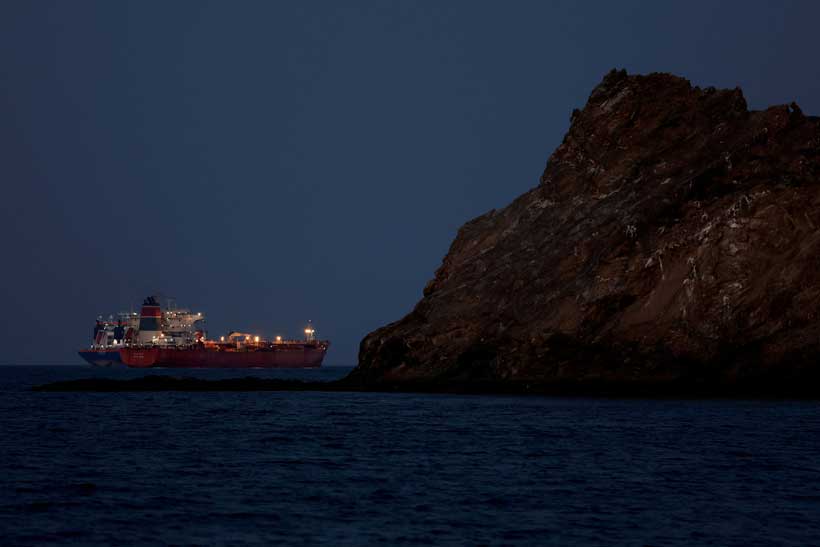
The latest diplomatic push over Iran, now centered on Bürgenstock, should be welcomed because talking is still cheaper than escalation. Yet President Donald Trump’s idea of possible American tolls in the Strait of Hormuz after the 60-day period risks turning a fragile ceasefire into a new argument over sovereignty, law, and humiliation. The United States may see itself as the region’s “guardian angel,” but shipping lanes are not private roads, and security cannot be converted into a unilateral invoice whenever negotiations become difficult.
Hormuz is not just another sea lane. The US Energy Information Administration has long described it as one of the world’s most important oil chokepoints, while Britannica notes the enormous share of petroleum trade that moves through this narrow passage. That is precisely why the world cannot afford a precedent in which any powerful navy claims reimbursement rights over international transit. If Iran cannot lawfully weaponize the strait, Washington should not normalize the same logic under a different flag.
The Law Matters
The stronger American argument has always been freedom of navigation, not ownership of navigation. Under the UN Convention on the Law of the Sea, straits used for international navigation are tied to transit passage. The United States has not ratified UNCLOS, but it frequently invokes navigational freedoms as customary law. That makes the toll threat awkward. Washington cannot credibly defend open seas on Monday and suggest a superpower surcharge on Saturday. Even if the proposal is rhetorical, rhetoric has consequences in a region where every word is treated as a signal.
Stay ahead of the geopolitical week.
MD Briefing delivers expert analysis across five global fronts — the Indo-Pacific, energy, geoeconomics, European security, and the Middle East — every Monday morning. Free.
The talks involving JD Vance, Iranian officials, Pakistan, Qatar and US envoys are too important to be reduced to branding. AP reported that Vance arrived to launch nuclear negotiations and build on the interim framework. Reuters reported that US officials dispute Iranian claims of closing Hormuz, while CENTCOM said commercial traffic continued through the waterway. A separate Reuters report tracked Iran’s closure announcement, and another Reuters dispatch noted US monitoring to keep the route open. That distinction matters. If ships are still moving, diplomacy should focus on verification, guarantees and de-escalation, not public threats that give every spoiler a reason to harden its position.
Pakistan’s Opening
Pakistan’s role should not be dismissed. Dawn reported that Prime Minister Shehbaz Sharif and Field Marshal Asim Munir traveled for technical-level talks, while Aaj English described the process as Pakistan-mediated. For Islamabad, this is an unusually high-stakes diplomatic opening: it can present itself not as a camp follower but as a practical bridge between Washington, Tehran, and the Gulf. That opportunity will evaporate if the talks become a contest over who can charge whom for regional security.
The Lebanon ceasefire is the other weak beam holding up the structure. The Guardian reported renewed tensions after Israeli strikes, while another Guardian report underlined how fragile the Israel-Hezbollah track remains. ABC News and CBS News have also framed the talks against clashing claims over Hormuz and Lebanon. The lesson is obvious: the nuclear file, the strait, and Lebanon are now interlocked. Failure on one front can poison the others.
Trump’s Pressure Play
Trump’s defenders will argue that his toll warning is leverage. India Today and Al Jazeera both reported his position that no tolls would be charged during the 60-day ceasefire but that Washington could impose them later. The problem is that leverage must point toward a settlement. This threat points toward resentment. Gulf states may appreciate US protection, but few will enjoy being cast as protected clients who must accept a tariff because Washington says so.
A smarter bargain would be multilateral, transparent, and temporary. Instead of unilateral American tolls, the parties could discuss an internationally supervised maritime security fund, tied to clear rules, audited costs, and equal treatment of commercial shipping. Axios reported that the talks are meant to move fast; speed is useful only if it produces durable rules. Switzerland’s official government platform symbolizes quiet institutional seriousness. The negotiators should borrow that mood. That is the real test before them now.
Iran should not close Hormuz. The United States should not monetize it. Israel and Hezbollah should not sabotage a diplomatic track they did not sign. And regional states should not allow one waterway to become the battlefield for every unresolved grievance. The next 60 days must produce more than a pause. They must produce rules strong enough to survive the end of the pause. If Trump wants reimbursement for American security, he should seek it through alliances, budgets and negotiated burden-sharing, not by threatening a toll booth at the mouth of the Gulf.
