


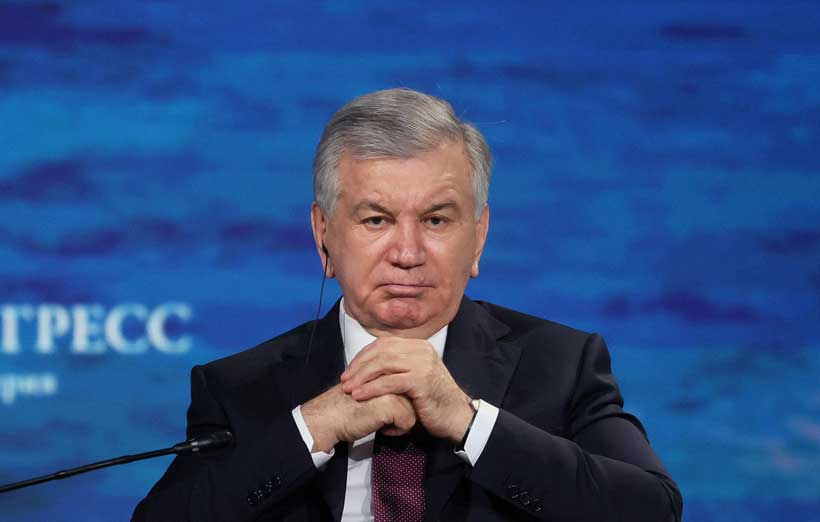
Following the Soviet collapse, Uzbekistan has maintained, to a large extent, a unique history and relations with Russia. Despite some divergencies in its approach toward economic development, Uzbekistan mutually benefits from its diplomatic relations and multifaceted cooperation with Russia. President of the Republic of Uzbekistan, Shavkat Mirziyoyev, noted these during the plenary session in the St. Petersburg forum held from 3rd to 6th June.
Today, both Russia and Uzbekistan are experiencing challenges of the future and the new architecture of the global economy. Politics are also rapidly changing, impacting the development of both countries. Uzbekistan is undergoing a profound restructuring that it still needs the support of Russia for. Competition is increasingly manifest not only in the contest for markets and natural resources—it is shifting into the sphere of technology, logistics, and infrastructure.
Amidst turbulence in the global economy, the importance of states and regions that play a consolidating role and that are capable of fostering around themselves a space of cooperation, stability, and mutual benefit is growing. Like other former Soviet republics, Uzbekistan needs to be a strong, united, economically interconnected, and stable Central Asian republic to serve the strategic interests of its partners in the region. For Uzbekistan, Russia is more than just a neighboring country. It is a longstanding strategic partner and ally; bilateral relations have entered a new stage, characterized by deep and multifaceted cooperation.
Scope of Russia-Uzbekistan trade
Stay ahead of the geopolitical week.
MD Briefing delivers expert analysis across five global fronts — the Indo-Pacific, energy, geoeconomics, European security, and the Middle East — every Monday morning. Free.
According to official statistics, bilateral trade has more than tripled over the past decade, increasing from $4 billion to $13 billion. The current portfolio of joint projects with Russia exceeds $50 billion.
Trade and economic cooperation between the regions of two countries continues to expand steadily. The key partners are actively involved in this process: Moscow and St. Petersburg, the Moscow and Leningrad regions, the republics of Tatarstan and Bashkortostan, the Krasnoyarsk Territory, the Perm Territory, and many other Russian regions.
The value of regional projects currently under implementation exceeds $5 billion, while an additional investment package worth another $5 billion is in preparation. Cooperation spans virtually all major sectors of the economy, including energy, chemicals and petrochemicals, mechanical engineering, agriculture, logistics, textiles, food processing, and many others.
Among these initiatives, the joint industrial parks established in five regions of Uzbekistan deserve particular attention. They are already delivering tangible results. Another notable example of successful cooperation is the creation of a railcar manufacturing cluster in Tashkent.
Uzbekistan benefits from Russia’s energy sector.
Through investment projects, including those with Russian participation, electricity production has expanded by 50 percent, from 58 to 87 billion kilowatt-hours. By 2030, there are plans to increase generation to 120 billion kilowatt-hours, 54 percent of which will come from renewable sources. The capacity is set to grow further with the commissioning of the first hybrid nuclear power plant in Uzbekistan, with Russian participation.
For Uzbekistan, this represents a long-term development project—the growth of a new engineering school and the advancement of cutting-edge technologies. It also intends to collaborate in other areas of peaceful nuclear applications, including medicine, agriculture, industry, and science.
In the current climate, technological and industrial cooperation between Uzbekistan and Russia should not be limited to bilateral ties. It is planned to focus on wider cooperation areas that can combine industrial potential, resources, markets, and competencies. There is already a solid proposal for the formation of a Eurasian Technological Industrialization Belt—a system of interconnected production and technology clusters united by a single digital industrial cooperation platform. This would involve creating full-cycle supply chains, from technology development and personnel training to the localization of industrial production and access to foreign markets.
Digitalizing Uzbekistan
A promising area of cooperation is undoubtedly digitalization, which is becoming the new language of the economy. Where infrastructure once meant roads, pipelines, and power lines, today it primarily means digital platforms. These platforms create entire ecosystems around themselves—generating jobs, logistics, payment services, and new export opportunities.
Uzbekistan’s businesses are pushing forward with digital solutions and, at the same time, are open to technological partnerships with a wide range of countries—through Russian marketplaces and digital services, for example. The sales volume has grown 3.5‑fold over the past few years, reaching over $1.5 billion. This is a positive outcome, and it bodes well for future collaboration.
Embarking on an effort to deepen cooperation by building a shared digital ecosystem. This could include enacting similar regulations for e-commerce and city services, and then moving on to promoting brands from both Uzbekistan and Russia on respective platforms, creating a single digital profile for employment-related matters, and developing AI-driven products. This would create new markets for businesses, while people stand to benefit from additional revenue streams.
Future Dimensions
Uzbekistan is a reliable and predictable country for the global and business communities. Uzbekistan, committing to openness, inclusivity, and pragmatism. It sees great cooperation potential in projects in the public-private partnership format—in energy, aviation, education, geology, and many other industries. It offers interested partners not only a growing domestic market but also direct access to neighboring countries and regions.
On 20 June 1990, Uzbekistan declared its state sovereignty. With an estimated population of 38.2 million, making it the most populous in Central Asia, Uzbekistan is a landlocked republic. It has borders with Kazakhstan to the north, Kyrgyzstan to the northeast, Tajikistan to the southeast, Afghanistan to the south, and Turkmenistan to the southwest. Uzbekistan is a member of the Commonwealth of Independent States (CIS), the United Nations (UN), and the Shanghai Cooperation Organization (SCO).
