Asia-pacific region is becoming increasingly contested with like-minded states forming coalitions. Two institutional models such as AUKUS and Quad, which are both US led, represent alliances in the region. Although both harbour concerns with China’s rise, yet they function differently; AUKUS for hard deterrence, and Quad for broad alignment. At one hand, AUKUS embodies high security institutionalization, while at the other Quad reflects low security institutionalisation. In addition to diverging strategic priorities of the Quad members, this articles argues that India’s commitment to strategic autonomy encourages a hedging strategy that reduces alliance cohesion and limits the security institutionalisation of the Quad.
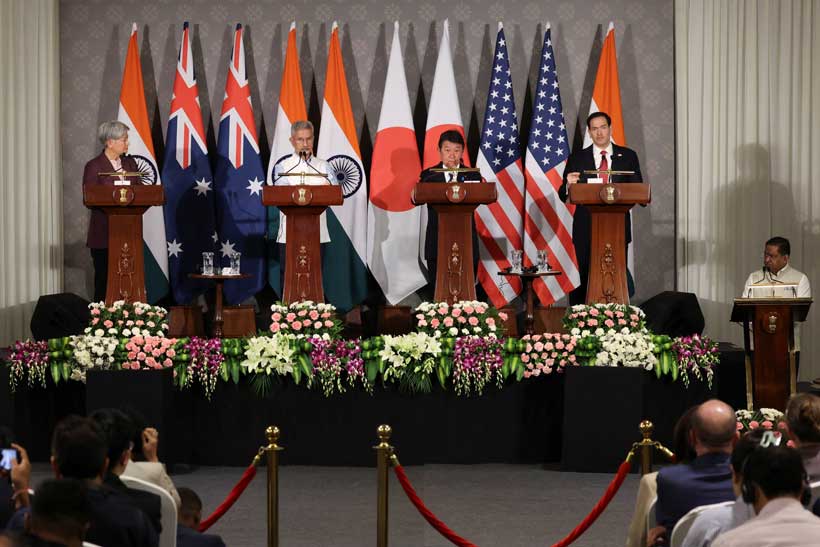
In May 2026, India hosted foreign minister’s meeting of Quad members. The joint statement reiterated ideals of defending the rule of law, sovereignty, maritime surveillance, and logistics coordination. These steps highlighted that the Quad remains active and relevant. However, as the strategic competition with China grows, the members continue to prioritise connectivity and resilience rather than mutual defence. This demonstrated persistent cracks among members regarding the ultimate purpose of the Quad.
The contradiction between the Quad and AUKUS lies not in their shared concern over Beijing’s rise but in their institutional design. The Quad functions as a broader diplomatic forum designed to coordinate policy among four states with differing strategic priorities. However, AUKUS was formed as a capability-driven security alliance focused on military integration and deterrence. Its focus on nuclear-powered submarines, advanced technologies, and interoperability reflects a much higher degree of security institutionalisation. This opposite institutional design explains why one alliance has advanced rapidly while the other remains limited to consultation forum.
Unlike AUKUS, Quad operates differently; although concerns over China have strengthened cooperation among its members, the grouping remains primarily diplomatic rather than operational. Its agenda increasingly focuses on critical technologies, infrastructure, supply chain resilience, climate initiatives, and vaccine diplomacy. Even after its revival in 2017 and elevation under the Biden administration, Quad falls short of a military alliance because its participants, mainly India and Japan, believe in countering the Chinese threat through diplomacy and bringing together democracies at one page.
Stay ahead of the geopolitical week.
MD Briefing delivers expert analysis across five global fronts — the Indo-Pacific, energy, geoeconomics, European security, and the Middle East — every Monday morning. Free.
India has traditionally been regarded, particularly in the West, as the Quad’s weakest link due to its reluctance to deepen defense cooperation. That is because Indian strategic culture is one of the main reasons behind Quad’s inability to evolve into an AUKUS-style security architecture. Since its independence, New Delhi has been following a policy of strategic autonomy to preserve its freedom of action and simultaneously meeting its interests through collaboration. In contemporary world, strategic autonomy promotes hedging strategy that justifies New Delhi’s involvement in BRICS and Quad and cultivating ties with China, Russia and the US. The essence of this policy lies in the narrative of being a friend to all and enemy to none.
Following the Doklam impasse in 2017 and the border conflicts in 2020, India’s willingness to support the Quad was strengthened by its deteriorating relations with China. Nevertheless, Indian officials have dismissed perceptions of QUAD as an ‘anti-China’ grouping or alliance in the making. this highlights India’s longstanding commitment to strategic autonomy, which aims to preserve its freedom of action and avoid binding alliance commitments. While New Delhi cooperates with Quad members on security issues, it remains reluctant to join arrangements that could impede its diplomatic flexibility or severe its economic ties with China.
It can be argued that strategic autonomy promotes issue-based cooperation, in which strategic partnerships are preferred over treaty obligations. Its simultaneous participation in the BRICS, Quad, and the SCO demonstrates its tilt towards flexible alignments. In this regard, Quad satisfies its interests by enhancing cooperation on maritime security, technology, including 5G, and supply-chain resilience, without succumbing to military commitments. Consequently, India remains cautious of initiatives that would transform Quad into an anti-China alliance.
New Delhi’s position strengthens and constraints the Quad. It solidifies the alliance by providing political legitimacy, geographic reach and strategic weight. For instance, the involvement of Indian Navy in Malabar exercise 2025 underscores the strength of Quad. Simultaneously, it also imposes limits on the security institutionalisation of Quad, which impedes Quad’s evolution into a formal security pact. As a result, it can be argued that Quad possesses significant diplomatic weight but lacks the institutional depth required for speedy military coordination.
All of this points to divergent national interests, leading to an identity crisis regarding the future of the Quad. For instance, Japan wants to have a “free and Open Indo-Pacific” security architecture, and the US aims to counter or balance China through Quad. Australia seeks a shift in the Quad’s focus towards delivery of goods, and greater institutional accountability. on the other hand, India wishes to ensure its strategic autonomy and limited security engagement. These diverging ambitions create an identity crisis for Quad.
To sum up, the Quad ministerial meeting in 2026 highlighted that the alliance remains politically active and operational. However, it also uncovered deeper strategic divergences that hamper the future trajectory of Quad. Unlike the US, Japan, and Australia that view Quad as a tool of strategic competition, India continues to view it as a platform suitable to its strategic culture of flexible alignment. Until these opposing priorities are reconciled, Quad is likely to remain politically active but with a constrained security mechanism.