


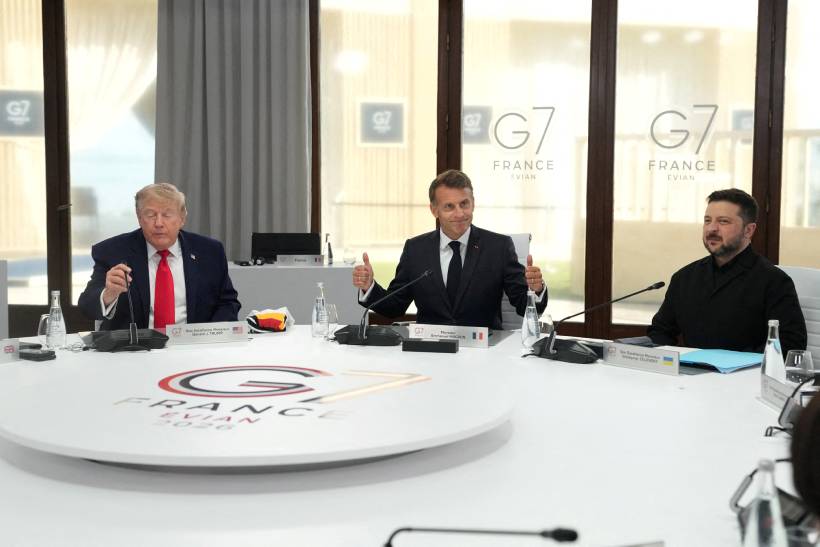
Ukrainian President Volodymyr Zelenskyy arrived at the G7 summit in Evian-les-Bains seeking to persuade U.S. President Donald Trump that Ukraine is gaining momentum in its war against Russia and needs sustained international backing.
The summit, hosted by French President Emmanuel Macron, comes at a critical diplomatic moment, with parallel negotiations also underway on the Middle East conflict following a preliminary U.S.-Iran agreement. The G7 discussions are expected to focus heavily on Ukraine’s battlefield position, European security strategy, and broader geopolitical stability.
Ukraine’s Diplomatic Push
Zelenskiy is using the summit to argue that Ukraine’s military position has improved, particularly due to increased drone operations and deeper strikes into Russian territory. European officials have echoed this assessment, suggesting that Russia’s war economy is under growing strain.
European Commission President Ursula von der Leyen has also signaled that Ukraine is making battlefield gains and that Western support should be sustained to maintain pressure on Moscow.
Stay ahead of the geopolitical week.
MD Briefing delivers expert analysis across five global fronts — the Indo-Pacific, energy, geoeconomics, European security, and the Middle East — every Monday morning. Free.
Zelenskiy has called for renewed diplomatic momentum and greater European involvement in any future peace process, while also seeking a direct meeting with Russian President Vladimir Putin during the summit—an offer that has not been accepted.
Why It Matters
The G7 summit is shaping up as a key diplomatic test for Ukraine’s international support strategy. Kyiv is attempting to shift U.S. perceptions of the war at a time when Washington is increasingly focused on other global crises, including the Middle East.
A central concern for Ukraine is ensuring that any potential negotiations do not favor Russian strategic interests or lock in territorial losses. European leaders are working to reinforce Ukraine’s position while also trying to influence U.S. policy direction.
At the same time, the summit intersects with broader geopolitical discussions, including energy security and maritime stability in the Strait of Hormuz, which has been disrupted by the Iran conflict. These overlapping crises are influencing global diplomatic priorities and attention spans.
Strategic Divisions Among Allies
While Western allies broadly support Ukraine, there are growing differences over strategy, timing, and long-term objectives.
European governments are pushing for stronger guarantees and sustained military aid, while U.S. policy under President Trump has signaled a preference for rapid diplomatic resolution if conditions allow. This divergence is shaping expectations around the next phase of negotiations with Russia.
The involvement of Middle Eastern leaders at the G7 further underscores how interconnected these crises have become, with energy security, sanctions policy, and conflict resolution increasingly treated as part of a single global stability framework.
Analysis: Ukraine’s Fight for Attention in a Crowded Crisis Agenda
Zelenskiy’s challenge at the G7 is not only military but diplomatic maintaining Ukraine’s centrality on the global agenda at a time when other crises, particularly the Iran war and energy market instability, are competing for attention.
Ukraine is attempting to leverage reported battlefield gains to strengthen its negotiating position and secure continued Western backing. However, shifting political priorities in Washington and elsewhere mean that support is no longer guaranteed at the same intensity or consistency as earlier in the war.
The outcome of the G7 discussions will likely influence not only future military assistance but also the broader framework for any eventual peace negotiations with Russia. For Ukraine, the key objective remains ensuring that any settlement reflects its security interests rather than external pressure for rapid compromise.
With information from Reuters.
