Japan’s protest over Putin’s visit to the Kuril Islands is loud because its response is capped: Tokyo cannot meaningfully sanction the one Russian energy relationship — Sakhalin-2 LNG — it now depends on more than ever, after the Strait of Hormuz closure gutted its Gulf oil access and made that supply a load-bearing pillar of its energy security through at least December 2026.
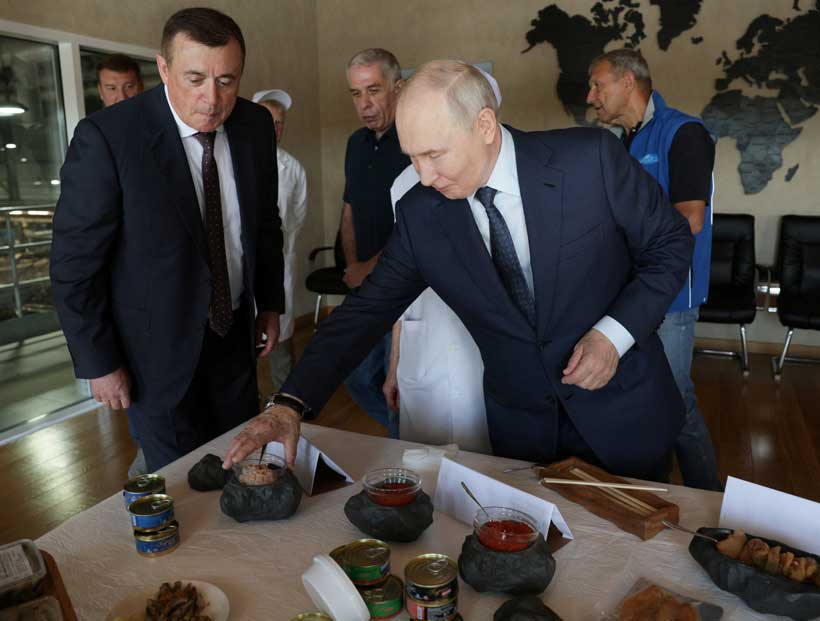
On August 13th, Vladimir Putin toured a fish-processing plant on Iturup Island, the largest of the four southern Kuril Islands Japan calls its Northern Territories, with Sakhalin’s regional governor at his side. It was his first visit there in twenty-six years in power. He called the islands’ status “enshrined” as a permanent outcome of the Second World War and pointedly invoked the late Shinzo Abe, who spent years personally courting him toward a peace treaty that never materialised. Tokyo’s response was immediate: Prime Minister Sanae Takaichi called the visit “absolutely unacceptable,” and her Foreign Ministry says an “additional sanctions package” is under consideration. What went unmentioned is that this same government told Washington, in writing, ten months earlier that a full ban on Russian LNG would be “difficult.” That contradiction, not the visit itself, is the story.
The dispute is old: the Soviet Union seized the four islands in the war’s final days, and the missing peace treaty has been Tokyo and Moscow’s unfinished business for eighty years. What is new is the energy math surrounding it. Sakhalin-2, the LNG project sitting directly across the strait from where Putin stood, supplied Japan roughly 3.6–3.9 million tonnes last year — about 9% of its total LNG imports, and enough to make Japan the project’s largest single buyer. The US Treasury sanctions waiver permitting those imports, along with the Gazprombank clearing that finances them, was just extended to December 18th, 2026, pushed back from an original June deadline. Washington’s stated reason was blunt: global supply is “constrained amid the continued closure of the Strait of Hormuz.”
BEHIND THE VISIT
Stay ahead of the geopolitical week.
MD Briefing delivers expert analysis across five global fronts — the Indo-Pacific, energy, geoeconomics, European security, and the Middle East — every Monday morning. Free.
That closure is the piece most coverage of the Kuril visit leaves out. Since February 28th, when the US and Israel launched their air campaign against Iran, the Strait of Hormuz has been effectively shut, with roughly 20,000 mariners and 2,000 ships stranded and Brent crude spiking to $126 a barrel at its peak. Around 90% of Japan’s crude oil and 11% of its LNG normally transit Hormuz. Tokyo has spent 2026 losing its largest energy artery to a war in the Gulf, which means Sakhalin-2 has quietly gone from “one Russian supplier among several” to one of the few pillars still standing under Japan’s winter power grid. Putin picked this year, not an arbitrary one, to make his sovereignty claim visible on the ground.
The waiver renewal is the tell. Washington and Tokyo did not merely tolerate the Sakhalin-2 exemption through the Ukraine-sanctions years — they actively rebuilt it in 2026, in the middle of the Hormuz crisis, explicitly carving out maritime transport, financial clearing, and joint-operations funding through the end of the year. Putin then chose that same window, with that same regional government’s leadership standing next to him, to plant a public flag on the neighbouring islands. He is not testing whether Japan objects. He knows it will. He is testing whether the general logic of sanctioning Russia survives contact with the specific, recently-renewed exemption that keeps Japanese lights on. Compare that to 2010, when Dmitry Medvedev made the first-ever Russian presidential visit to the same islands: Tokyo protested loudly, recalled its ambassador briefly, and moved on within weeks, because no comparable energy dependency was on the table at the time. The script is recognisable. The stakes underneath it are not.
Takaichi’s own words undercut her “absolutely unacceptable” framing before she said it. In October 2025, briefing President Trump on the LNG relationship, she told him directly that a total ban on Russian gas “would be difficult” — an unusually candid admission from a leader now weighing a fresh sanctions package over the same relationship’s home islands. A prime minister who has already told Washington, on the record, that cutting the energy tie is impractical cannot now credibly threaten it without the threat being understood, in Moscow as much as in Tokyo, as theatre. What remains available is a narrow band of symbolic measures — travel restrictions, asset freezes on individuals connected to the visit or the regional administration — that let Tokyo be seen to act without touching a single LNG cargo.
The standard objection is that Japan has options: JERA, its largest buyer, points to a 30–35 million tonne portfolio and spot-market access, and Tokyo Electric-linked utilities cite early-stage interest in the $44 billion Alaska LNG project as a long-term alternative. That is capability, not near-term relief. Japanese firms remain openly cautious about Alaska LNG’s cost and logistics, with no binding offtake timeline in sight, and the global spot market Japan would lean on is the same market already absorbing cargoes redirected from Hormuz-blocked routes — tighter, not looser, than in a normal year. Sanctioning the actual molecules, rather than a list of names, risks the electricity-price and blackout warnings Japanese officials themselves used to justify keeping the Sakhalin-2 waiver alive in the first place.
THE SCENARIOS
Base case (~55%): Japan announces a narrow, largely symbolic sanctions package — individual travel bans and targeted asset freezes tied to the Far East regional government — while explicitly leaving Sakhalin-2 supply and Gazprombank clearing untouched, repeating the 2010 script almost exactly. The December 18th waiver renewal proceeds quietly, folded into the broader Hormuz-driven energy calculus, and Moscow reads the episode as confirmation that its Pacific energy leverage over Japan is durable regardless of who occupies the Kremlin’s chair on any given August.
Downside case: domestic backlash — the same “hardened public sentiment” Takaichi herself warned the visit would produce — pushes her government into a genuine review of the Sakhalin-2 exemption as its December deadline approaches, right as Hormuz remains tight heading into winter and Asian spot LNG prices stay elevated from redirected Gulf cargoes. The result is Japan’s first real taste of sanctions-driven energy pain from the Ukraine-era regime, a burden that has so far landed almost entirely on European households rather than Japanese ones, arriving in the worst possible month of the heating season and forcing utilities into the kind of emergency rationing talk Tokyo has avoided since 2022.
Upside case: Tokyo treats the compounding shock — Hormuz plus the Kuril visit landing in the same year — as the forcing function it has lacked for three years, converting Minister Yoji Muto’s long-stated goal of “steadily reducing dependence” on Russian LNG into actual contracted volume rather than a talking point: accelerated Alaska LNG offtake commitments, expanded US Gulf Coast term deals, and a public timeline for winding down Sakhalin-2 purchases that uses the December waiver deadline as a hard exit ramp instead of an automatic renewal. Even here, the earliest realistic substitution volumes arrive on a multi-year timeline, not by next winter.
THE AFTERMATH
Putin’s flag on Iturup was never really a test of Japan’s territorial resolve — Tokyo’s position on the Northern Territories has not moved in eighty years and was never going to move now. It was a test of whether that resolve has any economic weight behind it at the one moment Japan’s alternatives are thinnest.
Watch for: what actually happens to the Sakhalin-2 waiver around December 18th, not the sanctions package announced this week. A quiet renewal, carved out exactly as before, will tell you Japan’s outrage and Japan’s energy security are now permanently on separate tracks — and that Moscow understands the gap between them better than Tokyo would like to admit.