There is a temptation to read current American foreign policy as incoherent. A transactional presidency dismantles alliances, antagonises partners, and lurches between confrontations without apparent strategic logic. On that reading, the contradictions accumulate until only one conclusion seems available, that the United States has abandoned the role of systemic manager. What that reading misses is that incoherence and deliberate disruption can look identical from the outside, and the distinction matters enormously. When adversarial positions begin giving way in sequence, the demanding question shifts from the coherence of American foreign policy to whether the apparent disorder is the instrument through which the international system itself is being restructured, the change running from the periphery inward through sequential degradation instead of from the centre outward through institutional design.
The response is defensive as much as it is offensive, and that distinction is essential to understanding the form it takes. The United States now faces rival states that have moved beyond bilateral competition into operational coordination across multiple theatres simultaneously. The 2026 National Defense Strategy has a name for what this produces. The simultaneity problem is the possibility that several opponents act concurrently across multiple theatres and thereby disperse American and allied capacity. Whether by design or by the accumulation of separate decisions, the pattern of recent American action can be read as an attempt to answer that problem, reducing simultaneity itself by degrading exposed adversarial nodes in sequence while allies assume primary responsibility in theatres from which Washington is shifting resources. To understand that pattern, one must first understand the network it confronts.
The Network and the Name
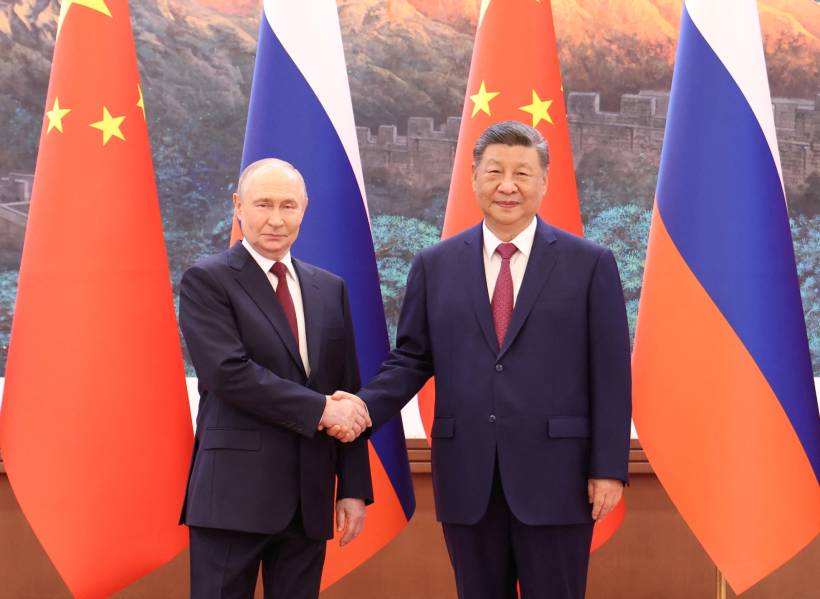
In November 2023, at the Halifax International Security Forum, the acronym CRINK entered the strategic vocabulary. China, Russia, Iran, and North Korea, named together less as a formal alliance than as a grouping whose operational coordination had reached a level that demanded a collective designation. The American and allied strategic community has a long history of producing geopolitical grammar before instruments follow. Axis of evil, axis of upheaval, and now CRINK. These do more than describe a world that already exists. They bring a strategic object into being, converting a diffuse set of overlapping trajectories into a single structure that can be reasoned about, planned against, and acted upon as a unit.
Stay ahead of the geopolitical week.
MD Briefing delivers expert analysis across five global fronts — the Indo-Pacific, energy, geoeconomics, European security, and the Middle East — every Monday morning. Free.
The label does the conceptual work first. It makes the network thinkable as a single strategic object, and therefore makes it possible to interpret pressure against its components as something more than a collection of bilateral confrontations, while organising allied perception and domestic legitimation as a secondary effect of that prior act of definition. Naming CRINK did not initiate anything. It made an emerging convergence analytically legible, drawing the boundary of an object that strategy could then address. What has followed can be read as the sequential degradation of its nodes.
The label names something looser than a Cold War ideological bloc. CRINK has no founding treaty, no formal command structure, no coherent positive vision for the order it would build if the American-led system collapsed. It is held together by something more brittle and more consequential. Shared adversarial pressure binds it, each member drawn into coordination by its own confrontation with American power, so that what looks like alignment is four separate quarrels pointing the same way. The Western sanctions architecture imposed after Russia’s invasion of Ukraine appears to have accelerated the network’s formation faster than any deliberate alliance-building could have achieved. Isolating Russia pushed it toward Iran, which pushed both toward North Korea, while China provided the economic oxygen without which none of the others could sustain their positions. The network is, in this sense, partly a product of the instrument now being used to dissolve it, and that structural irony sits at the heart of the current sequence’s long-term vulnerability.
The operational coordination that emerged from this pressure is more significant than the diplomatic alignment. Iran supplied Russia with Shahed one-way attack drones deployed at scale against Ukrainian infrastructure, then expanded to ballistic missiles and joint production of Iranian-designed drones inside Russia itself, with Moscow reciprocating through air defence systems and the military expertise that strengthened Iran’s own deterrence. North Korea supplied tens of millions of artillery rounds and over one hundred ballistic missiles to Russia, with some estimates suggesting Pyongyang now provides roughly half of Russia’s frontline ammunition, receiving in return economic relief and a degree of international cover it had not previously enjoyed. China stopped short of transferring arms directly, but the microelectronics, machine tools, and optical components it exported became the industrial foundation on which Russia rebuilt its defence production faster than sanctions were meant to allow.
Joint naval exercises, the Maritime Security Belt series held annually with China and Russia in the Gulf of Oman since 2019, formalised what had previously been transactional. A network of mutual reinforcement now operated across theatres the American-led order had managed separately. The analytical point worth drawing out is that a network held together by shared adversarial pressure, where genuine strategic integration never formed, has a specific vulnerability profile. When one node is degraded, the others do not mount the kind of collective defence a true alliance would. North Korea’s response to Iran illustrates the distinction. Pyongyang condemned the US-Israeli strikes as “illegal aggression“, but rhetorical solidarity did not translate into costly defence after Khamenei was killed in a US-Israeli strike. The solidarity that binds CRINK as a whole is instrumental rather than constitutive, and no network-wide obligation extends to bearing serious costs for a partner whose strategic value is falling.
The counterargument is that this informality confers strength. Freed from a treaty that would constrain them, these states cooperate flexibly and deniably, and their coordination has continued to deepen even as pressure has mounted. Moscow and Beijing reportedly extended indirect support to Iran during the war. In 2025 the two appear to have established a covert military training programme, and their leaders exchanged a run of high-level visits into 2026.
The distinction that holds is between flexibility in supply and solidarity in defence. There is also a deeper asymmetry at work. A network like this withstands pressure applied everywhere at once far better than pressure applied to a single vital point. Years of broad sanctions, spread across the whole grouping, were absorbed, redistributed, even converted into cohesion, which is how the pressure consolidated the network instead of breaking it. Concentrated pressure on an exposed junction is a different kind of blow, and it is the one such a structure handles worst.
The eighth of those exercises was announced for the Strait of Hormuz in February 2026, days before the American and Israeli campaign opened. What followed was more revealing than the advertised display. The only publicly verifiable drill was bilateral, between Russia and Iran, with no authoritative Chinese confirmation that its navy participated at all. A network preparing to demonstrate operational coordination was already calibrating the costs of that coordination before the shooting began. When the war came, neither partner converted military cooperation into collective defence. The same leaders who had stood together at Beijing’s Victory Day parade sent envoys to Tehran to mourn Khamenei, Medvedev standing in for Putin and a legislative deputy for Xi, a measured solidarity that revealed the limits of the coordination even as it displayed it.
The calibration has a structural cause, since Beijing seems to want the network as a pressure instrument against the United States while also seeking recognition as a global power and champion of the Global South, ambitions that full membership of a coalition of upheaval would compromise. The network could keep supplying arms and training its members’ forces while still proving unable to shield its most exposed junction from concentrated pressure, and it is that gap that sequential pressure can exploit.
Notably, Russia’s defence minister has identified Venezuela and Iran as cases requiring closer joint analysis and corresponding action within Moscow’s expanding military relationship with Beijing, an acknowledgement that the pressure on individual nodes is being read, on the other side, as a shared problem. The network was built by pressure, and pressure is now being used to take it apart.
The Sequence and Its Logic
Why not confront the network as a whole? Because simultaneous confrontation is the very thing its coordination imposes, American capacity dispersed across every theatre at once. Sequential pressure inverts that logic. It meets the network one exposed position at a time, and the wager is that each engagement concluded returns capacity instead of consuming it.
Political systems under sustained pressure do not degrade linearly. They absorb strain through feedback loops, through repeated diplomatic rituals, predictable institutional responses, and routine consultations that eventually stop resolving tension and begin amplifying it. At that point, a system becomes brittle, projecting stability through the surface continuity of its routines while losing, internally, the capacity to adapt to anything genuinely new. An external actor that correctly identifies this saturation and applies concentrated pressure at the point of maximum fragility does not need to defeat a system through direct confrontation. It needs only to push it past the threshold it can no longer hold from within. The system’s own accumulated weight does the rest.
In an international order too saturated for institutional redesign, too gridlocked at the centre to absorb any negotiated reconfiguration, that peripheral logic has become, for the moment at least, the dominant one.
Venezuela offers the clearest early application of this logic, and its inclusion requires a note. CRINK in its narrow formulation does not include Venezuela, but the adversarial adjacency network the sequence is targeting is wider than any single acronym captures. Maduro’s government deepened its ties with Russia, Iran, and China across precisely the period of intensified CRINK coordination, conducting joint military exercises with Russia, hosting Iranian-made fast attack craft in Venezuelan waters, and relying on China as the principal destination for its oil exports and a major economic lifeline against Western sanctions pressure. The mechanism by which pressure translated into fragility appears to have been largely monetary. US sanctions and the December blockade constrained oil revenue and foreign-currency flows, while the regime’s patronage system had long bought a form of political loyalty through financial benefits and food parcels. The combination made cohesion progressively more expensive to sustain.
Geographically, Venezuela represents the network’s closest foothold to American territorial interests, its presence in the Western hemisphere carrying a strategic significance disproportionate to its military weight. The 2025 strategy makes this logic explicit, reviving the Monroe Doctrine with a corollary that promises to deny non-hemispheric competitors any force position or strategically vital asset in the Americas. Functionally, removing that foothold amounted to flank-clearing before pressure shifted elsewhere, and the case established the method, which was to identify a system whose internal contradictions have already exceeded its absorptive capacity, apply coordinated pressure across every dimension at once from the economic to the diplomatic, and let the accumulated weight of failure do most of the work.
Direct confrontation with a functioning state is expensive and unpredictable. The Venezuelan case suggests a different method, prolonged isolation to weaken the node followed by a bounded application of overwhelming force to remove its strategic function without a systemic war. The naval blockade of Venezuelan oil tankers from December 2025 held the state below the threshold of stabilisation, and in January 2026 Operation Absolute Resolve completed the case, a one-night raid by more than one hundred and fifty aircraft that captured Maduro and flew him to New York, reportedly aided by defections from within the regime. The state was left intact under acting president Delcy Rodríguez. The regime was not collapsed. Its function as a secure adversarial base in the hemisphere was severely curtailed, at a cost of hours rather than years. Washington’s own explanation followed the same network logic, Secretary of State Marco Rubio telling the Senate that Maduro had to be removed because Venezuela had become a base of operations for China, Russia, and Iran.
Iran appears to represent the sequence’s most consequential target so far, less the network’s centre than its exposed hinge, the junction through which the wider coordination reached into the Middle East. For decades, Tehran managed its structural exposure through a distributed proxy network in place of conventional military power. Hezbollah in Lebanon, Hamas in Gaza, the Houthis in Yemen, and the Popular Mobilisation Forces in Iraq were not simply offensive instruments. They constituted an architecture for spreading pressure across multiple adjacencies, built to ensure that no single point of failure could trigger collapse at the centre. The network allowed Iran to project strategic relevance at a cost its economy could sustain, to maintain deterrence without ever fully committing its own forces, and to keep adversaries engaged across multiple theatres simultaneously, producing a form of insurance that functioned because its components were distributed and deniable.
Within the broader CRINK coordination, Iran’s proxy network served an additional function. It was the connective tissue linking the Middle East theatre to the wider adversarial structure, providing Russia and China with a layer of regional pressure they could neither generate nor sustain independently. October 7 broke that logic in ways that are still unfolding. What had been designed to manage pressure became the transmission vector for it, and the systematic targeting of the network’s command structures, Iran’s air defence capacity, and its missile production infrastructure, culminating in the joint US-Israeli strike that killed Khamenei in February 2026, has done more than degrade Iran militarily. It has collapsed the interpretive grammar through which Iran projected strategic coherence to its partners, its adversaries, and its own population.
The threshold ally concept, the logic by which a peripheral actor absorbs escalation on behalf of a patron and thereby shields the patron from direct confrontation, has been structurally inverted. The network now consumes Iranian resources and credibility faster than it generates leverage, and each node that falls accelerates the erosion of the overall architecture’s claim to strategic relevance. Degradation, though, is not disappearance. Networks reroute around damage, and there are already signs of the Iranian system reorganising around Iraq and Yemen after its losses in Syria and Lebanon. The contest the sequence has opened runs between sequential degradation on one side and adversarial rewiring on the other.
The Iranian case is now testing the wager at the heart of the sequence, that engagements conclude and return capacity. Five months into the campaign, the United States has reportedly expended virtually all of certain long-range precision missiles, close to half its global Tomahawk stock, and substantial shares of its Patriot and THAAD interceptors, figures the administration disputes even as it requests severalfold increases in production funding to replace them. Officials quoted in the same reporting worry openly about readiness for a contingency involving Russia or China. A sequence designed to reduce simultaneity by concluding engagements one at a time depends on the engagements concluding. An engagement that persists does the opposite of what the strategy intends. It consumes the capacity that sequencing was meant to conserve, and it converts the instrument of concentration into a source of the very dispersion it was built to escape.
That erosion runs directly into a Russia whose forward posture in Syria has been fundamentally disrupted, whose most reliable regional partner has been stripped of the proxy infrastructure that gave their coordination operational meaning, and whose southern strategic depth is being reduced at precisely the moment its military resources are consumed in Ukraine and its fiscal buffers are under mounting war and sanctions pressure. These convergent stresses arrive simultaneously across a system already saturated, already locked into patterns of response that no longer generate new strategic options, and the room for adaptation narrows with each passing month in ways that no single tactical adjustment can reverse.
Elsewhere in the network, the adaptation takes a different form. Cuba may be progressively isolated, but North Korea demonstrates the opposite possibility, that degradation at one part of the network can intensify coordination elsewhere. Pyongyang’s military integration with Moscow has deepened as pressure on Iran has mounted, with thousands of troops deployed to Russia’s war and a mutual defence treaty behind them, turning North Korea from a peripheral supplier into an increasingly operational participant. The sequence therefore does not simply remove nodes. It also changes the value of those that remain, and removal at one point can raise the centrality of another.
No remaining node matters more to the sequence’s endpoint than Beijing. China functions as the horizon toward which the sequence’s logic points most consequentially, and here the orientation is no longer a matter of inference. The strategic doctrine now guiding the Pentagon treats the prevention of Chinese regional hegemony as the organising priority to which other theatres are subordinated, with allies pressed to absorb regional burdens so that American power can concentrate where it regards the contest as decisive.
The declared objective is balance, a decent peace negotiated from strength, with regime change explicitly disavowed. Whatever the stated end, the cumulative effect of degrading Beijing’s peripheral relationships is to narrow the coalition through which China can impose simultaneous costs on the United States, and potentially to narrow the multipolar opening before it consolidates into more durable form. The sequencing does not require explicit coordination across these cases to function as strategy. It requires enough coherence for repeated actions to generate a consistent strategic effect, whether or not anyone initially designed the sequence as a whole. This pattern, at minimum, warrants the hypothesis.
The administration itself has come close to saying so. When the White House promoted the February campaign against Iran, it amplified commentary describing the president as acting against an exposed partner of the rival great powers, linking the operation explicitly to Venezuela and Cuba and naming Iran’s strategic degradation as the objective. A quoted commentator does not make doctrine. An official channel choosing to amplify that interpretation does, however, offer evidence of how the administration is increasingly presenting the pattern.
The Invoiced Architecture
The sequence has a second side. Concentrating American power against one adversarial position at a time requires reducing the demands imposed by the theatres being deprioritised, and that means transferring more of their security burden to allies. Here the apparently transactional treatment of allies becomes part of the same strategic logic.
This is not a liberal order project, and the distinction is not incidental to understanding what the sequence is for. There is no comparable multilateral architecture under construction, no encompassing framework being extended, no normative vision being exported alongside the strategic pressure. What the 2025 National Security Strategy and the 2026 National Defense Strategy codify instead is burden-shifting, the first devoting a section to it by name and declaring that the days of the United States holding up the world order like Atlas are over, the second recasting allies as regional burden-bearers expected to assume primary responsibility for their own theatres while Washington concentrates on the homeland and on China. The strategy draws the connection itself, presenting burden-sharing as the answer to simultaneity and arguing that properly invested allies would together generate enough force to deter opponents even acting concurrently. Burden-shifting is what makes sequencing possible. Every burden transferred to allies is American capacity released for concentration elsewhere. Sequential concentration becomes possible because simultaneous commitments have been reduced, which is why the invoice, far from an ancillary habit of a transactional administration, is the enabling condition of the sequence itself.
The resets are invoiced because the doctrine that governs them is already an accounting logic. The invoicing goes beyond transactional extraction. It is the allied counterpart to adversarial degradation. As pressure concentrates against the opposing network, responsibility is redistributed through the American-led network, and that redistribution is how network dissolution becomes positional consolidation. Allies who benefit from the resulting reconfiguration are billed for it, and the bill is presented before they have had the chance to calculate what alignment will cost them over time.
Gulf states consolidating regional dominance as Iran’s network degrades are expected to carry the region’s security burden themselves, with American support calibrated to needs rather than guaranteed. European states inheriting a restructured NATO calculus are expected to increase defence expenditure toward the five per cent pledge extracted at NATO’s Hague summit, absorb the reputational and economic costs of the Ukraine commitment, and accept that the American security guarantee has been repriced, a repricing announced to their faces at Munich a year before the strategy documents codified it and never formally negotiated since. Indo-Pacific partners gaining strategic breathing room as China’s regional influence contracts are expected to accelerate their own military buildups and align export controls and industrial policy with Washington’s technology decoupling agenda. For the allies, the effect is to sharpen the two oldest alliance fears at once, the fear of being abandoned by a guarantor whose commitment is now conditional, and the fear of being drawn deeper into its confrontations on terms they never set. In each case, the benefit flows before the invoice arrives, and the invoice arrives before anyone has agreed to the amount.
The operative logic of what might be called a reset sequence is therefore the deliberate or emergent ordering of adversarial network dissolution to produce a world order that is simpler, more legible, and more navigable for American power, reached by removing the complexity that made the old structures unmanageable. The existing institutions, alliance frameworks, and legal architectures are not being replaced in this logic. They remain in place, and they remain in use, but increasingly they register a distribution of power being altered before formal institutional redesign, because the emerging order is defined not only by what has been negotiated but by what has been removed, and by who is left carrying what remains. The shape of the system shifts with each removal whether or not anyone has settled what replaces it.
Conclusion
The question this sequence cannot answer for itself is whether what it produces is durable, and the structural irony embedded in the CRINK network’s formation makes that question sharper than it might otherwise appear. The network the sequence appears oriented toward dismantling was itself partly generated by the instrument now being used to dissolve it. The Western sanctions architecture imposed after 2022 appears to have accelerated adversarial coordination faster than any deliberate alliance-building could have achieved. If the sequence succeeds in dissolving the current network without addressing the pressure dynamic that generated it, the conditions for the next iteration of adversarial coordination will reassemble faster than the sequence can take them apart. The method that works against CRINK may, it seems to me, be producing the conditions for whatever comes after it.
The post-1945 order endured because destruction was followed by construction, by the frameworks and institutions that absorbed friction without requiring further collapse. The present strategy is far clearer about what it wants to remove than about what should absorb the pressures that removal releases.
The distinction between a degenerative and a constitutive reset turns on precisely this point. Destroying the old topology is not the same as producing a navigable new one. The removals leave vacancies in the order, and vacancies do not remain empty. They attract new configurations, new alignments, and new forms of adversarial coordination that the sequence was never designed to manage. Whether by design or structural drift, the destructive phase is proceeding with considerable coherence, and the constructive phase, the one that determines whether the larger system reorganises around American primacy or simply around a new pattern of fragmentation, remains almost entirely absent.
Whether this is deliberate strategy or emergent logic, whether it has been named in any policy document or simply represents the coherent aggregate effect of fragmented decisions made under transactional pressure, may ultimately matter less than its structural consequences. The world is being reorganised through the sequential degradation of adversarial networks, and the reorganisation is proceeding faster than any alternative architecture is being designed to replace what it removes. For every actor watching the sequence from outside it, the operative question has already shifted from whether the current order is changing to whether they are positioned within the network being degraded or among those now billed for holding the system together, and whether anything capable of absorbing the next cycle of adversarial coordination is being built before that question answers itself.