


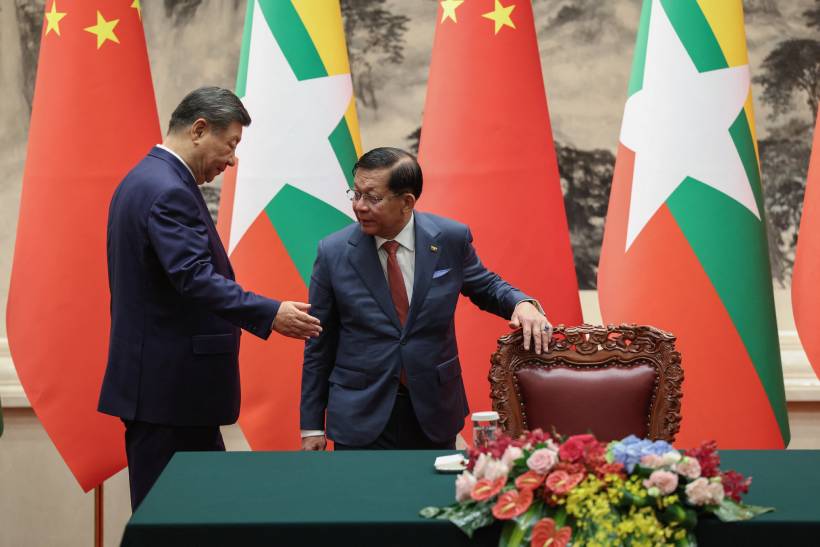
Myanmar President Min Aung Hlaing’s state visit to China marks one of the most important diplomatic moments for the country’s military leadership since the 2021 coup. Coming after a controversial election that entrenched military rule and amid an ongoing civil war, the visit signals that Beijing is prepared to engage with Myanmar’s new political order despite international criticism. The meeting with Chinese President Xi Jinping offers Min Aung Hlaing valuable political legitimacy at a time when his government remains isolated from much of the West.
China Sees Stability and Strategic Access in Myanmar
For Beijing, Myanmar’s importance extends far beyond politics. The country serves as a strategic gateway connecting China’s landlocked southwestern provinces to the Indian Ocean. Chinese investments in ports, pipelines, transport corridors and energy infrastructure make stability in Myanmar a critical national interest.
By welcoming Min Aung Hlaing, China is signaling that it is willing to work with whoever controls the state apparatus in Myanmar, regardless of how that leadership emerged. Beijing’s primary concern is ensuring that conflict does not threaten trade routes, energy projects or border security.
Stay ahead of the geopolitical week.
MD Briefing delivers expert analysis across five global fronts — the Indo-Pacific, energy, geoeconomics, European security, and the Middle East — every Monday morning. Free.
Rare Earths Could Become the Centerpiece of Cooperation
One of the most significant aspects of the visit is the growing importance of rare earth minerals. Myanmar has emerged as a major supplier of heavy rare earths that are essential for electric vehicles, advanced electronics and military technologies.
The presence of officials from Kachin State, home to major rare earth deposits, suggests that resource cooperation could feature prominently in discussions. As competition over critical minerals intensifies globally, securing access to Myanmar’s resources has become increasingly valuable for China.
A Shift in Regional Diplomacy
The visit also reflects a broader shift in regional diplomacy. While Western countries continue to criticize Myanmar’s military government, major Asian powers are increasingly engaging with it. Following Min Aung Hlaing’s recent visit to India, the China trip suggests that regional governments are prioritizing strategic and economic interests over political concerns.
This trend could weaken international efforts to isolate Myanmar’s leadership and provide the government with alternative diplomatic and economic partnerships.
The Return of the Myitsone Dam Debate
Another issue likely to feature in discussions is the long suspended Myitsone Dam project. The multibillion dollar Chinese backed hydropower project was halted in 2011 after widespread public opposition.
Recent signals from Myanmar’s military leadership indicate a renewed willingness to revisit the project. If discussions advance during the visit, it would demonstrate how economic cooperation is increasingly shaping relations between the two countries despite domestic sensitivities.
Analysis
China’s embrace of Min Aung Hlaing is less about supporting Myanmar’s political system and more about securing influence in a strategically important neighbor. Beijing has consistently demonstrated that its foreign policy is guided by stability, economic access and geopolitical advantage rather than ideological considerations.
For Min Aung Hlaing, the visit provides a much needed diplomatic victory. A formal state reception by Xi Jinping helps counter perceptions of international isolation and strengthens the government’s claim that it remains a legitimate partner for major powers. The symbolism is particularly important following an election that was widely criticized by opposition groups and many foreign governments.
However, China’s support is unlikely to be unconditional. Beijing maintains relationships with multiple actors inside Myanmar, including ethnic armed organizations operating near the border. This approach allows China to preserve leverage regardless of how the conflict evolves.
The deeper implication is that Myanmar may become increasingly dependent on China economically and diplomatically. As Western influence declines and sanctions remain in place, Beijing is well positioned to expand its role in infrastructure development, resource extraction and regional security management.
What emerges from this visit is not merely a diplomatic breakthrough for Myanmar’s military leadership but a sign of China’s growing ability to shape the country’s future. The meeting highlights a regional power balance in which strategic interests are increasingly outweighing concerns about governance, democracy and international legitimacy.
With information from Reuters.
