


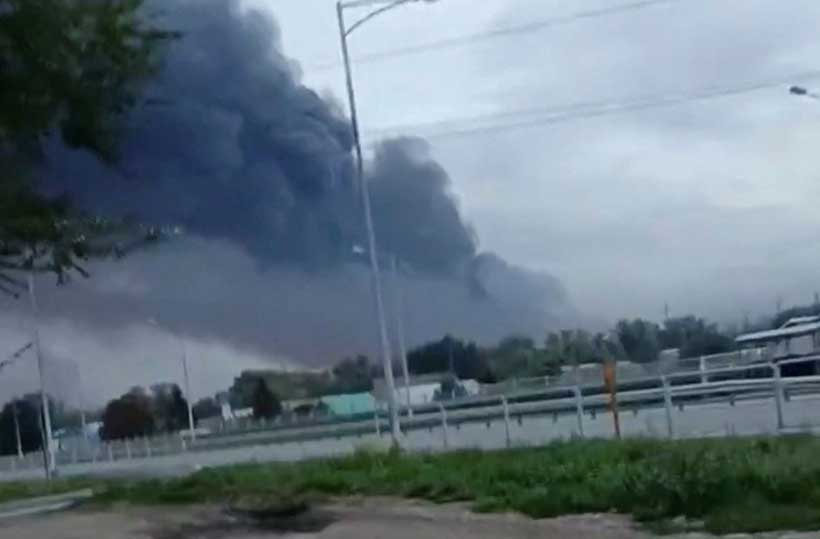
A Ukrainian drone attack struck and caused a fire at a major oil refinery in the Moscow region, marking another escalation in Kyiv’s ongoing campaign against Russia’s energy infrastructure. The targeted facility, part of the wider Russian refining network, has been repeatedly hit in recent months as Ukraine intensifies long-range strikes.
Ukrainian President Volodymyr Zelenskyy said the refinery, operated by Gazprom Neft, was hit from a distance of roughly 500 km, highlighting the expanding reach of Ukraine’s drone capabilities.
Strike Details and Immediate Impact
Russian local authorities reported a fire at the refinery, which was later extinguished, stating that operations were not significantly disrupted. However, damage to infrastructure was acknowledged, underscoring continued vulnerability of critical energy facilities within Russia’s interior.
The refinery is one of the largest in the Moscow region and processes millions of tons of crude oil annually, producing key fuels including petrol, diesel, and jet fuel. It has previously been targeted in earlier Ukrainian attacks.
Stay ahead of the geopolitical week.
MD Briefing delivers expert analysis across five global fronts — the Indo-Pacific, energy, geoeconomics, European security, and the Middle East — every Monday morning. Free.
Expanding Pressure on Russia’s Fuel System
Ukraine’s campaign against Russian refineries has intensified, with attacks reportedly doubling since the start of 2026. The strategy aims to disrupt Russia’s energy revenues, which are a major source of funding for its war effort.
Recent strikes have contributed to temporary shutdowns and reduced output across multiple facilities, affecting fuel availability in several regions. In some areas under Russian control, including Crimea and parts of southern Russia, long queues and localized shortages have been reported.
Fuel Restrictions and Market Response
The impact of these disruptions is now extending into Russia’s domestic fuel distribution system. Oil producer Tatneft has introduced nationwide caps on fuel purchases at its stations, marking one of the most visible signs of strain on retail supply.
Reports indicate limits on gasoline and diesel purchases per vehicle, alongside payment restrictions at some locations. These measures suggest growing pressure on distribution networks as refinery output fluctuations ripple through the supply chain.
Why It Matters
Energy infrastructure has become a central front in the broader conflict between Russia and Ukraine. Strikes on refineries directly affect domestic fuel availability while also targeting Russia’s export capacity and revenue streams.
Disruptions to refining operations can quickly translate into shortages of transport fuels, impacting logistics, agriculture, and consumer markets. The spread of retail restrictions signals that the effects are no longer confined to isolated facilities but are beginning to influence national supply conditions.
Analysis: Energy Infrastructure as a Battlefield
Ukraine’s intensified focus on Russian refineries represents a strategic shift toward long-range economic disruption rather than solely battlefield engagements. By targeting processing capacity rather than just crude production, Kyiv is aiming to compress Russia’s ability to refine, distribute, and export fuel.
The emerging pattern shows a feedback loop: repeated strikes reduce refining capacity, which tightens domestic supply, prompting rationing and restrictions that further strain logistics and economic stability.
However, the broader impact will depend on how quickly Russia can repair infrastructure, reroute supply chains, or absorb losses through alternative facilities. For now, the fuel system remains resilient but increasingly pressured suggesting that energy infrastructure will continue to be a critical front in the conflict’s next phase.
With information from Reuters.
