


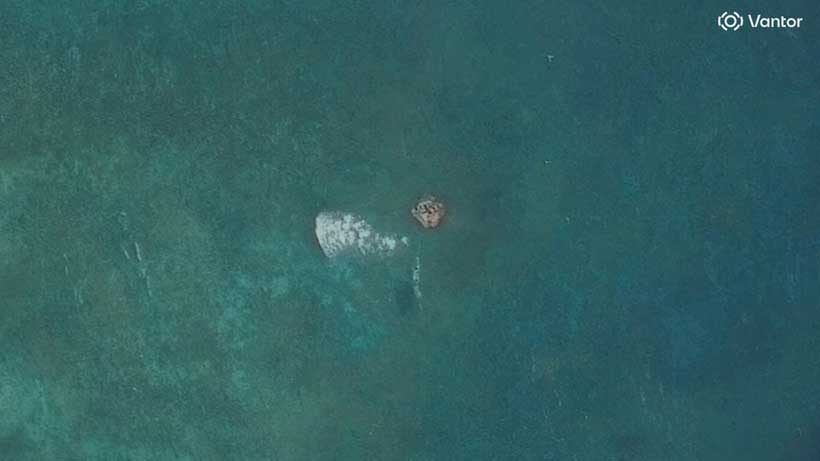
The Philippines has called on China to remove a floating structure placed at the disputed Scarborough Shoal in the South China Sea, escalating long standing tensions over one of Asia’s most contested maritime regions.
Manila lodged a formal diplomatic protest after Philippine authorities identified what they described as a movable platform allegedly deployed by Chinese vessels. The Philippine Coast Guard said the structure may have been placed by research ships operating in the area.
Philippine Navy spokesperson Roy Trinidad said Manila would not allow the shoal, known locally as Bajo de Masinloc, to be turned into a man made installation. Security officials released images showing a square floating platform with people on board, an antenna, and buoy like structures supporting its frame.
China has not confirmed ownership of the platform but maintains that it holds indisputable sovereignty over the shoal. Beijing argues that its activities in the area, including scientific research operations, are legitimate and lawful.
Stay ahead of the geopolitical week.
MD Briefing delivers expert analysis across five global fronts — the Indo-Pacific, energy, geoeconomics, European security, and the Middle East — every Monday morning. Free.
The Scarborough Shoal has been under de facto Chinese control since 2012 following a prolonged maritime standoff. It lies in a strategically important area of the South China Sea, a region that carries a significant share of global trade and is subject to overlapping territorial claims.
Why It Matters
The dispute highlights how territorial competition in the South China Sea is increasingly shifting from large scale military confrontations to incremental infrastructure and presence based strategies.
Even small floating structures are viewed as strategically significant because they can signal sovereignty claims, support future construction, and gradually alter control over disputed waters without triggering open conflict.
For the Philippines, the concern is that temporary or “movable” installations could be the first step toward more permanent infrastructure, similar to China’s island building activities at other disputed reefs in the region.
The issue also has broader implications for regional security and global trade. The South China Sea is a critical shipping route, and rising tensions increase risks for commercial navigation and regional stability.
At the diplomatic level, the incident adds pressure to ongoing negotiations between China and the Association of Southeast Asian Nations on a long delayed Code of Conduct, which has so far failed to produce binding rules to prevent escalation.
Key Stakeholders
- Philippines – Asserting maritime rights and opposing new structures in disputed waters
- China – Maintaining sovereignty claims over the Scarborough Shoal
- Scarborough Shoal – Central flashpoint in ongoing maritime tensions
- Philippine Coast Guard – Monitoring and reporting activity in the area
- Association of Southeast Asian Nations – Leading negotiations on a South China Sea Code of Conduct
- Maritime security analysts and legal experts tracking incremental territorial changes
- Global shipping and energy markets dependent on South China Sea routes
Future Outlook
Tensions are likely to remain elevated as both sides continue asserting their positions in the South China Sea through patrols, diplomatic protests, and symbolic infrastructure deployments.
The Philippines is expected to increase surveillance and diplomatic pressure while seeking stronger regional and international support to counter China’s activities in disputed waters.
China is unlikely to retreat from Scarborough Shoal and may continue using non permanent structures and scientific or administrative activities to reinforce its presence without crossing thresholds that could trigger direct military confrontation.
Efforts to finalize a Code of Conduct between China and ASEAN are expected to continue but remain slow, with major disagreements over enforcement mechanisms and sovereignty issues still unresolved.
In the absence of a binding agreement, incremental actions like floating platforms, patrols, and resource monitoring are likely to remain a key feature of South China Sea tensions.
With information from Reuters.
