


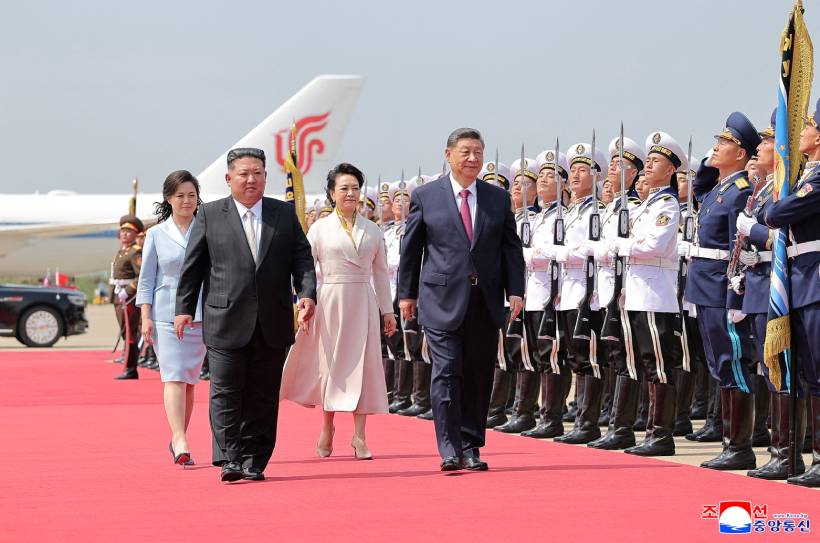
Chinese President Xi Jinping concluded a high profile two day visit to North Korea, with both Beijing and Pyongyang portraying the trip as a diplomatic success that deepened bilateral ties and reinforced their strategic partnership.
The visit was marked by elaborate ceremonies, including a 21 gun salute for Xi, cultural performances celebrating friendship between the two countries, and repeated pledges of stronger cooperation. The symbolism was particularly significant because it represented Xi’s first foreign trip of the year and demonstrated China’s willingness to publicly strengthen ties with one of the world’s most isolated states.
For North Korean leader Kim Jong Un, the visit provided another opportunity to showcase his country’s growing international relevance. Over the past two years, Pyongyang has expanded strategic cooperation with Russia while simultaneously rebuilding relations with China, creating a more favourable geopolitical environment than at any point in the past decade.
One of the most notable aspects of the visit was what was not discussed publicly. Unlike previous high level engagements, there was no significant focus on North Korea’s nuclear programme or denuclearisation, issues that historically created tensions between Beijing and Pyongyang.
Stay ahead of the geopolitical week.
MD Briefing delivers expert analysis across five global fronts — the Indo-Pacific, energy, geoeconomics, European security, and the Middle East — every Monday morning. Free.
Instead, discussions focused on economic cooperation, trade, tourism, law enforcement coordination, and broader strategic ties.
Why It Matters
The visit reflects a significant shift in Northeast Asian geopolitics and demonstrates how the regional balance of power is evolving amid increasing rivalry between major powers.
For years, China supported international efforts aimed at curbing North Korea’s nuclear ambitions while simultaneously protecting the Kim regime from complete diplomatic isolation. The absence of denuclearisation from the public agenda suggests Beijing may now view strategic cooperation with Pyongyang as more important than pursuing nuclear concessions.
The trip also signals China’s desire to prevent Russia from becoming North Korea’s dominant strategic partner. Since the outbreak of the Ukraine war, relations between Moscow and Pyongyang have deepened significantly through military, political, and economic cooperation.
For China, allowing Russia to become North Korea’s primary patron could reduce Beijing’s influence over a country that remains crucial to regional security calculations.
The visit therefore reflects a broader effort by Beijing to reassert its influence over developments on the Korean Peninsula while maintaining stability on its northeastern border.
What Stood Out During the Visit
Denuclearisation Was Largely Absent
The most striking development was the absence of meaningful public discussion regarding North Korea’s nuclear weapons programme.
In previous years, denuclearisation was often a central topic in China North Korea diplomacy. This time, both sides focused on strategic cooperation rather than nuclear negotiations.
The omission is likely to fuel debate over whether China has quietly accepted North Korea’s status as a de facto nuclear power.
Stronger Support for China’s Core Interests
North Korea explicitly reaffirmed support for Beijing’s One China policy regarding Taiwan.
While Pyongyang has traditionally supported China on sovereignty issues, the timing is notable as tensions across the Taiwan Strait continue to rise and Beijing seeks stronger international backing for its position.
Military Cooperation Signals
Chinese statements referencing military cooperation attracted attention among analysts.
Although no major defence agreements were announced, the inclusion of military cooperation language suggests both countries are exploring closer security coordination amid growing geopolitical competition.
Key Stakeholders
- Xi Jinping – Seeking to strengthen China’s influence over North Korea.
- Kim Jong Un – Looking to expand diplomatic options beyond Russia.
- China – Balancing regional stability with strategic competition.
- North Korea – Seeking economic and diplomatic support.
- Russia – Competing with China for influence in Pyongyang.
- United States – Monitoring shifts in regional security dynamics.
- South Korea – Concerned about deeper China North Korea cooperation.
- Taiwan – Referenced through Pyongyang’s endorsement of the One China principle.
Future Outlook
China and North Korea are likely to deepen cooperation in trade, tourism, infrastructure, and political coordination over the coming years. Beijing views a stable North Korea as strategically important amid intensifying competition with the United States and its allies.
However, the relationship still faces limitations. Despite the warm rhetoric, Kim’s strongest strategic relationship currently appears to be with Russian President Vladimir Putin. North Korea has gained substantial economic and military benefits from cooperation with Moscow, giving Pyongyang greater leverage in dealing with Beijing.
As a result, North Korea is increasingly positioned to balance relations between China and Russia rather than rely overwhelmingly on either power.
Analysis
China Appears to Have Prioritised Strategic Competition Over Denuclearisation
The biggest takeaway from Xi’s visit is that China’s priorities on the Korean Peninsula appear to be changing. A decade ago, Beijing frequently pressured Pyongyang over its nuclear programme because it feared regional instability and the possibility of a nuclear arms race.
Today, China’s primary concern appears to be geopolitical competition with the United States and maintaining influence in its strategic neighbourhood. In that context, North Korea’s value as a political and security partner may outweigh concerns about its nuclear arsenal.
This does not necessarily mean China formally accepts North Korea as a nuclear state, but it suggests Beijing is less willing to make denuclearisation a precondition for closer ties.
Kim Jong Un Is Emerging as a More Confident Diplomatic Actor
The visit highlights how dramatically North Korea’s diplomatic position has improved since the period of heavy sanctions and isolation in the late 2010s.
With Russia seeking military cooperation, China seeking strategic alignment, and the United States lacking an active diplomatic track with Pyongyang, Kim now enjoys greater leverage than at any time in recent years.
Rather than depending on a single patron, North Korea is increasingly able to play major powers against one another to secure economic assistance, political legitimacy, and security guarantees.
A New China Russia Competition Could Emerge Inside North Korea
While Beijing and Moscow remain strategic partners globally, they are not necessarily pursuing identical objectives in North Korea.
Russia’s rapid expansion of ties with Pyongyang has created concerns in Beijing that its traditional influence is being diluted. Xi’s visit can therefore be viewed not only as a show of friendship but also as an effort to remind North Korea that China remains its most important neighbour and economic lifeline.
In the coming years, North Korea may become an arena where China and Russia quietly compete for influence while publicly maintaining their broader partnership.
Regional Security Risks Are Increasing
The absence of denuclearisation discussions is likely to worry policymakers in Washington, Seoul, and Tokyo.
If China increasingly treats North Korea’s nuclear programme as a secondary issue, international pressure on Pyongyang could weaken further. That may encourage North Korea to continue expanding its missile and nuclear capabilities, increasing security concerns across Northeast Asia.
The long term result could be a more divided regional order in which China, Russia, and North Korea coordinate more closely while the United States, Japan, and South Korea deepen their own security cooperation. This would accelerate the emergence of competing geopolitical blocs across East Asia.
With information from Reuters.
