


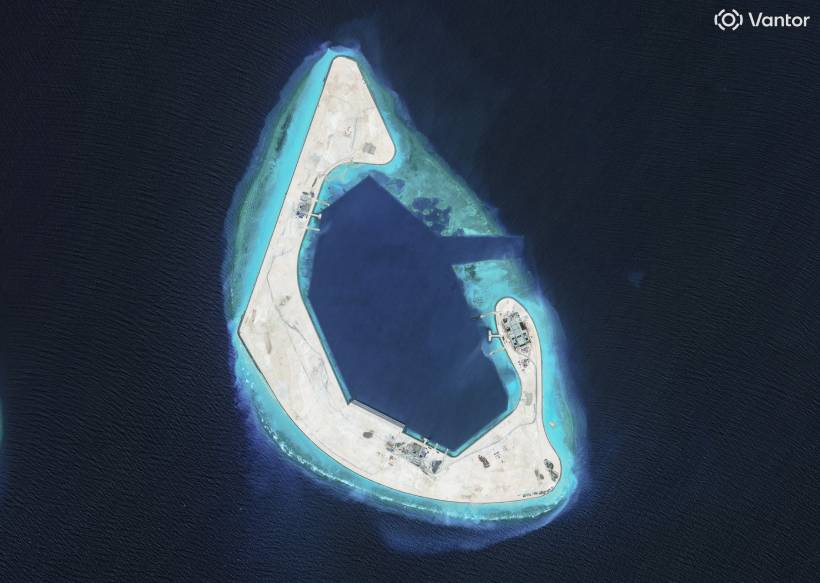
China has completed the first phase of construction at Antelope Reef in the disputed Paracel Islands, creating a large artificial island that analysts say could eventually become one of Beijing’s most important military facilities in the South China Sea.
Satellite images reviewed by Reuters show that the first stage of reclamation has been completed after at least six months of construction. The reclaimed feature is nearly 6 km long, while a deep water harbour and a large wharf have already taken shape.
The development comes as the South China Sea becomes increasingly important to the wider strategic competition between China, the United States and its regional allies. Analysts say Antelope Reef’s location could be particularly significant in any future conflict involving Taiwan.
Although China has not acknowledged plans for a new military base, Beijing has described the construction as serving civilian purposes, including scientific research and weather forecasting.
Stay ahead of the geopolitical week.
MD Briefing delivers expert analysis across five global fronts — the Indo-Pacific, energy, geoeconomics, European security, and the Middle East — every Monday morning. Free.
Regional security analysts, however, believe the facility is likely to strengthen China’s military presence in the northern South China Sea.
Why Is Antelope Reef Strategically Important?
Antelope Reef occupies a strategically significant position in the northern South China Sea.
Ben Lewis, founder of the open-source intelligence platform PLATracker, told Reuters that the northern part of the South China Sea would be particularly important in a Taiwan conflict scenario and that Antelope Reef was ideally positioned for such a contingency.
The location gives China another potential platform from which to monitor activity across the surrounding waters.
The emerging facility could also complement China’s existing military infrastructure in the Paracels, particularly Woody Island, which has previously hosted fighter aircraft and surface-to-air missiles.
Unlike some of China’s facilities farther south in the Spratlys, Antelope Reef is relatively close to the Chinese mainland.
That geographic position could make it easier for Beijing to reinforce and defend.
What Is China Building at the Reef?
The satellite imagery shows a substantial reclaimed island with a coastline stretching for several kilometres.
A 680-metre wharf fronts a deep water harbour, and one satellite image showed a Chinese coast guard ship alongside the facility.
Construction has also begun on buildings in the southeastern part of the reclaimed island, including a helicopter pad.
Analysts believe part of the island could eventually accommodate an airstrip. The Washington-based Center for Strategic and International Studies said this week that initial excavation work for a potential runway appeared to have begun.
If a runway is ultimately constructed, the strategic importance of the facility would increase considerably.
An airfield could allow China to deploy aircraft closer to contested waters while also expanding its ability to conduct surveillance and support military operations.
Could Antelope Reef Become a Military Base?
China has not officially confirmed that it is constructing a military facility.
Chinese state media have instead said that Antelope Reef will support civilian purposes such as weather forecasting and scientific research.
Chinese South China Sea scholar Ding Duo similarly argued that the construction was modest and intended to make the waters safer for those who depend on them.
However, regional security analysts are more sceptical.
The development resembles earlier Chinese construction activity in the South China Sea, where facilities initially described as having civilian purposes have subsequently acquired military capabilities.
The presence of a large harbour, potential runway and helicopter facilities could provide infrastructure that supports both civilian and military operations.
The distinction between the two becomes particularly difficult in an increasingly militarised maritime environment.
How Could the Base Affect a Taiwan Conflict?
The most important strategic question concerns Taiwan.
China considers Taiwan part of its territory and has not ruled out the use of force to achieve unification. The United States, meanwhile, maintains a longstanding security interest in the Taiwan Strait without formally recognizing Taiwan as an independent state.
Any major conflict over Taiwan would likely extend beyond the immediate waters surrounding the island.
The South China Sea could become an important supporting theatre, particularly because of its proximity to Taiwan, the Philippines and important maritime routes.
Antelope Reef could provide China with another location from which to conduct surveillance, deploy aircraft or support naval operations.
Ben Lewis told Reuters that the importance of the South China Sea and China’s Southern Theater Command had increased in recent years partly because of its relationship to Taiwan.
This suggests that Beijing may increasingly view its South China Sea infrastructure not as an isolated collection of outposts, but as part of a wider strategic architecture supporting its military planning.
Why Would China Keep Strategic Weapons Closer to Home?
Antelope Reef could also allow China to keep some military assets closer to the mainland.
Chinese military planners may prefer to operate certain weapons and aircraft from the Paracels rather than from more distant positions in the Spratlys.
The H-6 strategic bomber is one example.
Keeping such assets closer to mainland China could reduce logistical difficulties and potentially make them easier to protect.
The location could also provide a useful intermediate position between China’s mainland and the more contested waters farther south.
That would give Beijing greater flexibility in deciding where and how to deploy military capabilities during a crisis.
Could the Reef Protect China’s Nuclear Submarines?
Another important possibility concerns China’s nuclear armed ballistic missile submarines.
Security scholar Collin Koh said Antelope could contribute to Chinese efforts to establish so-called bastions, or protected maritime areas, in the South China Sea.
Such areas could help Beijing shield its nuclear submarines from surveillance and attack.
China’s ballistic missile submarines are a crucial component of its nuclear deterrent. Their survival is essential because a submarine that remains undetected can provide Beijing with a second strike capability even if other nuclear forces are attacked.
A protected operating environment close to Chinese naval bases could therefore strengthen the survivability of China’s nuclear forces.
Antelope Reef could potentially contribute to that objective by supporting surveillance systems and monitoring the movements of foreign vessels and submarines.
How Could It Complicate U.S. Military Operations?
The construction could also create new challenges for the United States.
If the facility eventually hosts extensive surveillance equipment, aircraft or other military capabilities, it could improve China’s ability to monitor U.S. and allied activity across the South China Sea.
That would not necessarily prevent American forces from operating in the region, but it could make those operations more complicated.
The United States already conducts military operations and freedom of navigation activities in the South China Sea, while regional allies such as Vietnam and the Philippines maintain their own security interests in the area.
A larger Chinese military footprint means more facilities that U.S. forces would have to monitor, avoid or potentially neutralize during a conflict.
Australian Defence Force Academy professor Carl Thayer told Reuters that the facility could strengthen China’s ability to monitor the United States and its allies during peacetime while adding complexity during a conflict.
Vietnam Faces Another Strategic Challenge
China’s construction also has direct implications for Vietnam.
Vietnam claims sovereignty over the Paracel Islands and has strongly opposed Chinese activity there. China has controlled the entire Paracel group since 1974, when it forced the navy of the former South Vietnam from the islands.
Vietnam has also expanded its own network of facilities in the Spratly Islands in recent years.
The developments therefore contribute to a broader infrastructure competition between China and other claimant states.
For Vietnam, the construction at Antelope Reef could further strengthen China’s position in waters that Hanoi considers its sovereign territory.
For Beijing, however, the facility represents another opportunity to consolidate its presence in a strategically important maritime area.
China’s South China Sea Strategy Is Becoming More Integrated
Antelope Reef should not be viewed in isolation.
China already maintains significant facilities in the Paracels and Spratlys, including military infrastructure, surveillance systems, ports and airfields.
The gradual expansion of these facilities creates a network rather than a single military installation.
This network gives China greater ability to monitor maritime activity, deploy forces and sustain operations across the South China Sea.
The strategic value comes from the combined effect.
A single artificial island may have limited military significance. Multiple interconnected facilities can create a much more difficult operating environment for rival forces.
Analysis: Is China Building a Military Architecture for a Future Conflict?
The construction at Antelope Reef reflects a broader transformation of the South China Sea from a disputed maritime space into an increasingly sophisticated military environment.
China’s approach appears to rely not only on warships and aircraft but also on geography, infrastructure and surveillance.
Artificial islands can provide locations for runways, ports, radar systems, communications equipment and other capabilities. Combined with China’s mainland military infrastructure, they can extend Beijing’s ability to observe and operate across strategically important waters.
The potential importance of Antelope Reef is therefore not simply its size.
It is its location within China’s wider strategic architecture.
For Beijing, the reef could strengthen control over the northern South China Sea, provide additional surveillance capacity and potentially support operations linked to Taiwan. It could also contribute to efforts to protect China’s nuclear submarine forces.
For Washington and its allies, the development creates another strategic complication. Any future conflict involving Taiwan could require U.S. forces to operate in an environment containing a growing number of Chinese military and surveillance facilities.
The development also highlights a central feature of China’s South China Sea strategy: military power can be expanded gradually through infrastructure before it is formally declared military.
China may continue describing Antelope as a civilian facility, but the strategic consequences of its location, harbour, potential runway and surrounding military network extend far beyond civilian activity.
If the facility develops into a major military hub, Antelope Reef could become another critical piece of China’s effort to reshape the balance of power in the South China Sea.
And if a Taiwan crisis ever expands into the surrounding region, that infrastructure could prove far more important than its current appearance suggests.
The significance of Antelope Reef is therefore not simply that China has built another artificial island. It is that Beijing may be building the infrastructure needed to make the South China Sea increasingly difficult for rival powers to operate in, particularly during a future Taiwan contingency.
With information from Reuters.
