


The United States and South Korea have long relied on their military alliance to deter North Korea and maintain stability on the Korean Peninsula. But President Donald Trump’s decision to substantially reduce U.S. participation in joint military exercises has introduced a new layer of uncertainty into the relationship.
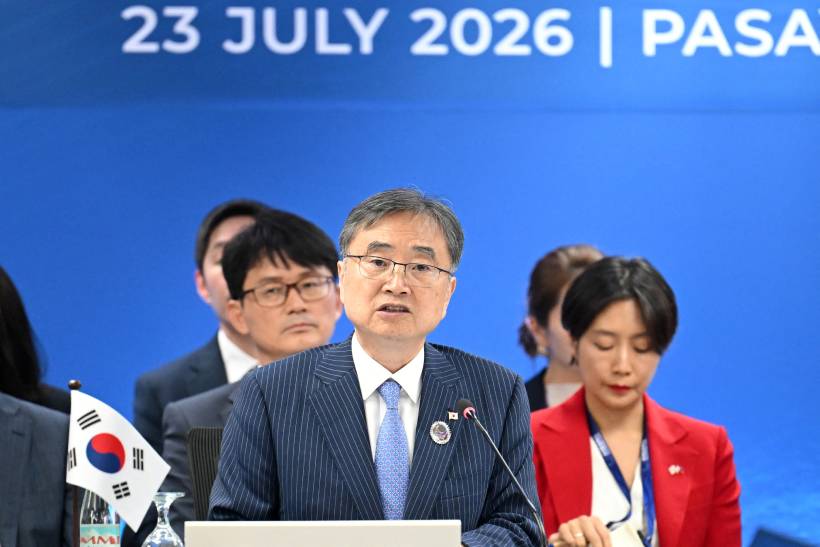
South Korean Foreign Minister Cho Hyun said on Wednesday that Trump’s order to curb the exercises appeared to be aimed partly at pressuring Seoul over several unresolved issues, including South Korea’s position on the Iran war and its commitment to invest $350 billion in the United States under a trade agreement signed last year.
The development comes as Washington seeks greater support from allies for its efforts against Iran while Trump continues to signal an interest in reopening dialogue with North Korean leader Kim Jong Un.
Stay ahead of the geopolitical week.
MD Briefing delivers expert analysis across five global fronts — the Indo-Pacific, energy, geoeconomics, European security, and the Middle East — every Monday morning. Free.
South Korea and the United States subsequently agreed to shorten their annual military exercises from 11 days to five and reduce some field training, following Trump’s order for a substantial reduction in U.S. participation.
The move raises a broader question about the future of the U.S. South Korea alliance: is Washington increasingly treating its security commitments not only as instruments of deterrence, but also as leverage in negotiations over wider American strategic and economic objectives?
Why Did Trump Order Cuts to U.S. South Korea Military Drills?
Trump’s decision was publicly linked to both the cost of the exercises and South Korea’s reluctance to participate in U.S. efforts against Iran.
The annual Ulchi Freedom Shield exercises are an important component of the allies’ military readiness. They are designed to strengthen their ability to respond to threats on the Korean Peninsula and have evolved over time to incorporate computer simulations and training for modern threats.
Trump has previously criticized the exercises as expensive and provocative toward North Korea. His latest decision therefore reflects both his longstanding skepticism toward large military exercises and his broader effort to reshape the U.S. alliance system around what he sees as greater burden sharing and direct strategic returns.
Reuters reported that Trump had also emphasized his positive relationship with Kim Jong Un while announcing the reduction, suggesting that the move could be connected to a renewed effort to engage Pyongyang.
For Seoul, however, reducing exercises with Washington carries implications that extend beyond cost.
Is Iran Becoming a Test of the U.S. South Korea Alliance?
South Korea’s position on the Iran war has emerged as a new source of tension.
According to Foreign Minister Cho, Trump’s message appeared to contain several elements, including pressure on Seoul to address pending bilateral issues and an American effort to break the stalemate in the conflict with Iran.
Trump had previously questioned why South Korea would not participate in U.S. efforts related to Iran. Seoul has said it is considering potential military contributions while also taking into account its own defense requirements on the Korean Peninsula and domestic legal procedures.
This puts South Korea in a difficult position.
Its primary security concern remains North Korea, which possesses nuclear weapons and ballistic missiles. Any decision to contribute military assets or resources to a conflict in the Middle East could therefore raise questions about whether Seoul is diverting attention and capabilities away from its immediate regional security environment.
Washington, however, increasingly appears to expect allies to contribute beyond their immediate geographical theatres.
The $350 Billion Investment Dispute
Security is not the only issue creating friction between Washington and Seoul.
South Korea committed to investing $350 billion in the United States as part of a trade agreement designed to reduce U.S. tariffs on South Korean automobiles. But Seoul has yet to announce the details of the investment plan.
Cho said Washington had already sent Seoul a proposal outlining projects that could be considered.
Seoul, however, has been cautious about moving quickly. The foreign minister cited concerns including commercial viability, legal procedures and other unexpected problems.
The disagreement illustrates the increasingly interconnected nature of the U.S. South Korea relationship.
Economic commitments, defense cooperation and foreign policy are no longer operating entirely as separate issues. Under Trump, Washington appears increasingly willing to connect them.
Why North Korea Matters to Trump’s Strategy
The reduction in military exercises also has a direct connection to North Korea.
South Korean Unification Minister Chung Dong-young said he believed Trump was moving closer toward potentially arranging another meeting with Kim Jong Un by reducing exercises that have long angered Pyongyang.
Trump has repeatedly emphasized his relationship with Kim and has previously suspended or reduced military exercises during periods of engagement with North Korea.
The latest move could therefore represent an attempt to create diplomatic space for renewed contact.
For Washington, there is another strategic consideration. North Korea has strengthened its relationship with Russia and has gained battlefield experience through its involvement in the war in Ukraine. Reuters has reported concerns among U.S. officials about North Korea’s military development and its growing cooperation with Moscow.
A renewed U.S. North Korea dialogue could therefore serve multiple purposes, including attempting to limit Pyongyang’s alignment with Moscow.
What Does the Move Mean for South Korea?
For Seoul, the reduction in joint exercises creates a complicated strategic dilemma.
South Korea remains dependent on the U.S. alliance for extended deterrence and military coordination, while simultaneously seeking greater autonomy in its own defense capabilities.
President Lee Jae Myung has emphasized the importance of maintaining the alliance while also strengthening South Korea’s independent defense capacity. Reuters reported that Lee has supported greater South Korean defense capabilities and the eventual transfer of wartime operational control from the United States.
That makes the current situation potentially significant.
If Washington reduces its military role, Seoul may increasingly have to invest in capabilities that allow it to assume greater responsibility for its own defense.
At the same time, South Korea cannot easily replace the strategic value of the U.S. alliance, particularly given North Korea’s nuclear and missile capabilities.
Is Trump Redefining the U.S. Alliance System?
The developments with South Korea reflect a broader pattern in Trump’s approach to alliances.
Rather than viewing alliances purely as long-term security commitments, Trump has repeatedly emphasized their costs, burden sharing and the contributions allies make to wider American objectives.
The South Korea relationship is particularly revealing because Washington now appears to be linking multiple issues that traditionally operated separately: military exercises on the Korean Peninsula, South Korean contributions to U.S. efforts against Iran, economic investment and possible diplomacy with North Korea.
This creates greater leverage for Washington, but it also introduces uncertainty into alliance management.
If allies begin to believe that security commitments can be adjusted in response to disagreements over unrelated economic or foreign policy issues, they may become more cautious about depending exclusively on American guarantees.
The Strategic Risk for Washington
Using military cooperation as diplomatic leverage can produce immediate concessions, but it also carries longer-term risks.
The U.S. South Korea alliance has been built around a relatively clear strategic purpose: deterring North Korea and maintaining stability on the Korean Peninsula.
When military exercises become bargaining tools in disputes over Iran or economic investment, that clarity can become weaker.
South Korean officials were reportedly caught off guard by Trump’s order, with Cho saying neither Seoul nor relevant officials had prior knowledge of the decision.
That lack of consultation matters because alliances depend not only on military capabilities but also on predictability and trust.
A partner that is uncertain about when and why American military commitments might change could increasingly prioritize independent defense capabilities.
From Alliance Management to Strategic Bargaining
The most significant aspect of Trump’s decision may therefore be the way it connects issues that have traditionally been treated separately.
For Seoul, the immediate concern is North Korea. For Washington, however, the alliance increasingly sits within a much wider strategic framework involving Iran, economic investment, burden sharing and relations with China and Russia.
Trump appears to be treating U.S. military commitments as part of a broader bargaining strategy. The reduction of exercises can simultaneously signal openness to North Korea, pressure Seoul over Iran and increase pressure on South Korea to advance its promised U.S. investment.
That may provide Washington with greater leverage in the short term.
But there is a strategic trade-off.
The strength of an alliance depends partly on the credibility and consistency of its commitments. If military cooperation becomes closely tied to economic and diplomatic disputes, Seoul may increasingly conclude that it needs greater independent military capabilities and more flexibility in its foreign policy.
For South Korea, the development could therefore accelerate a trend toward greater defense autonomy while preserving the alliance with Washington.
For the United States, the challenge is balancing transactional pressure with the long-term strategic value of the alliance. Washington may want South Korea to contribute more to American priorities beyond the Korean Peninsula, but pushing too aggressively could weaken the very alliance infrastructure that gives the United States influence in Northeast Asia.
The Iran war, the $350 billion investment pledge and the future of military exercises may appear to be separate disputes. They are increasingly becoming part of the same strategic negotiation.
The central question is no longer simply how much the United States and South Korea should cooperate militarily. It is whether their alliance can remain strategically stable as Washington increasingly links security commitments to economic and geopolitical concessions.
With information from Reuters.
